


Enhanced electrochemical performance and thermal stability of LiNi0.5Mn1.5O4 using an electrolyte with sulfolane
Literature Information
Publication Date
2015-03-25
DOI
10.1039/C5CP00799B
Impact Factor
3.676
Authors
Qian Zhang, Jia-Jia Chen, Xue-Yin Wang, Cheng Yang, Ming-Sen Zheng, Quan-Feng Dong
View Original
Abstract
A sulfide-based SEI layer was formed on the surface of a LiNi0.5Mn1.5O4 cathode by using a sulfolane–carbonate mixed solvent electrolyte, which led to an improvement in the electrochemical performance. Moreover, the thermal stability of the LiNi0.5Mn1.5O4 cathode was also significantly improved in the presence of the SEI layer. ARC (Accelerating Rate Calorimetry) tests showed that the self-heating rate of the delithiated LiNi0.5Mn1.5O4 material in the sulfolane–carbonate electrolyte was suppressed.
Recommended Journals

Chemical Communications

Russian Journal of Bioorganic Chemistry

Current Opinion in Solid State & Materials Science

Russian Chemical Bulletin

Nature Medicine

Russian Journal of Organic Chemistry

Acta Materialia

Journal of Saudi Chemical Society

Saudi Pharmaceutical Journal

Organic Process Research & Development
Related Literature
Role of the deposition temperature on the self-assembly of the non-planar molecule benzene-1,3,5-triphosphonic acid (BTP) at the liquid–solid interface
Doan Chau Yen Nguyen, Lars Smykalla, Thi Ngoc Ha Nguyen, Michael Mehring, Michael Hietschold
2016-08-05
Paper
DOI: 10.1039/C6CP04764E
Lipid bilayer permeation of aliphatic amine and carboxylic acid drugs: rates of insertion, translocation and dissociation from MD simulations
Tuğçe Oruç, Sami Emre Küçük, Deniz Sezer
2016-08-10
Paper
DOI: 10.1039/C6CP05278A
Quantum phase transitions in Sn bilayer based interfacial systems by an external strain
Li Chen, Qiandong Zhuang, Yeqing Chen, Changmin Shi, Dongchao Wang
2016-08-03
Paper
DOI: 10.1039/C6CP04534K
Prediction of two-photon absorption enhancement in red fluorescent protein chromophores made from non-canonical amino acids
M. Alaraby Salem, Isaac Twelves, Alex Brown
2016-08-10
Paper
DOI: 10.1039/C6CP03865D
Unraveling multiple binding modes of acridine orange to DNA using a multispectroscopic approach
Mhejabeen Sayed, Bhavana Krishnamurthy, Haridas Pal
2016-07-25
Paper
DOI: 10.1039/C6CP03716J
Tuning the thermal conductivity of methylammonium lead halide by the molecular substructure
Claudia Caddeo, Claudio Melis, Maria Ilenia Saba, Alessio Filippetti, Luciano Colombo, Alessandro Mattoni
2016-07-29
Paper
DOI: 10.1039/C6CP04246E
Proton transfer in acetaldehyde–water clusters mediated by a single water molecule
Oleg Kostko, Tyler P. Troy, Biswajit Bandyopadhyay, Musahid Ahmed
2016-09-05
Paper
DOI: 10.1039/C6CP04916H
ZnO nanorods prepared via ablation of Zn with millisecond laser in liquid media
Taku Goto, Tatsuki Owashi, Alex G. Rozhin, Shigeru Yamaguchi, Tsuyohito Ito
2016-08-03
Paper
DOI: 10.1039/C6CP04556A
A strategy to achieve enhanced electromagnetic interference shielding at low concentration with a new generation of conductive carbon black in a chlorinated polyethylene elastomeric matrix
Subhadip Mondal, Sayan Ganguly, Mostafizur Rahaman, Ali Aldalbahi, Tapan K. Chaki, Dipak Khastgir, Narayan Ch. Das
2016-08-19
Paper
DOI: 10.1039/C6CP04274K
Understanding metastable phase transformation during crystallization of RDX, HMX and CL-20: experimental and DFT studies
Mrinal Ghosh, Shaibal Banerjee, Md Abdul Shafeeuulla Khan, Nirmala Sikder, Arun Kanti Sikder
2016-07-27
Paper
DOI: 10.1039/C6CP02185A
You might also like
Compound Q&A
Is 2-(2-chloroacetamido)-3-phenylpropanoic acid (CAS: 7765-11-9) safe?
2-(2-Chloroacetamido)-3-phenylpropanoic acid (CAS: 7765-11-9) is generally consi...
7765-11-92-(2-chloroacetamido...
Compound Q&A
Is 2-(Benzyloxy)-5-bromobenzoic acid (CAS: 62176-31-2) safe?
2-(Benzyloxy)-5-bromobenzoic acid can be handled safely if appropriate precautio...
62176-31-22-(Benzyloxy)-5-brom...
Compound Q&A
What is (4-Methyl-1,2,5-oxadiazol-3-yl)methanamine hydrochloride (CAS: 1159825-48-5)?
(4-Methyl-1,2,5-oxadiazol-3-yl)methanamine hydrochloride is a chemical compound ...
1159825-48-5(4-Methyl-1,2,5-oxad...
Compound Q&A
What is 2-(5-Hexylthiophen-2-yl)-4,4,5,5-tetramethyl-1,3,2-dioxaborolane (CAS: 917985-54-7)?
2-(5-Hexylthiophen-2-yl)-4,4,5,5-tetramethyl-1,3,2-dioxaborolane (CAS: 917985-54...
917985-54-72-(5-Hexylthiophen-2...
Compound Q&A
Are there alternatives to 4-(8-Methyl-9H-1,3-dioxolo[4,5-h][2,3]benzodiazepin-5-yl)benzenamine (CAS: 102771-26-6) in synthesis?
While 4-(8-Methyl-9H-1,3-dioxolo[4,5-h][2,3]benzodiazepin-5-yl)benzenamine (CAS:...
102771-26-64-(8-Methyl-9H-1,3-d...
Compound Q&A
What is the market or research trend for tert-butyl 3-hydroxy-4,5,7,8-tetrahydro-2H-pyrazolo[3,4-d]azepine-6-carboxylate (CAS: 851376-80-2)?
The market for tert-butyl 3-hydroxy-4,5,7,8-tetrahydro-2H-pyrazolo[3,4-d]azepine...
851376-80-2tert-butyl 3-hydroxy...
Compound Q&A
How should waste containing 3,5-Diamino-1H-pyrazole-4-carbonitrile (CAS: 6844-58-2) be handled?
Waste containing 3,5-Diamino-1H-pyrazole-4-carbonitrile (CAS: 6844-58-2) should ...
6844-58-23,5-Diamino-1H-pyraz...
Compound Q&A
How is (6-Fluoro-3-pyridinyl)boronic acid (CAS: 351019-18-6) typically synthesized?
(6-Fluoro-3-pyridinyl)boronic acid can be synthesized through the reaction of 6-...
351019-18-6(6-Fluoro-3-pyridiny...
Compound Q&A
What industries use Dibenzyl carbonimidoylbiscarbamate (CAS: 10065-79-9)?
Dibenzyl carbonimidoylbiscarbamate (CAS: 10065-79-9) finds applications in vario...
10065-79-9Dibenzyl carbonimido...
Compound Q&A
What is the market or research trend for (beta,beta,2,3,4,5,6-~2~H_7_)Phenylalanine (CAS: 74228-83-4)?
The market for (beta,beta,2,3,4,5,6-~2~H_7_)Phenylalanine (CAS: 74228-83-4) is g...
74228-83-4(beta,beta,2,3,4,5,6...
Source Journal
Physical Chemistry Chemical Physics

CiteScore:
5.5
Self-citation Rate:
10.3%
Articles per Year:
3036
Physical Chemistry Chemical Physics (PCCP) is an international journal co-owned by 19 physical chemistry and physics societies from around the world. This journal publishes original, cutting-edge research in physical chemistry, chemical physics and biophysical chemistry. To be suitable for publication in PCCP, articles must include significant innovation and/or insight into physical chemistry; this is the most important criterion that reviewers and Editors will judge against when evaluating submissions. The journal has a broad scope and welcomes contributions spanning experiment, theory, computation and data science. Topical coverage includes spectroscopy, dynamics, kinetics, statistical mechanics, thermodynamics, electrochemistry, catalysis, surface science, quantum mechanics, quantum computing and machine learning. Interdisciplinary research areas such as polymers and soft matter, materials, nanoscience, energy, surfaces/interfaces, and biophysical chemistry are welcomed if they demonstrate significant innovation and/or insight into physical chemistry. Joined experimental/theoretical studies are particularly appreciated when complementary and based on up-to-date approaches.
Recommended Compounds
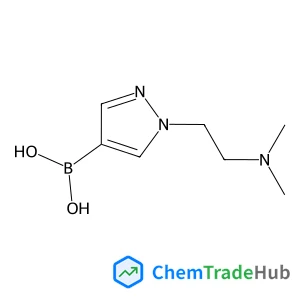
(1-(2-(Dimethylamino)ethyl)-1H-pyrazol-4-yl)boronic acid
CAS Number:
1086063-73-1
Molecular Formula:
C7H14BN3O2

![2-[(E)-(2-Methoxyphenyl)diazenyl]-3-oxo-N-(2-oxo-2,3-dihydro-1H-benzimidazol-5-yl)butanamide structure](https://static.chemtradehub.com/structs/821/82199-12-0-f1d0.webp "2-[(E)-(2-Methoxyphenyl)diazenyl]-3-oxo-N-(2-oxo-2,3-dihydro-1H-benzimidazol-5-yl)butanamide structure")
2-[(E)-(2-Methoxyphenyl)diazenyl]-3-oxo-N-(2-oxo-2,3-dihydro-1H-benzimidazol-5-yl)butanamide
CAS Number:
82199-12-0
Molecular Formula:
C18H17N5O4
Recommended Suppliers




Disclaimer
This page provides academic journal information for reference and research purposes only. We are not affiliated with any journal publishers and do not handle publication submissions. For publication-related inquiries, please contact the respective journal publishers directly.
If you notice any inaccuracies in the information displayed, please contact us at support@chemtradehub.com. We will promptly review and address your concerns.