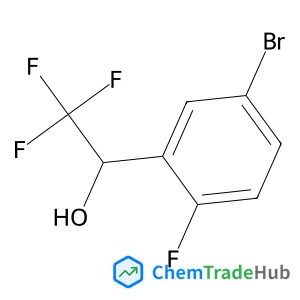
1-(5-Bromo-2-fluorophenyl)-2,2,2-trifluoroethanol
CAS Number:
1039827-16-1
Molecular Formula:
C8H5BrF4O
Hany A. El-Sayed, Corie A. Horwood, Ebenezer Owusu-Ansah, Yujun J. Shi, Viola I. Birss
Here we show that pulsed laser-induced dewetting (PLiD) of a thin Au metallic film on a nano-scale ordered dimpled tantalum (DT) surface results in the formation of a high quality Au nanoparticle (NP) array. In contrast to thermal dewetting, PLiD does not result in deformation of the substrate, even when the Au film is heated to above its melting point. PLiD causes local heating of only the metal film and thus thermal oxidation of the Ta substrate can be avoided, also because of the high vacuum (low pO2) environment employed. Therefore, this technique can potentially be used to fabricate NP arrays composed of high melting point metals, such as Pt, not previously possible using conventional thermal annealing methods. We also show that the Au NPs formed by PLiD are more spherical in shape than those formed by thermal dewetting, likely demonstrating a different dewetting mechanism in the two cases. As the metallic NPs formed on DT templates are electrochemically addressable, a longer-term objective of this work is to determine the effect of NP size and shape (formed by laser vs. thermal dewetting) on their electrocatalytic properties.

Journal of Saudi Chemical Society

New Journal of Chemistry

Saudi Pharmaceutical Journal

Russian Journal of General Chemistry

Russian Journal of Applied Chemistry

Journal of Natural Medicines

Crystallography Reports

Chemistry Education Research and Practice

Russian Journal of Organic Chemistry

Drug Discovery Today
Pablo A. Denis, Federico Iribarne
DOI: 10.1039/C6CP02481E
Anton J. Stasyuk, Yi-Ting Chen, Chi-Lin Chen, Pei-Jhen Wu, Pi-Tai Chou
DOI: 10.1039/C6CP05236C
Wai Kit Tang, Han Zhang, Chi-Kit Siu
DOI: 10.1039/C6CP03324E
Sergio Díaz-Rodríguez, Ranna Tolouei, Pascale Chevallier, Emmanuel Pauthe, Diego Mantovani
DOI: 10.1039/C6CP04527H
Mhejabeen Sayed, Bhavana Krishnamurthy, Haridas Pal
DOI: 10.1039/C6CP03716J
P. Harrison, C. I. Smith, Y. Gründer, C. A. Lucas, S. D. Barrett, P. Weightman
DOI: 10.1039/C6CP03576K
Xiao Wang, Jay Agarwal, Henry F. Schaefer III
DOI: 10.1039/C6CP03513B
Xiangyang Liu, Shun Wang, Haiwu Zheng, Xiuying Cheng, Yuzong Gu
DOI: 10.1039/C6CP02656G
Petr Dohnal, Ábel Kálosi, Radek Plašil, Štěpán Roučka, Artem Kovalenko, Serhiy Rednyk, Rainer Johnsen, Juraj Glosík
DOI: 10.1039/C6CP04152C
M. Alaraby Salem, Isaac Twelves, Alex Brown
DOI: 10.1039/C6CP03865D
2-(2-Chloroacetamido)-3-phenylpropanoic acid (CAS: 7765-11-9) is generally consi...
2-(Benzyloxy)-5-bromobenzoic acid can be handled safely if appropriate precautio...
(4-Methyl-1,2,5-oxadiazol-3-yl)methanamine hydrochloride is a chemical compound ...
2-(5-Hexylthiophen-2-yl)-4,4,5,5-tetramethyl-1,3,2-dioxaborolane (CAS: 917985-54...
While 4-(8-Methyl-9H-1,3-dioxolo[4,5-h][2,3]benzodiazepin-5-yl)benzenamine (CAS:...
The market for tert-butyl 3-hydroxy-4,5,7,8-tetrahydro-2H-pyrazolo[3,4-d]azepine...
Waste containing 3,5-Diamino-1H-pyrazole-4-carbonitrile (CAS: 6844-58-2) should ...
(6-Fluoro-3-pyridinyl)boronic acid can be synthesized through the reaction of 6-...
Dibenzyl carbonimidoylbiscarbamate (CAS: 10065-79-9) finds applications in vario...
The market for (beta,beta,2,3,4,5,6-~2~H_7_)Phenylalanine (CAS: 74228-83-4) is g...

Physical Chemistry Chemical Physics (PCCP) is an international journal co-owned by 19 physical chemistry and physics societies from around the world. This journal publishes original, cutting-edge research in physical chemistry, chemical physics and biophysical chemistry. To be suitable for publication in PCCP, articles must include significant innovation and/or insight into physical chemistry; this is the most important criterion that reviewers and Editors will judge against when evaluating submissions. The journal has a broad scope and welcomes contributions spanning experiment, theory, computation and data science. Topical coverage includes spectroscopy, dynamics, kinetics, statistical mechanics, thermodynamics, electrochemistry, catalysis, surface science, quantum mechanics, quantum computing and machine learning. Interdisciplinary research areas such as polymers and soft matter, materials, nanoscience, energy, surfaces/interfaces, and biophysical chemistry are welcomed if they demonstrate significant innovation and/or insight into physical chemistry. Joined experimental/theoretical studies are particularly appreciated when complementary and based on up-to-date approaches.