













Progress in developing polymerized crystalline colloidal array sensors for point-of-care detection of myocardial ischemia
Literature Information
Publication Date
2008-01-18
DOI
10.1039/B712482A
Impact Factor
4.616
Authors
Justin T. Baca, David N. Finegold, Sanford A. Asher
View Original
Abstract
The difficulty of rapid, definitive diagnosis of myocardial ischemia leads to unnecessary hospital admissions and treatment delays. Previously, decreased metal binding affinity in human serum was investigated as a marker for myocardial ischemia. Polymerized Crystalline Colloidal Array (PCCA) sensors for Ni2+ may be useful in developing a point-of-care test to determine metal binding affinity in plasma and to help rule out myocardial ischemia. PCCA sensors for Ni2+, with 5-amino-8-hydroxyquinoline as a chelating agent, were tested in aqueous solutions and diluted human plasma. The peak wavelength diffracted by the sensors was monitored by reflectance spectrometry and correlated with Ni2+ concentration. The PCCA sensors show a linear response to aqueous Ni2+ concentrations between 0.2 and 1.0 mmol L−1, and can detect changes in free Ni2+ concentration of <60 µmol L−1. The sensors respond at physiologic pH and can be reversibly dehydrated. The PCCA sensors developed here can report on free Ni2+ concentration in the presence of human plasma. These sensors can be used to detect a decrease in the Ni2+ affinity of plasma proteins, which may indicate recent myocardial ischemia. PCCA sensors offer a practical approach to rapid, point-of-care detection of a proposed biochemical signature of myocardial ischemia.
Related Literature
Nuclear dynamics in quantum clusters
Andreas Heidenreich, Isidore Last, Uzi Even, Joshua Jortner
2001-05-18
Paper
DOI: 10.1039/B100550M
Correction: α-Diimine nickel complexes bearing axially bulky terphenyl and equatorially bulky dibenzobarrelene groups: synthesis, characterization and olefin polymerization studies
Bo Dong, Qi Yang
2021-11-22
Correction
DOI: 10.1039/D1PY90152D
The effect of mechanical stress on the potential of the Ag/Ag+ electrode
2001-06-05
Paper
DOI: 10.1039/B100887K
DFT calculations of the electronic structure of the paramagnetic states Ni-A, Ni-B and Ni-C of [NiFe] hydrogenase
Matthias Stein, Wolfgang Lubitz
2001-06-05
Paper
DOI: 10.1039/B101508G
Electron stimulated desorption of O− and O2− from condensed ozone: Possible implications for the heterogeneous photochemistry of stratospheric O3
Martin Penno, Eugen Illenberger
2001-05-31
Paper
DOI: 10.1039/B101137P
Effect of temperature on the molar conductivity of aqueous solutions of sodium and calcium fullerenehexamalonates, Th-C66(COONa)12 and Th-C66((COO)2Ca)6
Aleksander Vrhovšek, Janez Cerar, Marija Bešter-Rogač, Jože Škerjanc
2001-06-01
Paper
DOI: 10.1039/B101625N
Branching ratios and incubation times in the thermal decomposition of methyl radicals: Experiments and theory
Ronald A. Eng, Andreas Gebert, Elke Goos, Horst Hippler, Chatuna Kachiani
2001-04-30
Paper
DOI: 10.1039/B100983O
First experimental demonstration of crossed isodimorphism: (CH3)3CCl + CCl4 melting phase diagram
Luis C. Pardo, María Barrio, Josep Ll. Tamarit, David O. López, Josep Salud, Philippe Négrier, Denise Mondieig
2001-06-04
Paper
DOI: 10.1039/B103441N
You might also like
Compound Q&A
How should waste containing (6-Bromo-2-naphthyl)oxy](dimethyl)(2-methyl-2-propanyl)silane be handled?
Waste containing (6-Bromo-2-naphthyl)oxy](dimethyl)(2-methyl-2-propanyl)silane (...
100751-65-3[(6-Bromo-2-naphthyl...
Compound Q&A
How is 7-Fluoro-4-isoquinolinecarboxylic acid (CAS: 1841081-40-0) typically synthesized?
7-Fluoro-4-isoquinolinecarboxylic acid can be synthesized via a multi-step proce...
1841081-40-07-Fluoro-4-isoquinol...
Compound Q&A
What are the physical and chemical properties of 2,3,5,6-Tetrabromothieno[3,2-b]thiophene (CAS: 124638-53-5)?
2,3,5,6-Tetrabromothieno[3,2-b]thiophene is a crystalline compound with a high m...
124638-53-52,3,5,6-Tetrabromoth...
Compound Q&A
Is 1-[4-(Benzylamino)-7,8-dihydro-5H-pyrano[4,3-d]pyrimidin-2-yl]-2-methyl-1H-indole-4-carboxamide (CAS: 1542705-92-9) safe?
1-[4-(Benzylamino)-7,8-dihydro-5H-pyrano[4,3-d]pyrimidin-2-yl]-2-methyl-1H-indol...
1542705-92-91-[4-(Benzylamino)-7...
Compound Q&A
What is the market or research trend for imidazo[5,1-d]-1,2,3,5-tetrazine-8-carboxylic acid, 3,4-dihydro-3-methyl-4-oxo- (CAS: 113942-30-6)?
The market for imidazo[5,1-d]-1,2,3,5-tetrazine-8-carboxylic acid, 3,4-dihydro-3...
113942-30-6Imidazo[5,1-d]-1,2,3...
Compound Q&A
What is 3-(Triisopropylsilyl)propiolaldehyde (CAS: 163271-80-5)?
3-(Triisopropylsilyl)propiolaldehyde is a synthetic organic compound with the CA...
163271-80-53-(Triisopropylsilyl...
Compound Q&A
What regulatory guidelines apply to 6-Nitro-2H-1,4-benzoxazin-3(4H)-one (CAS: 81721-87-1)?
6-Nitro-2H-1,4-benzoxazin-3(4H)-one (CAS: 81721-87-1) is subject to various regu...
81721-87-16-Nitro-2H-1,4-benzo...
Compound Q&A
How should waste containing (3-Fluorophenyl)(4-{[(2-methyl-2-propanyl)oxy]carbonyl}-1-piperazinyl)acetic acid (CAS: 885272-91-3) be handled?
Waste containing (3-Fluorophenyl)(4-{[(2-methyl-2-propanyl)oxy]carbonyl}-1-piper...
885272-91-3(3-Fluorophenyl)(4-{...
Compound Q&A
What are the physical and chemical properties of N,N'-4,4'-Biphenyldiyldiisonicotinamide (CAS: 55119-40-9)?
N,N'-4,4'-Biphenyldiyldiisonicotinamide is a white crystalline solid with a mole...
55119-40-9N,N'-4,4'-Biphenyldi...
Compound Q&A
What industries use 6-Bromo-8-fluoro-2-quinazolinol (CAS: 1036756-15-6)?
6-Bromo-8-fluoro-2-quinazolinol is primarily used in the pharmaceutical industry...
1036756-15-66-Bromo-8-fluoro-2-q...
Source Journal
Analyst

CiteScore:
7.8
Self-citation Rate:
5.6%
Articles per Year:
653
Analyst publishes analytical and bioanalytical research that reports premier fundamental discoveries and inventions, and the applications of those discoveries, unconfined by traditional discipline barriers.
Recommended Compounds

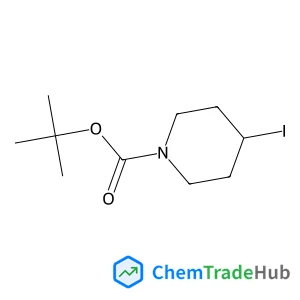
2-Methyl-2-propanyl 4-iodo-1-piperidinecarboxylate
CAS Number:
301673-14-3
Molecular Formula:
C10H18INO2

Recommended Suppliers





Disclaimer
This page provides academic journal information for reference and research purposes only. We are not affiliated with any journal publishers and do not handle publication submissions. For publication-related inquiries, please contact the respective journal publishers directly.
If you notice any inaccuracies in the information displayed, please contact us at support@chemtradehub.com. We will promptly review and address your concerns.