













Luminescent lanthanide bimetallic triple-stranded helicates as potential cellular imaging probes
Literature Information
Publication Date
2007-04-05
DOI
10.1039/B701482A
Impact Factor
6.222
Authors
Caroline D. B. Vandevyver, Anne-Sophie Chauvin, Steve Comby, Jean-Claude G. Bünzli
View Original
Abstract
Water-soluble triple-stranded [Ln2(L)3] helicates have been successfully tested as imaging probes in human cervical adenocarcinoma cells (HeLa), the complex being not toxic and clearly staining their cytoplasm in a concentration-dependent manner.
Related Literature
Molecular dynamics simulation of nanoconfined glycerol
R. Busselez, R. Lefort, Q. Ji, F. Affouard, D. Morineau
2009-11-05
Paper
DOI: 10.1039/B911859D
On the low volatility of cyclic esters: an infrared spectroscopy comparison between dimers of γ-butyrolactone and methyl propionate
Susanne Hesse, Martin A. Suhm
2009-11-05
Paper
DOI: 10.1039/B915419A
Influence of salt on assembly and compression of PDADMAC/PSSMA polyelectrolyte multilayers
Xiao Gong, Changyou Gao
2009-10-29
Paper
DOI: 10.1039/B915335G
Integral and differential cross sections for the S(1D)+HD reaction employing the ground adiabatic electronic state
H. Yang, K.-L. Han, G. C. Schatz, S.-H. Lee, K. Liu, S. C. Smith, M. Hankel
2009-11-05
Paper
DOI: 10.1039/B917972K
Temperature evolution of structure and bonding of formic acid and formate on fully oxidized and highly reduced CeO2(111)
Wesley O. Gordon, Ye Xu, David R. Mullins, Steven H. Overbury
2009-10-19
Paper
DOI: 10.1039/B913310K
Supported vanadium oxide in heterogeneous catalysis: elucidating the structure–activity relationship with spectroscopy
Ilke Muylaert, Pascal Van Der Voort
2009-03-05
Perspective
DOI: 10.1039/B819808J
A proton NMR relaxation study of water dynamics in bovine serum albumin nanoparticles
Monica Belotti, Andrea Martinelli, Raffaella Gianferri
2009-11-17
Paper
DOI: 10.1039/B911433E
Ultrathin oxide films and heterojunctions: CaO layers on BaO and SrO
Neil L. Allan, John H. Harding
2009-03-17
Paper
DOI: 10.1039/B822588E
Hydrogen adsorption on Pd-containing Au(111) bimetallic surfaces
Sudha Venkatachalam, Timo Jacob
2009-03-06
Paper
DOI: 10.1039/B900250B
First-principles study on defect chemistry and migration of oxide ions in ceria doped with rare-earth cations
Manfred Martin
2009-03-11
Paper
DOI: 10.1039/B900162J
You might also like
Compound Q&A
What precautions should be taken when handling 2-Chloro-1,2-bis(4-methylphenyl)ethanone (CAS: 71193-32-3)?
When handling 2-Chloro-1,2-bis(4-methylphenyl)ethanone (CAS: 71193-32-3), it is ...
71193-32-32-Chloro-1,2-bis(4-m...
Compound Q&A
What industries use 4-Ethoxy-3-(5-methyl-4-oxo-7-propyl-1,4-dihydroimidazo[5,1-f][1,2,4]triazin-2-yl)benzenesulfonyl chloride (CAS: 224789-26-8)?
4-Ethoxy-3-(5-methyl-4-oxo-7-propyl-1,4-dihydroimidazo[5,1-f][1,2,4]triazin-2-yl...
224789-26-84-Ethoxy-3-(5-methyl...
Compound Q&A
How should Methyl 3-Oxo-4-Androsten-17-Carboxylate (CAS: 2681-55-2) be stored?
Methyl 3-Oxo-4-Androsten-17-Carboxylate (CAS: 2681-55-2) should be stored in a c...
2681-55-2Methyl 3-Oxo-4-Andro...
Compound Q&A
What are the main uses of (R)-3-Amino-4-(3-hexylphenylamino)-4-oxobutylphosphonic acid (CAS: 909725-61-7)?
(R)-3-Amino-4-(3-hexylphenylamino)-4-oxobutylphosphonic acid is primarily used i...
909725-61-7(R)-3-Amino-4-(3-hex...
Compound Q&A
What regulatory guidelines apply to 2-Methyl-2-propanyl 3-amino-3-carbamoyl-1-azetidinecarboxylate (CAS: 1254120-14-3)?
2-Methyl-2-propanyl 3-amino-3-carbamoyl-1-azetidinecarboxylate (CAS: 1254120-14-...
1254120-14-32-Methyl-2-propanyl ...
Compound Q&A
Are there alternatives to (E)-4-(tert-Butoxy)-4-oxobut-2-enoic acid (CAS: 135355-96-3) in synthesis?
There are alternative reagents that can be used in synthesis instead of (E)-4-(t...
135355-96-3(E)-4-(tert-Butoxy)-...
Compound Q&A
What are the physical and chemical properties of [2-(3-Chlorophenyl)-1,3-thiazol-4-yl]methanol (CAS: 121202-20-8)?
[2-(3-Chlorophenyl)-1,3-thiazol-4-yl]methanol (CAS: 121202-20-8) is a crystallin...
121202-20-8[2-(3-Chlorophenyl)-...
Compound Q&A
What is the market or research trend for Methyl (2S)-[(4S)-2,2-dimethyl-1,3-dioxolan-4-yl]{[(4-methylphenyl)sulfonyl]oxy}acetate (CAS: 166249-17-8)?
The market and research trends for Methyl (2S)-[(4S)-2,2-dimethyl-1,3-dioxolan-4...
166249-17-8Methyl (2S)-[(4S)-2,...
Compound Q&A
What is the market or research trend for 1-Bromo-2-isocyanatoethane (CAS: 42865-19-0)?
The market for 1-Bromo-2-isocyanatoethane (CAS: 42865-19-0) is driven by its use...
42865-19-01-Bromo-2-isocyanato...
Compound Q&A
What are the main uses of 4-Nitro-D-phenylalanine hydrochloride (CAS: 147065-06-3)?
4-Nitro-D-phenylalanine hydrochloride (CAS: 147065-06-3) is primarily used in re...
147065-06-34-Nitro-D-phenylalan...
Source Journal
Chemical Communications

CiteScore:
8.6
Self-citation Rate:
4.7%
Articles per Year:
2458
ChemComm publishes urgent research which is of outstanding significance and interest to experts in the field, while also appealing to the journal’s broad chemistry readership. Our communication format is ideally suited to short, urgent studies that are of such importance that they require accelerated publication. Our scope covers all topics in chemistry, and research at the interface of chemistry and other disciplines (such as materials science, nanoscience, physics, engineering and biology) where there is a significant novelty in the chemistry aspects. Major topic areas covered include: Analytical Chemistry Catalysis Chemical Biology and medicinal chemistry Computational Chemistry and Machine Learning Energy and sustainable chemistry Environmental Chemistry Green Chemistry Inorganic Chemistry Materials Chemistry Nanoscience Organic Chemistry Physical Chemistry Polymer Chemistry Supramolecular Chemistry
Recommended Compounds

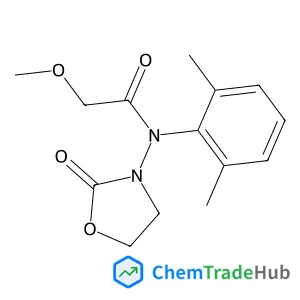
N-(2,6-Dimethylphenyl)-2-methoxy-N-(2-oxo-1,3-oxazolidin-3-yl)acetamide
CAS Number:
77732-09-3
Molecular Formula:
C14H18N2O4

Recommended Suppliers





Disclaimer
This page provides academic journal information for reference and research purposes only. We are not affiliated with any journal publishers and do not handle publication submissions. For publication-related inquiries, please contact the respective journal publishers directly.
If you notice any inaccuracies in the information displayed, please contact us at support@chemtradehub.com. We will promptly review and address your concerns.