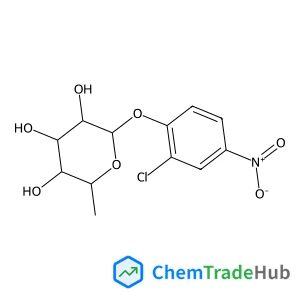
2-Chloro-4-nitrophenyl 6-deoxy-alpha-L-galactopyranoside
CAS Number:
157843-41-9
Molecular Formula:
C12H14ClNO7
H. Yang, K.-L. Han, G. C. Schatz, S.-H. Lee, K. Liu, S. C. Smith, M. Hankel
We present converged quantum mechanical calculations for the title reaction employing a time-dependent wavepacket method. We obtained integral and differential cross sections over an energy range from 0.23 to 0.35 eV total energy as well as product state distributions for both product channels. The excitation functions decrease with energy and point to statistical dynamics as do the cold vibrational distributions and highly inverted rotational distributions. The differential cross sections oscillate strongly with energy for both product channels. Our differential cross sections for both product channels at 2.5 kcal/mol, one of the experimental energies, compare well to the experimental results. The quantum results obtained in this study are similar to what has been found employing QCT methods, implying that the differences between the experimental and theoretical results are due to the potential energy surface or non-adiabatic effects rather than due to quantum effects or the methods employed.
Wiliam Ferreira da Cunha, Ramiro Marcelo dos Santos, Rafael Timóteo de Sousa Júnior, Renato Batista Santos, Geraldo Magela e Silva, Luiz Antônio Ribeiro Júnior
DOI: 10.1039/C9CP00980A
Yosuke Ugata, Morgan L. Thomas, Kazuhide Ueno, Masayoshi Watanabe
DOI: 10.1039/C9CP01839E
Paul Smith, Robert M. Ziolek, Elena Gazzarrini, Dylan M. Owen, Christian D. Lorenz
DOI: 10.1039/C9CP01532A
Adrien Sthoer, Jana Hladílková, Mikael Lund, Eric Tyrode
DOI: 10.1039/C9CP00398C
Si Zhou, Wei Pei, Qiuying Du, Jijun Zhao
DOI: 10.1039/C9CP01517E
Valery Andrushchenko, Walter Pohle
DOI: 10.1039/C9CP01475F
A. Vila-Costa, J. Ràfols-Ribé, M. Gonzalez-Silveira, A. Lopeandía, J. Ll. Tamarit, J. Rodríguez-Viejo
DOI: 10.1039/C9CP00976K
Wenyan Su, Qunping Fan, Xia Guo, Jingnan Wu, Maojie Zhang
DOI: 10.1039/C9CP01101C
Cameron J. Bodenschatz, Tianjun Xie, Xiaohong Zhang, Rachel B. Getman
DOI: 10.1039/C9CP00824A
Shasha Liu, Chao Jin, Dongxing Zheng, Xin Pang, Yuchen Wang, Ping Wang, Wanchao Zheng, Haili Bai
DOI: 10.1039/C9CP01809C
When handling 2-Chloro-1,2-bis(4-methylphenyl)ethanone (CAS: 71193-32-3), it is ...
4-Ethoxy-3-(5-methyl-4-oxo-7-propyl-1,4-dihydroimidazo[5,1-f][1,2,4]triazin-2-yl...
Methyl 3-Oxo-4-Androsten-17-Carboxylate (CAS: 2681-55-2) should be stored in a c...
(R)-3-Amino-4-(3-hexylphenylamino)-4-oxobutylphosphonic acid is primarily used i...
2-Methyl-2-propanyl 3-amino-3-carbamoyl-1-azetidinecarboxylate (CAS: 1254120-14-...
There are alternative reagents that can be used in synthesis instead of (E)-4-(t...
[2-(3-Chlorophenyl)-1,3-thiazol-4-yl]methanol (CAS: 121202-20-8) is a crystallin...
The market and research trends for Methyl (2S)-[(4S)-2,2-dimethyl-1,3-dioxolan-4...
The market for 1-Bromo-2-isocyanatoethane (CAS: 42865-19-0) is driven by its use...
4-Nitro-D-phenylalanine hydrochloride (CAS: 147065-06-3) is primarily used in re...

Physical Chemistry Chemical Physics (PCCP) is an international journal co-owned by 19 physical chemistry and physics societies from around the world. This journal publishes original, cutting-edge research in physical chemistry, chemical physics and biophysical chemistry. To be suitable for publication in PCCP, articles must include significant innovation and/or insight into physical chemistry; this is the most important criterion that reviewers and Editors will judge against when evaluating submissions. The journal has a broad scope and welcomes contributions spanning experiment, theory, computation and data science. Topical coverage includes spectroscopy, dynamics, kinetics, statistical mechanics, thermodynamics, electrochemistry, catalysis, surface science, quantum mechanics, quantum computing and machine learning. Interdisciplinary research areas such as polymers and soft matter, materials, nanoscience, energy, surfaces/interfaces, and biophysical chemistry are welcomed if they demonstrate significant innovation and/or insight into physical chemistry. Joined experimental/theoretical studies are particularly appreciated when complementary and based on up-to-date approaches.