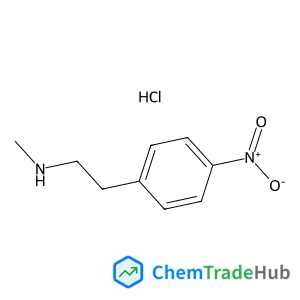
N-Methyl-2-(4-nitrophenyl)ethanamine hydrochloride (1:1)
CAS Number:
166943-39-1
Molecular Formula:
C9H13ClN2O2
Ji'en Wu, Sian M. Cooper, Russell J. Cox, John Crosby, Matthew P. Crump, Joanne Hothersall, Thomas J. Simpson, Christopher M. Thomas, Christine L. Willis
Mutation of the HMG-CoA synthase encoding mupH gene in Pseudomonas fluorescens gives rise to a new metabolite formed from a truncated polyketide intermediate, providing in vivo evidence for the roles of mupH and cognate genes found in several “AT-less” and other bacterial PKS gene clusters responsible for the biosynthesis of diverse metabolites containing acetate/propionate derived side chains.
Annia Galano, Ana Martínez
DOI: 10.1039/B917636E
Hana Gerbelová, Tiago Q. Faria, Maria Manuel Sampaio, Rainer Rudolph, António L. Maçanita, Helena Santos
DOI: 10.1039/B819365G
Neil L. Allan, John H. Harding
DOI: 10.1039/B822588E
Shiqiang Hao, David S. Sholl
DOI: 10.1039/B917804J
S. E. Korchak, H.-M. Vieth
DOI: 10.1039/B914188J
R. Cabriolu, M. G. Del Pópolo, P. Ballone
DOI: 10.1039/B913358E
Taku Watanabe, Seda Keskin, Sankar Nair, David S. Sholl
DOI: 10.1039/B918254N
Vincent Finsy, Sofia Calero, Elena García-Pérez, Patrick J. Merkling, Gill Vedts, Dirk E. De Vos, Gino V. Baron, Joeri F. M. Denayer
DOI: 10.1039/B822247A
When handling 2-Chloro-1,2-bis(4-methylphenyl)ethanone (CAS: 71193-32-3), it is ...
4-Ethoxy-3-(5-methyl-4-oxo-7-propyl-1,4-dihydroimidazo[5,1-f][1,2,4]triazin-2-yl...
Methyl 3-Oxo-4-Androsten-17-Carboxylate (CAS: 2681-55-2) should be stored in a c...
(R)-3-Amino-4-(3-hexylphenylamino)-4-oxobutylphosphonic acid is primarily used i...
2-Methyl-2-propanyl 3-amino-3-carbamoyl-1-azetidinecarboxylate (CAS: 1254120-14-...
There are alternative reagents that can be used in synthesis instead of (E)-4-(t...
[2-(3-Chlorophenyl)-1,3-thiazol-4-yl]methanol (CAS: 121202-20-8) is a crystallin...
The market and research trends for Methyl (2S)-[(4S)-2,2-dimethyl-1,3-dioxolan-4...
The market for 1-Bromo-2-isocyanatoethane (CAS: 42865-19-0) is driven by its use...
4-Nitro-D-phenylalanine hydrochloride (CAS: 147065-06-3) is primarily used in re...

ChemComm publishes urgent research which is of outstanding significance and interest to experts in the field, while also appealing to the journal’s broad chemistry readership. Our communication format is ideally suited to short, urgent studies that are of such importance that they require accelerated publication. Our scope covers all topics in chemistry, and research at the interface of chemistry and other disciplines (such as materials science, nanoscience, physics, engineering and biology) where there is a significant novelty in the chemistry aspects. Major topic areas covered include: Analytical Chemistry Catalysis Chemical Biology and medicinal chemistry Computational Chemistry and Machine Learning Energy and sustainable chemistry Environmental Chemistry Green Chemistry Inorganic Chemistry Materials Chemistry Nanoscience Organic Chemistry Physical Chemistry Polymer Chemistry Supramolecular Chemistry