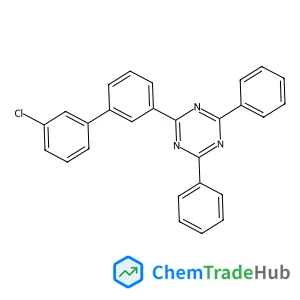
2-(3'-Chlorobiphenyl-3-yl)-4,6-diphenyl-1,3,5-triazine
CAS Number:
1443049-83-9
Molecular Formula:
C27H18ClN3
Annia Galano, Ana Martínez
The electron transfer (ET) reaction between carotenoids and the superoxide radical anion is found to be not only a viable process but also a very unique one. The nature of the O2˙− inverts the direction of the transfer, with respect to ET involving other ROS: the O2˙− becomes the electron donor and carotenoids (CAR) the electron acceptor. Therefore the “antioxidant” activity of CAR when reacting with O2˙− lies in their capacity to prevent the formation of oxidant ROS. This peculiar charge transfer is energetically feasible in non-polar environments but not in polar media. In addition the relative reactivity of CAR towards O2˙− is drastically different from their reactivity to other ROS. Asthaxanthin (ASTA) is predicted to be a better O2˙− quencher than LYC and the other CAR. The CAR + O2˙− reactions were found to be diffusion controlled. The agreement with available experimental data supports the density functional theory results from the present work.

Bioorganic & Medicinal Chemistry Letters

Journal of Chemical Sciences

Critical Reviews in Solid State and Materials Sciences

Cellulose

Journal of the Indian Institute of Science

Biocatalysis and Biotransformation

Polycyclic Aromatic Compounds

Bioorganic & Medicinal Chemistry

Atomization and Sprays

Acta Metallurgica Sinica-English Letters
Prashun Gorai, Eric S. Toberer, Vladan Stevanović
DOI: 10.1039/C6CP06943F
Ulrich Kuenzer, Jan-Andrè Sorarù, Thomas S. Hofer
DOI: 10.1039/C6CP06698D
Ying Wei, Jun Lu, Tong Lu, Feihong Meng, Jia Xu, Li Wang, Yang Li, Liping Wang, Fei Li
DOI: 10.1039/C6CP04431J
A. K. Sivadasan, Chirantan Singha, A. Bhattacharyya, Sandip Dhara
DOI: 10.1039/C6CP05520F
Yunxi Yao, Konstantinos P. Giapis
DOI: 10.1039/C6CP06533C
Rui-Qin Zhang, Yan-Ling Zhao, Fei Qi, Klaus Hermann, Michel A. Van Hove
DOI: 10.1039/C6CP05996A
Mouritz N. Svenson, Randall E. Youngman, Yuanzheng Yue, Sylwester J. Rzoska, Michal Bockowski, Lars R. Jensen, Morten M. Smedskjaer
DOI: 10.1039/C6CP06341A
Shirui Luo, Jarrod Schiffbauer
DOI: 10.1039/C6CP06085D
When handling 2-Chloro-1,2-bis(4-methylphenyl)ethanone (CAS: 71193-32-3), it is ...
4-Ethoxy-3-(5-methyl-4-oxo-7-propyl-1,4-dihydroimidazo[5,1-f][1,2,4]triazin-2-yl...
Methyl 3-Oxo-4-Androsten-17-Carboxylate (CAS: 2681-55-2) should be stored in a c...
(R)-3-Amino-4-(3-hexylphenylamino)-4-oxobutylphosphonic acid is primarily used i...
2-Methyl-2-propanyl 3-amino-3-carbamoyl-1-azetidinecarboxylate (CAS: 1254120-14-...
There are alternative reagents that can be used in synthesis instead of (E)-4-(t...
[2-(3-Chlorophenyl)-1,3-thiazol-4-yl]methanol (CAS: 121202-20-8) is a crystallin...
The market and research trends for Methyl (2S)-[(4S)-2,2-dimethyl-1,3-dioxolan-4...
The market for 1-Bromo-2-isocyanatoethane (CAS: 42865-19-0) is driven by its use...
4-Nitro-D-phenylalanine hydrochloride (CAS: 147065-06-3) is primarily used in re...

Physical Chemistry Chemical Physics (PCCP) is an international journal co-owned by 19 physical chemistry and physics societies from around the world. This journal publishes original, cutting-edge research in physical chemistry, chemical physics and biophysical chemistry. To be suitable for publication in PCCP, articles must include significant innovation and/or insight into physical chemistry; this is the most important criterion that reviewers and Editors will judge against when evaluating submissions. The journal has a broad scope and welcomes contributions spanning experiment, theory, computation and data science. Topical coverage includes spectroscopy, dynamics, kinetics, statistical mechanics, thermodynamics, electrochemistry, catalysis, surface science, quantum mechanics, quantum computing and machine learning. Interdisciplinary research areas such as polymers and soft matter, materials, nanoscience, energy, surfaces/interfaces, and biophysical chemistry are welcomed if they demonstrate significant innovation and/or insight into physical chemistry. Joined experimental/theoretical studies are particularly appreciated when complementary and based on up-to-date approaches.

![(1R)-3-Bromo-1,7,7-trimethylbicyclo[2.2.1]heptan-2-one structure](https://static.chemtradehub.com/structs/102/10293-06-8-dd8a.webp "(1R)-3-Bromo-1,7,7-trimethylbicyclo[2.2.1]heptan-2-one structure")