












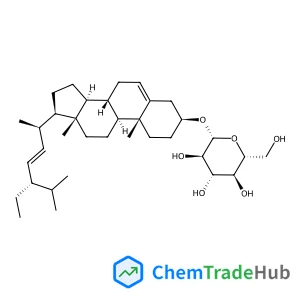
(3beta,22E)-Stigmasta-5,22-dien-3-yl beta-D-glucopyranoside
CAS Number:
19716-26-8
Molecular Formula:
C35H58O6
The first page of this article is displayed as the abstract.
Y. Cui, K. D. Fulfer, J. Ma, T. K. Weldeghiorghis, D. G. Kuroda
DOI: 10.1039/C6CP06318G
Chih-Yu Chang, Bo-Chou Tsai, Yu-Cheng Hsiao, Yu-Ching Huang
DOI: 10.1039/C6CP06486H
Peng Liu, Dunyou Wang, Yulong Xu
DOI: 10.1039/C6CP06195H
Richard Dawes, Hua Guo
DOI: 10.1039/C6CP06232F
Juan P. Marcolongo, Uriel N. Morzan, Ari Zeida, Damián A. Scherlis, José A. Olabe
DOI: 10.1039/C6CP06314D
Shinichi Enami, Michael R. Hoffmann, Agustín J. Colussi
DOI: 10.1039/C6CP06652F
Xiaolei Zhang, Huimin Sui, Xiaolei Wang, Hongyang Su, Weina Cheng, Xu Wang, Bing Zhao
DOI: 10.1039/C6CP04370D
P. S. Ghosh, A. Arya, G. K. Dey, N. Kuganathan, R. W. Grimes
DOI: 10.1039/C6CP05794B
(3.beta.)-3-Hydroxy-N,N-dimethyl-chol-5-en-24-amide (CAS: 79066-03-8) is primari...
5-(Aminomethyl)-2-methoxyphenol (CAS: 89702-89-6) is classified under GHS as a s...
Thieno[2,3-c]pyridin-7(6H)-one (CAS: 28981-13-7) is a heterocyclic organic compo...
1-[(6-Methoxy-3-pyridinyl)methyl]-4-piperidinamine dihydrochloride is generally ...
[(2E)-3-Phenyl-2-propen-1-yl]phosphonic acid (CAS: 146404-58-2) is regulated und...
6-Bromo-7-methoxyquinoline (CAS: 1620515-86-7) falls under the scope of the Glob...
This compound is primarily used in the pharmaceutical industry for the developme...
1-Ethyl-7-[2-methyl-6-(4H-1,2,4-triazol-3-yl)-3-pyridinyl]-3,5-dihydropyrazino[2...
Alternative reagents such as 2-[(dimethylamino)methyl]phenylboronic acid or rela...
3-(Piperidin-4-yloxy)pyridine (CAS: 310881-48-2) is an organic compound with the...

Physical Chemistry Chemical Physics (PCCP) is an international journal co-owned by 19 physical chemistry and physics societies from around the world. This journal publishes original, cutting-edge research in physical chemistry, chemical physics and biophysical chemistry. To be suitable for publication in PCCP, articles must include significant innovation and/or insight into physical chemistry; this is the most important criterion that reviewers and Editors will judge against when evaluating submissions. The journal has a broad scope and welcomes contributions spanning experiment, theory, computation and data science. Topical coverage includes spectroscopy, dynamics, kinetics, statistical mechanics, thermodynamics, electrochemistry, catalysis, surface science, quantum mechanics, quantum computing and machine learning. Interdisciplinary research areas such as polymers and soft matter, materials, nanoscience, energy, surfaces/interfaces, and biophysical chemistry are welcomed if they demonstrate significant innovation and/or insight into physical chemistry. Joined experimental/theoretical studies are particularly appreciated when complementary and based on up-to-date approaches.

![4-[2-(Trichlorosilyl)ethyl]benzenesulfonyl chloride structure](https://static.chemtradehub.com/structs/797/79793-00-3-de16.webp "4-[2-(Trichlorosilyl)ethyl]benzenesulfonyl chloride structure")






