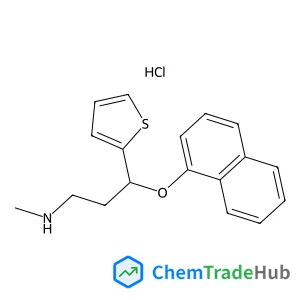
N-Methyl-3-(1-naphthyloxy)-3-(2-thienyl)-1-propanamine hydrochloride (1:1)
CAS Number:
1188266-11-6
Molecular Formula:
C18H20ClNOS
Katsuhiko Ariga, Jonathan P. Hill, Qingmin Ji
The layer-by-layer (LbL) adsorption technique offers an easy and inexpensive process for multilayer formation and allows a variety of materials to be incorporated within the film structures. Therefore, the LbL assembly method can be regarded as a versatile bottom-up nanofabrication technique. Research fields concerned with LbL assembly have developed rapidly but some important physicochemical aspects remain uninvestigated. In this review, we will introduce several examples from physicochemical investigations regarding the basics of this method to advanced research aimed at practical applications. These are selected mostly from recent reports and should stimulate many physical chemists and chemical physicists in the further development of LbL assembly. In order to further understand the mechanism of the LbL assembly process, theoretical work, including thermodynamics calculations, has been conducted. Additionally, the use of molecular dynamics simulation has been proposed. Recently, many kinds of physicochemical molecular interactions, including hydrogen bonding, charge transfer interactions, and stereo-complex formation, have been used. The combination of the LbL method with other fabrication techniques such as spin-coating, spraying, and photolithography has also been extensively researched. These improvements have enabled preparation of LbL films composed of various materials contained in well-designed nanostructures. The resulting structures can be used to investigate basic physicochemical phenomena where relative distances between interacting groups is of great importance. Similarly, LbL structures prepared by such advanced techniques are used widely for development of functional systems for physical applications from photovoltaic devices and field effect transistors to biochemical applications including nano-sized reactors and drug delivery systems.

Acta Materialia

Drug Discovery Today

Nature Medicine

Current Opinion in Solid State & Materials Science

Russian Journal of Applied Chemistry

Organic Process Research & Development

Russian Journal of Organic Chemistry

Chemistry Education Research and Practice

Journal of Peptide Science

New Journal of Chemistry
Alexander Holm, Alexander Southan, Curtis W. Frank
DOI: 10.1039/D0PY00697A
DOI: 10.1039/D1PY01301G
Haosheng Pang, Yunjun Luo, Bing Zhang
DOI: 10.1039/D1PY00920F
Katelyn M. Lindenmeyer, R. Daniel Johnson, Kevin M. Miller
DOI: 10.1039/D0PY00016G
Sina Sabury, Tyler J. Adams, Margaret Kocherga, Michael G. Walter
DOI: 10.1039/D0PY00972E
Pedro Salas-Ambrosio, Ségolène Antoine, Emmanuel Ibarboure, Olivier Sandre, Mark W. Grinstaff, Sébastien Lecommandoux, Colin Bonduelle
DOI: 10.1039/D1PY00995H
Filip Du Prez, Julia Kalow
DOI: 10.1039/D0PY90102D
Riqiang Li, Wenzhuo Chen, Ying Yang, Hui Li, Fenfen Xu, Zhaozhao Duan, Tongxiang Liang, Herui Wen, Wei Tian
DOI: 10.1039/D0PY00829J
Mengqian Huang, De Bai, Qin Chen, Changbo Zhao, Tianhua Ren, Caijuan Huang, Michael North, Haibo Xie
DOI: 10.1039/D0PY00291G
Tieshuai Zhao, Ben Drain, Gokhan Yilmaz, C. Remzi Becer
DOI: 10.1039/D1PY00944C
N-(4-Methoxybenzyl)-2-pyridinamine (CAS: 52818-63-0) is increasingly being used ...
When handling Ethyl 4-(2-chlorophenyl)-1,3-thiazole-2-carboxylate, appropriate p...
Diethyldiselane (CAS: 628-39-7) is classified under the Globally Harmonized Syst...
The market for oxocopper (CAS: 12053-18-8) is primarily driven by its use in cat...
The market for 5-{[(2-Methyl-2-propanyl)oxy]carbonyl}-5-azaspiro[2.4]heptane-7-c...
2-(1-Pyrrolidinyl)-4-pyridinamine is a chemical compound with the CAS number 359...
2-(3-Pyridinyl)-1-azabicyclo[2.2.2]octane (CAS: 91556-75-1) is a crystalline sol...
(S)-Alpha-allyl-proline hydrochloride is usually synthesized via a Wittig reacti...
3-Methyl-1,2-oxazole-5-carboxylic acid (CAS: 4857-42-5) is an organic compound w...
Lys-SMCC-DM1 is synthesized via a multi-step process involving the coupling of S...

Physical Chemistry Chemical Physics (PCCP) is an international journal co-owned by 19 physical chemistry and physics societies from around the world. This journal publishes original, cutting-edge research in physical chemistry, chemical physics and biophysical chemistry. To be suitable for publication in PCCP, articles must include significant innovation and/or insight into physical chemistry; this is the most important criterion that reviewers and Editors will judge against when evaluating submissions. The journal has a broad scope and welcomes contributions spanning experiment, theory, computation and data science. Topical coverage includes spectroscopy, dynamics, kinetics, statistical mechanics, thermodynamics, electrochemistry, catalysis, surface science, quantum mechanics, quantum computing and machine learning. Interdisciplinary research areas such as polymers and soft matter, materials, nanoscience, energy, surfaces/interfaces, and biophysical chemistry are welcomed if they demonstrate significant innovation and/or insight into physical chemistry. Joined experimental/theoretical studies are particularly appreciated when complementary and based on up-to-date approaches.
![1-(1-Benzyl-1,2,3,6-tetrahydropyridin-4-yl)-1H-benzo[d]imidazol-2(3H)-one structure](https://static.chemtradehub.com/structs/603/60373-71-9-7dfb.webp "1-(1-Benzyl-1,2,3,6-tetrahydropyridin-4-yl)-1H-benzo[d]imidazol-2(3H)-one structure")