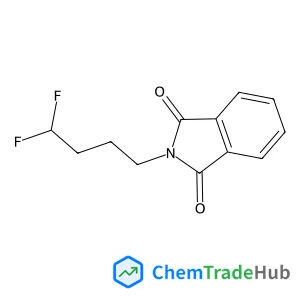
2-(4,4-Difluorobutyl)-1H-isoindole-1,3(2H)-dione
CAS Number:
1265341-14-7
Molecular Formula:
C12H11F2NO2
Sina Sabury, Tyler J. Adams, Margaret Kocherga, Michael G. Walter
Fundamental properties of conjugated copolymers are sensitively linked to their constitution and features of their repeat unit design that govern assembly and organization across multiple length scales, ultimately impacting device performance. Herein we report the efficient synthesis and characterization, and optical, electrochemical and transport properties of complementary pairs of nucleobase-functionalized, fully conjugated copolymers based on benzo[1,2-b:4,5-b′]-dithiophene (BDT) and 3-hexylthiophene (3hT), which is a quintessential low bandgap polymer. Stille cross-coupling polymerizations enable access to high molecular weight, alternating copolymers of modest dispersity containing pendant adenine or thymine groups in each repeating unit, which provide the capacity to direct molecular assembly. Variations in nucleobase type and design of alkyl side chains on BDT units give rise to a strongly red-shifted absorbance onset for the copolymers containing thymine and adenine functionality in comparison to solution and dried films. Higher hole mobilities were also observed and attributed to the tendency of the nucleobase inclusion to heighten organization. The influence of the nucleobases on the organization is further revealed when thermal pre-treatment is used during film formation: modest heating before casting the non-functionalized BDT-3hT copolymers leads to increases in the mobility, optical absorbance and fluorescence, while copolymers with adenine or thymine pendant groups do not show analogous improvements, suggesting that the nucleobases have promoted nanoscale organization, which is consistent with assessments of hydrogen bonding interactions. Given the structure-directing ability of nucleobases through hydrogen bonding, π-stacking, and complementary base pairing, these novel materials engender myriad opportunities to examine how specific molecular-level interactions that cue self-assembly affect optoelectronic properties and device-level performance.
Dalton T. Snyder, Lucas J. Szalwinski, J. Mitchell Wells, R. Graham Cooks
DOI: 10.1039/C8AN01661E
Anthony Dicken, Daniel Spence, Keith Rogers, Danae Prokopiou, Paul Evans
DOI: 10.1039/C8AN01537F
Lok Nath Neupane, Pramod Kumar Mehta, Semin Oh, See-Hyoung Park, Keun-Hyeung Lee
DOI: 10.1039/C8AN01221K
Shuai-Liang Yang, Jiu-Nan Lu, Sai-Jun Zhang
DOI: 10.1039/C8AN00701B
Do Hyun Kang, Keesung Kim, Younghwan Son, Pahn-Shick Chang, Ho-Sup Jung
DOI: 10.1039/C8AN01097H
Oliver Jonas, Jeon Woong Kang, Surya P. Singh, Alex Lammers, Freddy T. Nguyen, Ramachandra R. Dasari, Peter T. C. So, Robert Langer
DOI: 10.1039/C8AN00913A
Joëlle De Meutter, Julie Vandenameele, André Matagne, Erik Goormaghtigh
DOI: 10.1039/C6AN02048H
Kawarpal Singh, Bernhard Blümich
DOI: 10.1039/C7AN00020K
Guang Li, Liping Bai, Farong Tao, Aixia Deng, Liping Wang
DOI: 10.1039/C8AN01130C
Wei Sun, Yuqing Chen, Yuerong Wang, Pei Luo, Min Zhang, Hongyang Zhang, Ping Hu
DOI: 10.1039/C8AN01216D
N-(4-Methoxybenzyl)-2-pyridinamine (CAS: 52818-63-0) is increasingly being used ...
When handling Ethyl 4-(2-chlorophenyl)-1,3-thiazole-2-carboxylate, appropriate p...
Diethyldiselane (CAS: 628-39-7) is classified under the Globally Harmonized Syst...
The market for oxocopper (CAS: 12053-18-8) is primarily driven by its use in cat...
The market for 5-{[(2-Methyl-2-propanyl)oxy]carbonyl}-5-azaspiro[2.4]heptane-7-c...
2-(1-Pyrrolidinyl)-4-pyridinamine is a chemical compound with the CAS number 359...
2-(3-Pyridinyl)-1-azabicyclo[2.2.2]octane (CAS: 91556-75-1) is a crystalline sol...
(S)-Alpha-allyl-proline hydrochloride is usually synthesized via a Wittig reacti...
3-Methyl-1,2-oxazole-5-carboxylic acid (CAS: 4857-42-5) is an organic compound w...
Lys-SMCC-DM1 is synthesized via a multi-step process involving the coupling of S...

Polymer Chemistry welcomes submissions in all areas of polymer science that have a strong focus on macromolecular chemistry. Manuscripts may cover a broad range of fields, yet no direct application focus is required.
![N-{15-[(2,5-Dioxo-1-pyrrolidinyl)oxy]-15-oxo-3,6,9,12-tetraoxapentadec-1-yl}-2-(2-propyn-1-yloxy)acetamide structure](https://static.chemtradehub.com/structs/210/2101206-92-0-2eb5.webp "N-{15-[(2,5-Dioxo-1-pyrrolidinyl)oxy]-15-oxo-3,6,9,12-tetraoxapentadec-1-yl}-2-(2-propyn-1-yloxy)acetamide structure")