












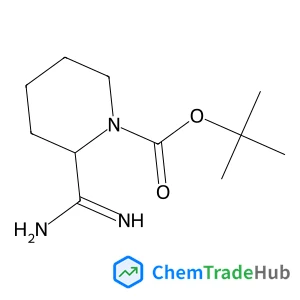
2-Methyl-2-propanyl 2-carbamimidoyl-1-piperidinecarboxylate
CAS Number:
1258640-98-0
Molecular Formula:
C11H21N3O2
Patrick Nuernberger, Gerhard Vogt, Tobias Brixner, Gustav Gerber
We review the progress in controlling quantum dynamical processes in the condensed phase with femtosecond laser pulses. Due to its high particle density the condensed phase has both high relevance and appeal for chemical synthesis. Thus, in recent years different methods have been developed to manipulate the dynamics of condensed-phase systems by changing one or multiple laser pulse parameters. Single-parameter control is often achieved by variation of the excitation pulse’s wavelength, its linear chirp or its temporal subpulse separation in case of pulse sequences. Multiparameter control schemes are more flexible and provide a much larger parameter space for an optimal solution. This is realized in adaptive femtosecond quantum control, in which the optimal solution is iteratively obtained through the combination of an experimental feedback signal and an automated learning algorithm. Several experiments are presented that illustrate the different control concepts and highlight their broad applicability. These fascinating achievements show the continuous progress on the way towards the control of complex quantum reactions in the condensed phase.
Mahammad Anas, Priyanka Dinda, Mahuya Kar, Tarun K. Mandal
DOI: 10.1039/D1PY01187A
Wentao Peng, Yingying Cai, Luise Fanslau, Philipp Vana
DOI: 10.1039/D1PY01172C
Katelyn M. Lindenmeyer, R. Daniel Johnson, Kevin M. Miller
DOI: 10.1039/D0PY00016G
Chuandong Dou
DOI: 10.1039/D0PY00868K
Filip Du Prez, Julia Kalow
DOI: 10.1039/D0PY90102D
Bilal Özen, Nicolas Candau, Cansel Temiz, Ferdinand C. Grozema, Grégory Stoclet, Christopher J. G. Plummer, Holger Frauenrath
DOI: 10.1039/D1PY01203G
Jirui Zhang, Evelina Liarou, James Town, Yongguang Li, Alan M. Wemyss, David M. Haddleton
DOI: 10.1039/D0PY00555J
Xiaoyan Yang, Haibao Jin, Xinfeng Tao, Binbin Xu, Shaoliang Lin
DOI: 10.1039/D1PY00984B
Xiaochun Mu, Yang Li
DOI: 10.1039/D1PY00896J
Alexander Holm, Alexander Southan, Curtis W. Frank
DOI: 10.1039/D0PY00697A
N-(4-Methoxybenzyl)-2-pyridinamine (CAS: 52818-63-0) is increasingly being used ...
When handling Ethyl 4-(2-chlorophenyl)-1,3-thiazole-2-carboxylate, appropriate p...
Diethyldiselane (CAS: 628-39-7) is classified under the Globally Harmonized Syst...
The market for oxocopper (CAS: 12053-18-8) is primarily driven by its use in cat...
The market for 5-{[(2-Methyl-2-propanyl)oxy]carbonyl}-5-azaspiro[2.4]heptane-7-c...
2-(1-Pyrrolidinyl)-4-pyridinamine is a chemical compound with the CAS number 359...
2-(3-Pyridinyl)-1-azabicyclo[2.2.2]octane (CAS: 91556-75-1) is a crystalline sol...
(S)-Alpha-allyl-proline hydrochloride is usually synthesized via a Wittig reacti...
3-Methyl-1,2-oxazole-5-carboxylic acid (CAS: 4857-42-5) is an organic compound w...
Lys-SMCC-DM1 is synthesized via a multi-step process involving the coupling of S...

Physical Chemistry Chemical Physics (PCCP) is an international journal co-owned by 19 physical chemistry and physics societies from around the world. This journal publishes original, cutting-edge research in physical chemistry, chemical physics and biophysical chemistry. To be suitable for publication in PCCP, articles must include significant innovation and/or insight into physical chemistry; this is the most important criterion that reviewers and Editors will judge against when evaluating submissions. The journal has a broad scope and welcomes contributions spanning experiment, theory, computation and data science. Topical coverage includes spectroscopy, dynamics, kinetics, statistical mechanics, thermodynamics, electrochemistry, catalysis, surface science, quantum mechanics, quantum computing and machine learning. Interdisciplinary research areas such as polymers and soft matter, materials, nanoscience, energy, surfaces/interfaces, and biophysical chemistry are welcomed if they demonstrate significant innovation and/or insight into physical chemistry. Joined experimental/theoretical studies are particularly appreciated when complementary and based on up-to-date approaches.
![N-{15-[(2,5-Dioxo-1-pyrrolidinyl)oxy]-15-oxo-3,6,9,12-tetraoxapentadec-1-yl}-2-(2-propyn-1-yloxy)acetamide structure](https://static.chemtradehub.com/structs/210/2101206-92-0-2eb5.webp "N-{15-[(2,5-Dioxo-1-pyrrolidinyl)oxy]-15-oxo-3,6,9,12-tetraoxapentadec-1-yl}-2-(2-propyn-1-yloxy)acetamide structure")
![1-(1-Benzyl-1,2,3,6-tetrahydropyridin-4-yl)-1H-benzo[d]imidazol-2(3H)-one structure](https://static.chemtradehub.com/structs/603/60373-71-9-7dfb.webp "1-(1-Benzyl-1,2,3,6-tetrahydropyridin-4-yl)-1H-benzo[d]imidazol-2(3H)-one structure")
![5'-Fluoro-[2,3'-biindolinylidene]-2',3-dione structure](https://static.chemtradehub.com/structs/251/251903-00-1-9cb1.webp "5'-Fluoro-[2,3'-biindolinylidene]-2',3-dione structure")
![(2R,6S)-6-[(Benzyloxy)methyl]-4-{[(2-methyl-2-propanyl)oxy]carbonyl}-2-morpholinecarboxylic acid structure](https://static.chemtradehub.com/structs/109/1093085-91-6-3382.webp "(2R,6S)-6-[(Benzyloxy)methyl]-4-{[(2-methyl-2-propanyl)oxy]carbonyl}-2-morpholinecarboxylic acid structure")



