












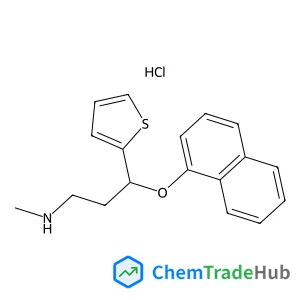
N-Methyl-3-(1-naphthyloxy)-3-(2-thienyl)-1-propanamine hydrochloride (1:1)
CAS Number:
1188266-11-6
Molecular Formula:
C18H20ClNOS
Wenyong Dong, Yongfeng Zhou, Deyue Yan, Huiqin Li, Yu Liu
This work has presented a typical example to reveal the great influence of the terminal groups on the self-assembly of hyperbranched polymers. The hyperbranched polymers with hydroxyl terminal groups (HBPO-OH) were hydrophobic and precipitated in water, however, they displayed a pH-responsive self-assembly behavior when the terminal groups were replaced by carboxyl groups. The obtained carboxyl-terminated hyperbranched polymers (HBPO-COOH) existed as unimolecular micelles at high pH (12.21) due to the ionization of carboxyl groups, while the polymers aggregated into multimolecular micelles from 10 to 500 nm with the decrease of pH as a result of the partial protonation of the carboxyl groups. The size of the obtained micelles depended strongly on the solution pH—the lower the pH, the bigger the micelles. TEM, DLS, ATR-FT-IR, 1H NMR and AFM measurements substantiated that the multimolecular micelles were formed by the secondary aggregation of unimolecular micelles driven by the hydrogen bonding interaction depending on the solution pH.
Prantik Mondal, Gourhari Jana, Tuhin Subhra Pal, Nikhil K. Singha
DOI: 10.1039/D1PY00910A
Fang Guo, Ming Deng, Fan Li, Shoulong Chen
DOI: 10.1039/D1PY00938A
Jens C. Markwart, Alexander Battig, Tobias Urbaniak, Katharina Haag, Katharina Koschek, Bernhard Schartel, Frederik R. Wurm
DOI: 10.1039/D0PY00275E
Huiying Wang, Qiang Chen, Zhen Geng, Jingyi Rao, Bijin Xiong, Frédéric Lortie, Julien Bernard, Wolfgang H. Binder, Senbin Chen, Jintao Zhu
DOI: 10.1039/D1PY01061A
Haosheng Pang, Yunjun Luo, Bing Zhang
DOI: 10.1039/D1PY00920F
Oliver B. Penrhyn-Lowe, Sean Flynn, Savannah R. Cassin, Samuel Mckeating, Sarah Lomas, Stephen Wright, Pierre Chambon, Steve P. Rannard
DOI: 10.1039/D1PY01103K
Alicja Balcerak, Dominika Kwiatkowska, Katarzyna Iwińska, Janina Kabatc
DOI: 10.1039/D0PY00763C
Matthias Rohmer, Özgün Ucak, Rahul Fredrick, Wolfgang H. Binder
DOI: 10.1039/D1PY01021B
Shengfei Wang, Sen Zhang, Chun Feng, Guolin Lu, Xiaoyu Huang
DOI: 10.1039/D1PY01016F
N-(4-Methoxybenzyl)-2-pyridinamine (CAS: 52818-63-0) is increasingly being used ...
When handling Ethyl 4-(2-chlorophenyl)-1,3-thiazole-2-carboxylate, appropriate p...
Diethyldiselane (CAS: 628-39-7) is classified under the Globally Harmonized Syst...
The market for oxocopper (CAS: 12053-18-8) is primarily driven by its use in cat...
The market for 5-{[(2-Methyl-2-propanyl)oxy]carbonyl}-5-azaspiro[2.4]heptane-7-c...
2-(1-Pyrrolidinyl)-4-pyridinamine is a chemical compound with the CAS number 359...
2-(3-Pyridinyl)-1-azabicyclo[2.2.2]octane (CAS: 91556-75-1) is a crystalline sol...
(S)-Alpha-allyl-proline hydrochloride is usually synthesized via a Wittig reacti...
3-Methyl-1,2-oxazole-5-carboxylic acid (CAS: 4857-42-5) is an organic compound w...
Lys-SMCC-DM1 is synthesized via a multi-step process involving the coupling of S...

Physical Chemistry Chemical Physics (PCCP) is an international journal co-owned by 19 physical chemistry and physics societies from around the world. This journal publishes original, cutting-edge research in physical chemistry, chemical physics and biophysical chemistry. To be suitable for publication in PCCP, articles must include significant innovation and/or insight into physical chemistry; this is the most important criterion that reviewers and Editors will judge against when evaluating submissions. The journal has a broad scope and welcomes contributions spanning experiment, theory, computation and data science. Topical coverage includes spectroscopy, dynamics, kinetics, statistical mechanics, thermodynamics, electrochemistry, catalysis, surface science, quantum mechanics, quantum computing and machine learning. Interdisciplinary research areas such as polymers and soft matter, materials, nanoscience, energy, surfaces/interfaces, and biophysical chemistry are welcomed if they demonstrate significant innovation and/or insight into physical chemistry. Joined experimental/theoretical studies are particularly appreciated when complementary and based on up-to-date approaches.
![N-{15-[(2,5-Dioxo-1-pyrrolidinyl)oxy]-15-oxo-3,6,9,12-tetraoxapentadec-1-yl}-2-(2-propyn-1-yloxy)acetamide structure](https://static.chemtradehub.com/structs/210/2101206-92-0-2eb5.webp "N-{15-[(2,5-Dioxo-1-pyrrolidinyl)oxy]-15-oxo-3,6,9,12-tetraoxapentadec-1-yl}-2-(2-propyn-1-yloxy)acetamide structure")
![N-{[(2-Methyl-2-propanyl)oxy]carbonyl}-L-methionylglycine structure](https://static.chemtradehub.com/structs/234/23446-03-9-e1e5.webp "N-{[(2-Methyl-2-propanyl)oxy]carbonyl}-L-methionylglycine structure")




