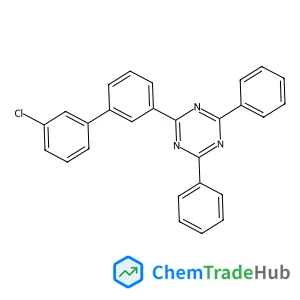
2-(3'-Chlorobiphenyl-3-yl)-4,6-diphenyl-1,3,5-triazine
CAS Number:
1443049-83-9
Molecular Formula:
C27H18ClN3
T. Rojas-Durán, I. Sánchez-Barragán, J. M. Costa-Fernández, A. Sanz-Medel
An innovative analytical methodology for the rapid identification of aflatoxin-producing moulds belonging to Aspergillus genus is presented here. The procedure is based on the measurement, using a fibre-optic luminometer, of the room temperature phosphorescence (RTP) emitted by aflatoxins produced by isolated aflatoxigenic strains, cultured in a special culture medium consisting of malt extract agar modified with β-cyclodextrin and sodium deoxycholate for RTP induction. Unequivocal detection of the presence of aflatoxins in the culture medium is achieved within the first 36 h of incubation at 32 °C, owing to the selectivity and sensitivity of the RTP emission, as compared with the minimum of 72 h needed using a conventional microbiological method. In a first step, the capability of aflatoxin standard solutions to emit analytically useful RTP was evaluated. In this line all experimental conditions were optimised for in vitro induction of RTP from aflatoxins. In a second step, a simple analytical test was developed and it has been evaluated for the rapid identification of aflatoxigenic strains, as a discriminating assay from non-aflatoxigenic strains based on the measurement of experimental RTP emission observed. Confirmation of aflatoxin production on the studied culture plates was accomplished by means of an HPLC/fluorescence reference method.
Rosa Becerra, J. Pat Cannady, Guy Dormer, Robin Walsh
DOI: 10.1039/B823109E
David Lesthaeghe, Veronique Van Speybroeck, Michel Waroquier
DOI: 10.1039/B902364J
Yue Zhang, George L. Barnes, Tianying Yan, William L. Hase
DOI: 10.1039/B923858C
Hongmei Jin, Valeri Ligatchev, Shuo-Wang Yang, Michael B. Sullivan, Yuanping Feng
DOI: 10.1039/B927272K
Pitamber Mahanandia, Jörg J. Schneider, Marina Khaneft, Bernd Stühn, Tiago P. Peixoto, Barbara Drossel
DOI: 10.1039/B922906J
Gérald Chaplais, Angélique Simon-Masseron, Claude Lecomte, Delphine Bazer-Bachi, Nicolas Bats, Joël Patarin
DOI: 10.1039/B822163D
James P. R. Day, Paul D. A. Pudney, Colin D. Bain
DOI: 10.1039/B921887D
DOI: 10.1039/B904614C
L. F. Vieira Ferreira, A. M. Botelho do Rego, E. Sikorska, M. Sikorski
DOI: 10.1039/B903013A
T. P. M. Goumans, C. Richard A. Catlow, Wendy A. Brown, Johannes Kästner, Paul Sherwood
DOI: 10.1039/B816905E
When handling 2-Chloro-1,2-bis(4-methylphenyl)ethanone (CAS: 71193-32-3), it is ...
4-Ethoxy-3-(5-methyl-4-oxo-7-propyl-1,4-dihydroimidazo[5,1-f][1,2,4]triazin-2-yl...
Methyl 3-Oxo-4-Androsten-17-Carboxylate (CAS: 2681-55-2) should be stored in a c...
(R)-3-Amino-4-(3-hexylphenylamino)-4-oxobutylphosphonic acid is primarily used i...
2-Methyl-2-propanyl 3-amino-3-carbamoyl-1-azetidinecarboxylate (CAS: 1254120-14-...
There are alternative reagents that can be used in synthesis instead of (E)-4-(t...
[2-(3-Chlorophenyl)-1,3-thiazol-4-yl]methanol (CAS: 121202-20-8) is a crystallin...
The market and research trends for Methyl (2S)-[(4S)-2,2-dimethyl-1,3-dioxolan-4...
The market for 1-Bromo-2-isocyanatoethane (CAS: 42865-19-0) is driven by its use...
4-Nitro-D-phenylalanine hydrochloride (CAS: 147065-06-3) is primarily used in re...

Analyst publishes analytical and bioanalytical research that reports premier fundamental discoveries and inventions, and the applications of those discoveries, unconfined by traditional discipline barriers.