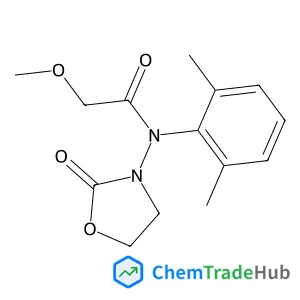
N-(2,6-Dimethylphenyl)-2-methoxy-N-(2-oxo-1,3-oxazolidin-3-yl)acetamide
CAS Number:
77732-09-3
Molecular Formula:
C14H18N2O4
Yue Zhang, George L. Barnes, Tianying Yan, William L. Hase
Model non-equilibrium molecular dynamics (MD) simulations are presented of heat transfer from a hot Au {111} substrate to an alkylthiolate self-assembled monolayer (H-SAM) to assist in obtaining an atomic-level understanding of experiments by Wang et al. (Z. Wang, J. A. Carter, A. Lagutchev, Y. K. Koh, N.-H. Seong, D. G. Cahill, and D. D. Dlott, Science, 2007, 317, 787). Different models are considered to determine how they affect the heat transfer dynamics. They include temperature equilibrated (TE) and temperature gradient (TG) thermostat models for the Au(s) surface, and soft and stiff S/Au(s) models for bonding of the S-atoms to the Au(s) surface. A detailed analysis of the non-equilibrium heat transfer at the heterogeneous interface is presented. There is a short time temperature gradient within the top layers of the Au(s) surface. The S-atoms heat rapidly, much faster than do the C-atoms in the alkylthiolate chains. A high thermal conductivity in the H-SAM, perpendicular to the interface, results in nearly identical temperatures for the CH2 and CH3 groups versus time. Thermal-induced disorder is analyzed for the Au(s) substrate, the S/Au(s) interface and the H-SAM. Before heat transfer occurs from the hot Au(s) substrate to the H-SAM, there is disorder at the S/Au(s) interface and within the alkylthiolate chains arising from heat-induced disorder near the surface of hot Au(s). The short-time rapid heating of the S-atoms enhances this disorder. The increasing disorder of H-SAM chains with time results from both disorder at the Au/S interface and heat transfer to the H-SAM chains.

Acta Materialia

Russian Journal of Coordination Chemistry

Current Opinion in Solid State & Materials Science

Journal of Saudi Chemical Society

Current Opinion in Colloid & Interface Science

Russian Journal of Organic Chemistry

Russian Journal of Applied Chemistry

Russian Chemical Bulletin

Chemistry Education Research and Practice

Organic Process Research & Development
Isao Kagomiya, Keigo Jimbo, Ken-ichi Kakimoto, Masanobu Nakayama, Olivier Masson
DOI: 10.1039/C4CP00736K
Frederico Alabarse, Claire Levelut, Aude Isambert, Philippe Hébert, Shinji Kohara, David Maurin, Jean-Louis Bantignies, Olivier Cambon, Gaëlle Creff, Pascale Roy, Jean-Blaise Brubach, Tahar Hammouda, Denis Andrault, Julien Haines
DOI: 10.1039/C4CP00186A
Nourdine Zibouche, Pier Philipsen, Thomas Heine, Agnieszka Kuc
DOI: 10.1039/C4CP00966E
Yasuhiro Shiraishi, Kohei Yamamoto, Shigehiro Sumiya, Takayuki Hirai
DOI: 10.1039/C3CP55478C
Yan Gao, Linlin Zhang, Xin Ding
DOI: 10.1039/C3CP55204G
Bryan T. Spann, S. Venkataprasad Bhat, Qiong Nian, Kelly M. Rickey, Gary J. Cheng, Xiulin Ruan, Xianfan Xu
DOI: 10.1039/C4CP01298D
Cheng Li, Dan Credgington, Doo-Hyun Ko, Zhuxia Rong, Jianpu Wang, Neil C. Greenham
DOI: 10.1039/C4CP01251H
Julien Guthmuller
DOI: 10.1039/C4CP00562G
Zhansheng Lu, Dongwei Ma, Lin Yang, Xiaobing Wang, Guoliang Xu, Zongxian Yang
DOI: 10.1039/C4CP00540F
When handling 2-Chloro-1,2-bis(4-methylphenyl)ethanone (CAS: 71193-32-3), it is ...
4-Ethoxy-3-(5-methyl-4-oxo-7-propyl-1,4-dihydroimidazo[5,1-f][1,2,4]triazin-2-yl...
Methyl 3-Oxo-4-Androsten-17-Carboxylate (CAS: 2681-55-2) should be stored in a c...
(R)-3-Amino-4-(3-hexylphenylamino)-4-oxobutylphosphonic acid is primarily used i...
2-Methyl-2-propanyl 3-amino-3-carbamoyl-1-azetidinecarboxylate (CAS: 1254120-14-...
There are alternative reagents that can be used in synthesis instead of (E)-4-(t...
[2-(3-Chlorophenyl)-1,3-thiazol-4-yl]methanol (CAS: 121202-20-8) is a crystallin...
The market and research trends for Methyl (2S)-[(4S)-2,2-dimethyl-1,3-dioxolan-4...
The market for 1-Bromo-2-isocyanatoethane (CAS: 42865-19-0) is driven by its use...
4-Nitro-D-phenylalanine hydrochloride (CAS: 147065-06-3) is primarily used in re...

Physical Chemistry Chemical Physics (PCCP) is an international journal co-owned by 19 physical chemistry and physics societies from around the world. This journal publishes original, cutting-edge research in physical chemistry, chemical physics and biophysical chemistry. To be suitable for publication in PCCP, articles must include significant innovation and/or insight into physical chemistry; this is the most important criterion that reviewers and Editors will judge against when evaluating submissions. The journal has a broad scope and welcomes contributions spanning experiment, theory, computation and data science. Topical coverage includes spectroscopy, dynamics, kinetics, statistical mechanics, thermodynamics, electrochemistry, catalysis, surface science, quantum mechanics, quantum computing and machine learning. Interdisciplinary research areas such as polymers and soft matter, materials, nanoscience, energy, surfaces/interfaces, and biophysical chemistry are welcomed if they demonstrate significant innovation and/or insight into physical chemistry. Joined experimental/theoretical studies are particularly appreciated when complementary and based on up-to-date approaches.