













Oxidization states of metal atoms in linear bimetallic multi-sandwich molecules Vn(FeCp2)(n+1) and magnetic moment enhancement mechanism of its 1D wire
Literature Information
Publication Date
2010-03-15
DOI
10.1039/B927272K
Impact Factor
3.676
Authors
Hongmei Jin, Valeri Ligatchev, Shuo-Wang Yang, Michael B. Sullivan, Yuanping Feng
View Original
Abstract
Using density functional theory calculations, we demonstrate that one-dimensional bimetallic molecular ferromagnets (FeCpMCp)∞ (M = Sc, Ti, V, Cr and Mn, Cp = cyclopentadienyl) exhibit significant enhancement in local and global atomic magnetic moments as well as relatively large spin-polarization energy as compared to their monometallic counterparts. These yield an unusual charge configuration for one of the wires: (Fe0Cp−1V+2Cp−1)∞. Hückel's rule and double-exchange interaction model are used to illustrate the details of local charge transfer and long-range ferromagnetic order. We then propose a growth mechanism for Vn(FeCp2)(n+1) (n = 1–4) clusters, which is supported unambiguously with time-of-flight mass spectroscopy data.
Related Literature
Rapid cloning and expression of a fungal polyketide synthase gene involved in squalestatin biosynthesis
Russell J. Cox, Frank Glod, Deirdre Hurley, Colin M. Lazarus, Thomas. P. Nicholson, Brian A. M. Rudd, Thomas J. Simpson, Barrie Wilkinson, Ying Zhang
2004-09-24
Communication
DOI: 10.1039/B411973H
The first tandem double palladium-catalyzed aminations: synthesis of dipyrido[1,2-a∶3′,2′-d]imidazole and its benzo- and aza-analogues
Kristof T. J. Loones, Bert U. W. Maes, Roger A. Dommisse, Guy L. F. Lemière
2004-09-20
Communication
DOI: 10.1039/B409161B
Direct synthesis of hydrogen peroxide solution with palladium-loaded sulfonic acid polystyrene resins
Gema Blanco-Brieva, Encarnación Cano-Serrano, Jose M. Campos-Martin, Jose L. G. Fierro
2004-04-22
Communication
DOI: 10.1039/B402530J
Large scale, templateless, surfactantless route to rapid synthesis of uniform poly(o-phenylenediamine) nanobelts
Xuping Sun, Shaojun Dong, Erkang Wang
2004-04-23
Communication
DOI: 10.1039/B401777C
First cation radical salt of a tetrathiafulvalene–based phosphine metal complex
Narcis Avarvari, Marc Fourmigué
2004-05-05
Communication
DOI: 10.1039/B403168G
Y-shaped two-photon absorbing molecules with an imidazole–thiazole core
Ke Feng, Leonardo De Boni, Lino Misoguti, C. R. Mendonça, Michael Meador, Fu-Lian Hsu, Xiu R. Bu
2004-04-21
Communication
DOI: 10.1039/B402019G
Synthesis and study of a new diamidodipyrromethane macrocycle. An anion receptor with a high sulfate-to-nitrate binding selectivity
Jonathan L. Sessler, G. Dan Pantos, Yuri A. Ustynyuk
2004-05-03
Communication
DOI: 10.1039/B403665D
Solid-state caging of 1,10-phenanthroline π–π stacked dimers by calix[4]arene dihydroxyphosphonic acid
Adina N. Lazar, Alda Navaza, Anthony W. Coleman
2004-03-30
Communication
DOI: 10.1039/B315600C
First example of the chemical, oxidative cleavage of the C–P bond in aminophosphonate chemistry. The oxidation of 1-amino-1-(3,4-dihydroxyphenyl)methylphosphonic acid by NaIO4
Marcin Drąg, Adam Jezierski, Pawel Kafarski
2004-04-08
Communication
DOI: 10.1039/B401633E
NH4[BPO4F]: A novel open-framework ammonium fluorinated borophosphate with a zeolite-like structure related to gismondine topology
Man-Rong Li, Wei Liu, Ming-Hui Ge, Hao-Hong Chen, Xin-Xin Yang, Jing-Tai Zhao
2004-04-29
Communication
DOI: 10.1039/B402966F
You might also like
Compound Q&A
What precautions should be taken when handling 2-Chloro-1,2-bis(4-methylphenyl)ethanone (CAS: 71193-32-3)?
When handling 2-Chloro-1,2-bis(4-methylphenyl)ethanone (CAS: 71193-32-3), it is ...
71193-32-32-Chloro-1,2-bis(4-m...
Compound Q&A
What industries use 4-Ethoxy-3-(5-methyl-4-oxo-7-propyl-1,4-dihydroimidazo[5,1-f][1,2,4]triazin-2-yl)benzenesulfonyl chloride (CAS: 224789-26-8)?
4-Ethoxy-3-(5-methyl-4-oxo-7-propyl-1,4-dihydroimidazo[5,1-f][1,2,4]triazin-2-yl...
224789-26-84-Ethoxy-3-(5-methyl...
Compound Q&A
How should Methyl 3-Oxo-4-Androsten-17-Carboxylate (CAS: 2681-55-2) be stored?
Methyl 3-Oxo-4-Androsten-17-Carboxylate (CAS: 2681-55-2) should be stored in a c...
2681-55-2Methyl 3-Oxo-4-Andro...
Compound Q&A
What are the main uses of (R)-3-Amino-4-(3-hexylphenylamino)-4-oxobutylphosphonic acid (CAS: 909725-61-7)?
(R)-3-Amino-4-(3-hexylphenylamino)-4-oxobutylphosphonic acid is primarily used i...
909725-61-7(R)-3-Amino-4-(3-hex...
Compound Q&A
What regulatory guidelines apply to 2-Methyl-2-propanyl 3-amino-3-carbamoyl-1-azetidinecarboxylate (CAS: 1254120-14-3)?
2-Methyl-2-propanyl 3-amino-3-carbamoyl-1-azetidinecarboxylate (CAS: 1254120-14-...
1254120-14-32-Methyl-2-propanyl ...
Compound Q&A
Are there alternatives to (E)-4-(tert-Butoxy)-4-oxobut-2-enoic acid (CAS: 135355-96-3) in synthesis?
There are alternative reagents that can be used in synthesis instead of (E)-4-(t...
135355-96-3(E)-4-(tert-Butoxy)-...
Compound Q&A
What are the physical and chemical properties of [2-(3-Chlorophenyl)-1,3-thiazol-4-yl]methanol (CAS: 121202-20-8)?
[2-(3-Chlorophenyl)-1,3-thiazol-4-yl]methanol (CAS: 121202-20-8) is a crystallin...
121202-20-8[2-(3-Chlorophenyl)-...
Compound Q&A
What is the market or research trend for Methyl (2S)-[(4S)-2,2-dimethyl-1,3-dioxolan-4-yl]{[(4-methylphenyl)sulfonyl]oxy}acetate (CAS: 166249-17-8)?
The market and research trends for Methyl (2S)-[(4S)-2,2-dimethyl-1,3-dioxolan-4...
166249-17-8Methyl (2S)-[(4S)-2,...
Compound Q&A
What is the market or research trend for 1-Bromo-2-isocyanatoethane (CAS: 42865-19-0)?
The market for 1-Bromo-2-isocyanatoethane (CAS: 42865-19-0) is driven by its use...
42865-19-01-Bromo-2-isocyanato...
Compound Q&A
What are the main uses of 4-Nitro-D-phenylalanine hydrochloride (CAS: 147065-06-3)?
4-Nitro-D-phenylalanine hydrochloride (CAS: 147065-06-3) is primarily used in re...
147065-06-34-Nitro-D-phenylalan...
Source Journal
Physical Chemistry Chemical Physics

CiteScore:
5.5
Self-citation Rate:
10.3%
Articles per Year:
3036
Physical Chemistry Chemical Physics (PCCP) is an international journal co-owned by 19 physical chemistry and physics societies from around the world. This journal publishes original, cutting-edge research in physical chemistry, chemical physics and biophysical chemistry. To be suitable for publication in PCCP, articles must include significant innovation and/or insight into physical chemistry; this is the most important criterion that reviewers and Editors will judge against when evaluating submissions. The journal has a broad scope and welcomes contributions spanning experiment, theory, computation and data science. Topical coverage includes spectroscopy, dynamics, kinetics, statistical mechanics, thermodynamics, electrochemistry, catalysis, surface science, quantum mechanics, quantum computing and machine learning. Interdisciplinary research areas such as polymers and soft matter, materials, nanoscience, energy, surfaces/interfaces, and biophysical chemistry are welcomed if they demonstrate significant innovation and/or insight into physical chemistry. Joined experimental/theoretical studies are particularly appreciated when complementary and based on up-to-date approaches.
Recommended Compounds


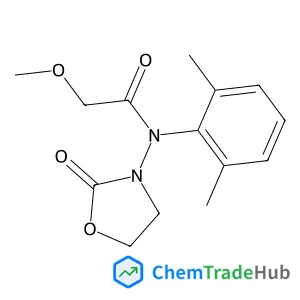
N-(2,6-Dimethylphenyl)-2-methoxy-N-(2-oxo-1,3-oxazolidin-3-yl)acetamide
CAS Number:
77732-09-3
Molecular Formula:
C14H18N2O4
Recommended Suppliers





Disclaimer
This page provides academic journal information for reference and research purposes only. We are not affiliated with any journal publishers and do not handle publication submissions. For publication-related inquiries, please contact the respective journal publishers directly.
If you notice any inaccuracies in the information displayed, please contact us at support@chemtradehub.com. We will promptly review and address your concerns.