












Back matter
Literature Information
Publication Date
DOI
10.1039/B607343N
Impact Factor
6.222
Authors
View Original
Abstract
The first page of this article is displayed as the abstract.
Recommended Journals
Related Literature
Metal-directed ring-expansion in Schiff-base polypyrrolic macrocycles
Gonzalo Givaja, Alexander J. Blake, Claire Wilson, Martin Schröder, Jason B. Love
2005-07-29
Communication
DOI: 10.1039/B507729J
Synthesis and crystal structure of [tBu3SiPAg2]8: A novel Ag16-cluster featuring a remarkable symmetrical structure
Hans-Wolfram Lerner, Günter Margraf, Jan W. Bats, Matthias Wagner
2005-08-11
Communication
DOI: 10.1039/B507833D
A novel and facile Zn-mediated intramolecular five-membered cyclization of β-tetraarylporphyrin radicals from β-bromotetraarylporphyrins
Dong-Mei Shen, Chao Liu, Qing-Yun Chen
2005-09-09
Communication
DOI: 10.1039/B509972B
Protein solubilising and stabilising ionic liquids
Kyoko Fujita, Douglas R. MacFarlane, Maria Forsyth
2005-09-07
Communication
DOI: 10.1039/B508238B
Organometallic chemistry, biology and medicine: ruthenium arene anticancer complexes
2005-08-26
Feature Article
DOI: 10.1039/B508531B
Synthesis of bis(bora)calix[4]arenes bearing perfluoroaryl substituents
Carl Redshaw, Mark R. J. Elsegood
2005-09-07
Communication
DOI: 10.1039/B509556E
Efficient nickel catalyst for coupling of acetonitrile with aldehydes
Lei Fan, Oleg. V. Ozerov
2005-08-08
Communication
DOI: 10.1039/B505778G
The depth of molecular recognition: voltage-sensitive blockage of synthetic multifunctional pores with refined architecture
Yoann Baudry, Masamichi Nishihara, Naomi Sakai, Stefan Matile
2005-09-05
Communication
DOI: 10.1039/B509610C
One step synthesis of highly crystalline and high coercive cobalt-ferrite nanocrystals
Sanjib Bhattacharyya, Jean-Paul Salvetat, Romain Fleurier, Anke Husmann, Thomas Cacciaguerra, Marie-Louise Saboungi
2005-09-01
Communication
DOI: 10.1039/B509026A
You might also like
Compound Q&A
Is 6-(3-Fluorophenyl)picolinic acid (CAS: 887982-40-3) safe?
6-(3-Fluorophenyl)picolinic acid is generally considered safe for laboratory use...
887982-40-36-(3-Fluorophenyl)pi...
Compound Q&A
What industries use (3R)-3-Pyrrolidinol (CAS: 2799-21-5)?
(3R)-3-Pyrrolidinol is used in the pharmaceutical industry as a precursor for dr...
2799-21-5(3R)-3-Pyrrolidinol
Compound Q&A
What precautions should be taken when handling (4R,5R)-4,5-Diethoxycarbonyl-2,2-dimethyldioxolane (CAS: 59779-75-8)?
When handling (4R,5R)-4,5-Diethoxycarbonyl-2,2-dimethyldioxolane (CAS: 59779-75-...
59779-75-8(4R,5R)-4,5-Diethoxy...
Compound Q&A
How is 1-(6-Chloroimidazo[1,2-b]pyridazin-3-yl)ethanone (CAS: 90734-71-7) typically synthesized?
1-(6-Chloroimidazo[1,2-b]pyridazin-3-yl)ethanone is often synthesized via a mult...
90734-71-71-(6-Chloroimidazo[1...
Compound Q&A
What is the market or research trend for N-Ethyl-3,4-dimethylbenzylamine (CAS: 39180-83-1)?
The market for N-Ethyl-3,4-dimethylbenzylamine (CAS: 39180-83-1) remains steady,...
39180-83-1N-Ethyl-3,4-dimethyl...
Compound Q&A
What is Tert-butyl 3-(pyrrolidin-1-yl)azetidine-1-carboxylate (CAS: 1019008-21-9)?
Tert-butyl 3-(pyrrolidin-1-yl)azetidine-1-carboxylate is a chemical compound wit...
1019008-21-9Tert-butyl 3-(pyrrol...
Compound Q&A
What regulatory guidelines apply to 1-Bromo-3-chloro-2,4-dimethoxybenzene (CAS: 1228956-93-1)?
1-Bromo-3-chloro-2,4-dimethoxybenzene (CAS: 1228956-93-1) falls under the classi...
1228956-93-11-Bromo-3-chloro-2,4...
Compound Q&A
Is 8-Bromo-2-methyl-3,4-dihydroisoquinolin-1(2H)-one (CAS: 1368622-07-4) safe?
The safety of 8-Bromo-2-methyl-3,4-dihydroisoquinolin-1(2H)-one (CAS: 1368622-07...
1368622-07-48-Bromo-2-methyl-3,4...
Compound Q&A
Is Benzyl [(3S)-2,6-dioxo-3-piperidinyl]carbamate (CAS: 22785-43-9) safe?
Benzyl [(3S)-2,6-dioxo-3-piperidinyl]carbamate is generally safe when handled wi...
22785-43-9Benzyl [(3S)-2,6-dio...
Compound Q&A
How should 1-{[4-(4,4,5,5-Tetramethyl-1,3,2-dioxaborolan-2-yl)phenyl]sulfonyl}pyrrolidine (CAS: 928657-21-0) be stored?
1-{[4-(4,4,5,5-Tetramethyl-1,3,2-dioxaborolan-2-yl)phenyl]sulfonyl}pyrrolidine s...
928657-21-01-{[4-(4,4,5,5-Tetra...
Source Journal
Chemical Communications

CiteScore:
8.6
Self-citation Rate:
4.7%
Articles per Year:
2458
ChemComm publishes urgent research which is of outstanding significance and interest to experts in the field, while also appealing to the journal’s broad chemistry readership. Our communication format is ideally suited to short, urgent studies that are of such importance that they require accelerated publication. Our scope covers all topics in chemistry, and research at the interface of chemistry and other disciplines (such as materials science, nanoscience, physics, engineering and biology) where there is a significant novelty in the chemistry aspects. Major topic areas covered include: Analytical Chemistry Catalysis Chemical Biology and medicinal chemistry Computational Chemistry and Machine Learning Energy and sustainable chemistry Environmental Chemistry Green Chemistry Inorganic Chemistry Materials Chemistry Nanoscience Organic Chemistry Physical Chemistry Polymer Chemistry Supramolecular Chemistry
Recommended Compounds
![4-[(2,4-Dihydroxyphenyl)diazenyl]-5-hydroxy-2,7-naphthalenedisulfonic acid structure](https://static.chemtradehub.com/structs/362/3627-01-8-79ac.webp "4-[(2,4-Dihydroxyphenyl)diazenyl]-5-hydroxy-2,7-naphthalenedisulfonic acid structure")
4-[(2,4-Dihydroxyphenyl)diazenyl]-5-hydroxy-2,7-naphthalenedisulfonic acid
CAS Number:
3627-01-8
Molecular Formula:
C16H12N2O9S2
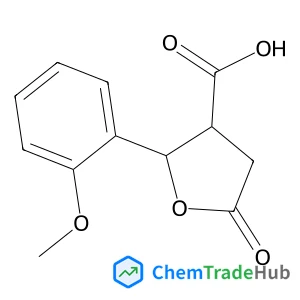
trans-2-(2-Methoxyphenyl)-5-oxotetrahydrofuran-3-carboxylic acid
CAS Number:
99226-02-5
Molecular Formula:
C12H12O5
Recommended Suppliers





Disclaimer
This page provides academic journal information for reference and research purposes only. We are not affiliated with any journal publishers and do not handle publication submissions. For publication-related inquiries, please contact the respective journal publishers directly.
If you notice any inaccuracies in the information displayed, please contact us at support@chemtradehub.com. We will promptly review and address your concerns.