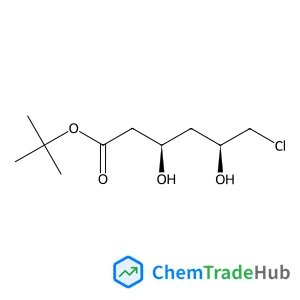
2-Methyl-2-propanyl (3R,5S)-6-chloro-3,5-dihydroxyhexanoate
CAS Number:
154026-93-4
Molecular Formula:
C10H19ClO4
Yoann Baudry, Masamichi Nishihara, Naomi Sakai, Stefan Matile
Voltage-sensitive blockage by ADP, ATP and phytate (IP6) demonstrates that active-site contraction toward the middle of newly synthesized rigid-rod β-barrels provides a general strategy to rationally create and modulate the voltage sensitivity (and to increase the efficiency) of molecular recognition by synthetic multifunctional pores.
Mengchao Hou, Fang Li, Aizhong Jia, Yingying Wang, Yanji Wang
DOI: 10.1039/D2RE00016D
Jianguo Liu, Xinghua Zhang, Lungang Chen, Longlong Ma, Qi Zhang
DOI: 10.1039/D2RE00180B
DOI: 10.1039/D2RE00044J
Markus Schörner, Stefanie Kämmerle, Dorothea Wisser, Benjamin Baier, Martin Hartmann, Matthias Thommes, Marco Haumann
DOI: 10.1039/D2RE00143H
Chaoqiang Wu, Chengyong Wang, Kequan Chen, Fei Cao, Pingkai Ouyang
DOI: 10.1039/D2RE00118G
DOI: 10.1039/D2RE00228K
Danim Yun, Zhongyao Zhang, David W. Flaherty
DOI: 10.1039/D2RE00160H
Ian Clegg, Anna Codina
DOI: 10.1039/D2RE00123C
Vaibhav Pandey, Kamal K. Pant, Sreedevi Upadhyayula
DOI: 10.1039/D2RE00427E
Chris Barnes, Manoj Nair, Eric O. Aboagye
DOI: 10.1039/D2RE00219A
Waste containing 2-Ethyl-4-Methyl-1H-Imidazole-5-Carbaldehyde (CAS: 88634-80-4) ...
Triethoxy(octyl)silane (CAS: 1385031-14-0) is widely used in the pharmaceuticals...
Several alternatives to 3-iodo-7-nitro-1H-indazole (CAS: 864724-64-1) exist in t...
Yes, there are alternatives to Benzene, bis[(trimethoxysilyl)ethyl] (CAS: 266317...
Isothiazole-3-carbonitrile (CAS: 1452-17-1) is generally considered safe when us...
(3-Chlorophenyl)methanol (CAS: 873-63-2) is considered low to moderately toxic. ...
(2S,3S)-2-Hydroxy-3-({[(2-methyl-2-propanyl)oxy]carbonyl}amino)-3-(2-naphthyl)pr...
Proper handling of methyl 2-(bromomethyl)-5-methoxybenzoate requires the use of ...
6,8-Dibromoimidazo[1,2-a]pyridine-2-carboxylic acid (CAS: 904805-36-3) is an aro...
3-Amino-5-bromo-2-pyridinecarbonitrile is considered safe when handled under pro...

ChemComm publishes urgent research which is of outstanding significance and interest to experts in the field, while also appealing to the journal’s broad chemistry readership. Our communication format is ideally suited to short, urgent studies that are of such importance that they require accelerated publication. Our scope covers all topics in chemistry, and research at the interface of chemistry and other disciplines (such as materials science, nanoscience, physics, engineering and biology) where there is a significant novelty in the chemistry aspects. Major topic areas covered include: Analytical Chemistry Catalysis Chemical Biology and medicinal chemistry Computational Chemistry and Machine Learning Energy and sustainable chemistry Environmental Chemistry Green Chemistry Inorganic Chemistry Materials Chemistry Nanoscience Organic Chemistry Physical Chemistry Polymer Chemistry Supramolecular Chemistry
![N-[(9H-Fluoren-9-ylmethoxy)carbonyl]-beta-phenyl-L-phenylalanine structure](https://static.chemtradehub.com/structs/201/201484-50-6-c2fc.webp "N-[(9H-Fluoren-9-ylmethoxy)carbonyl]-beta-phenyl-L-phenylalanine structure")