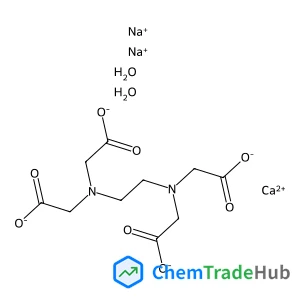
EthylenediaminetetraaceticacidcalciumDisodiumsalthydrate
CAS Number:
23411-34-9
Molecular Formula:
C10H16CaN2Na2O10
Yuki Kametani, Makoto Ouchi
In this article, we report an unusual reactivity of saccharin-pendant methacrylamide (1) in radical copolymerization. The bulky vinylidene molecule showed no homopolymerization ability under general radical polymerization conditions likely due to the bulky pendant for the inherently low reactivity monomer of N,N-disubstituted methacrylamide. However, in the presence of styrene, it was smoothly consumed at the same rate as styrene. Given the near-zero monomer reactivity ratios of the pair [r1 = 0.040 and r2 = 0.045 for 1 (M1) and styrene (M2)], it was assumed that the comonomer pair afforded alternating copolymerization. The copolymerization was very specific to the combination since copolymerizations of 1 with other conjugated monomers such as methacrylate and acrylate did not progress. The peculiar copolymerization reactivity of 1 was supported by DFT calculations. The side chains of 1 in the alternating copolymer were converted into methyl ester via hydrolysis and methylation, and thus an alternating copolymer of methyl methacrylate and styrene was obtained, and the alternating sequence was characterized by 1H and 13C NMR.
Junmei Zhang, Jennifer S. Brodbelt
DOI: 10.1039/B412577K
Nataliya Afonina, Lokesh Bhattacharyya, John P. Hennessey, Jr.
DOI: 10.1039/B404899G
Tomohiro Higashi, Hiroshi Nishiyama, Yuriy Pihosh, Kaisei Wakishima, Yudai Kawase, Yutaka Sasaki, Kenji Yoshino, Kazuhiro Takanabe
DOI: 10.1039/D3CP02563B
Eugenia Soboleva, Karam Ahad, Árpád Ambrus
DOI: 10.1039/B405024J
Su-Na Pang, Feng Wang, Ya-Ting Sun, Fei Mao, Cong-Zhang Gao
DOI: 10.1039/D3CP01506H
DOI: 10.1039/B407726A
R. Geßner, P. Rösch, R. Petry, M. Schmitt, M. A. Strehle, W. Kiefer, J. Popp
DOI: 10.1039/B411690A
Ernst Schmeisser, Walter Goessler, Norbert Kienzl, Kevin A. Francesconi
DOI: 10.1039/B502445E
Feng Wu, Hongju Li, Mingku Feng
DOI: 10.1039/D3CP90160B
1H-Indazole-6-carbonitrile finds applications in pharmaceuticals, where it serve...
Waste containing Dioctyl (2E)-2-butenedioate (CAS: 2997-85-5) should be collecte...
Sodium [(1,2-benzoxazol-3-ylmethyl)sulfonyl]azanide is primarily used in pharmac...
Dimethyl 4-(4,4,5,5-tetramethyl-1,3,2-dioxaborolan-2-yl)-2,6-pyridinedicarboxyla...
Waste containing 2-Fluoro-6-hydrazinopyridine (CAS: 80714-39-2) should be manage...
6-Formyl-2-pyridinecarboxylic acid is an organic compound with the molecular for...
Research trends for this compound indicate a focus on its potential applications...
9H-Tribenzo[b,d,f]azepine is typically synthesized via a multi-step process invo...
1-Cyclopropyl-7-ethoxy-6-fluoro-8-methoxy-4-oxo-1,4-dihydro-3-quinolinecarboxyli...
Waste containing Methyl 3-oxo-1,2,3,4-tetrahydro-6-quinoxalinecarboxylate (CAS: ...

Polymer Chemistry welcomes submissions in all areas of polymer science that have a strong focus on macromolecular chemistry. Manuscripts may cover a broad range of fields, yet no direct application focus is required.