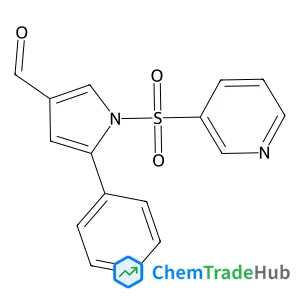
5-Phenyl-1-(pyridin-3-ylsulfonyl)-1H-pyrrole-3-carbaldehyde
CAS Number:
881676-90-0
Molecular Formula:
C16H12N2O3S
David Curiel, Miriam Más-Montoya, Guzmán Sánchez, Raúl A. Orenes, Pedro Molina, Alberto Tárraga
A novel carbazolocarbazole system has been evaluated as an anion receptor in DMF solution. A good affinity has been detected for oxoanions. The anion binding studies have been contrasted by different experimental techniques.

European Journal of Wood and Wood Products

Kinetics and Catalysis

Pharmacological Reviews

Proceedings of the National Academy of Sciences of the United States of America

Molecular Pharmacology

Pure and Applied Chemistry

Journal of Catalysis

Journal of Physics and Chemistry of Solids

Organic Preparations and Procedures International

Planta Medica
Junxiang Jiang, Yuanhao Tang, Lin Dong, Wenhao Zhang, Haobin Wu
DOI: 10.1039/D0SE00381F
Chandrasekaran Nithya, Gowtham Thiyagaraj
DOI: 10.1039/D0SE00469C
DOI: 10.1039/AN8992400202
Shuai Ru, Xia Wang, Guoqing Ma, Junyu Tan, Haihong Xiao, Zhaoquan Ai
DOI: 10.1039/D0SE00517G
Malik Muhammad Umair, Yuang Zhang, Shufen Zhang, Xin Jin
DOI: 10.1039/D0SE00368A
Ping Zhou, Bo Liu, Mingming Luan, Na Li, Bo Tang
DOI: 10.1039/D1BM00619C
Yupeng Wang, Zhijian Luo, Dongfang Zhou, Xuefeng Wang
DOI: 10.1039/D1BM00087J
(1R,3S)-1,3-Cyclopentanediol finds applications in various industries. In the ph...
When handling N'-[4-(Dimethylamino)phenyl]-N,N-dimethyl-1,4-benzenediamine, it i...
There are several alternatives to 5-(2,4-Difluorophenyl)-2-methoxypyrimidine in ...
1-(3-Methoxyphenoxy)propan-2-ol (CAS: 382141-68-6) must comply with the Globally...
Tetrodotoxin Citrate is extremely dangerous and should be handled with extreme c...
2-Methyl-2-propanyl [(1R,3S)-3-hydroxycyclopentyl]carbamate (CAS: 225641-84-9) i...
Waste containing 4-(2-Hydroxyhexafluoroisopropyl)Benzoic Acid (CAS: 16261-80-6) ...
2-Methyl-2-proanyl {(2S)-1-[(benzyloxy)amino]-3-hydroxy-3-methyl-1-oxo-2-butanyl...
Benzeneethanamine, α-ethyl-, hydrochloride (1:1) is an organic compound with the...
In the synthesis of compounds similar to 3-{(E)-[4-(Dimethylamino)phenyl]diazeny...

Organic & Biomolecular Chemistry (OBC) publishes original and high impact research and reviews in organic chemistry. We welcome research that shows new or significantly improved protocols or methodologies in total synthesis, synthetic methodology or physical and theoretical organic chemistry as well as research that shows a significant advance in the organic chemistry or molecular design aspects of chemical biology, catalysis, supramolecular and macromolecular chemistry, theoretical chemistry, mechanism-oriented physical organic chemistry, medicinal chemistry or natural products. Articles published in the journal should report new work which makes a highly-significant impact in the field. Routine and incremental work is generally not suitable for publication in the journal. More details about key areas of our scope are below. In all cases authors should include in their article clear rationale for why their research has been carried out.
![6-Bromo-2,3-dihydro-1H-pyrido[2,3-b][1,4]oxazine structure](https://static.chemtradehub.com/structs/120/1203499-17-5-b4d1.webp "6-Bromo-2,3-dihydro-1H-pyrido[2,3-b][1,4]oxazine structure")
![(2S)-2-{[(9H-Fluoren-9-ylmethoxy)carbonyl]amino}-4-(methylselanyl)butanoic acid structure](https://static.chemtradehub.com/structs/121/1217852-49-7-f252.webp "(2S)-2-{[(9H-Fluoren-9-ylmethoxy)carbonyl]amino}-4-(methylselanyl)butanoic acid structure")