


REMPI-TOF studies of the translational anisotropy and the polarization of the O (1D2) photofragment angular momentum following ozone photolysis at 298 nm
Literature Information
Publication Date
2006-03-15
DOI
10.1039/B517523B
Impact Factor
3.676
Authors
W. Denzer, S. J. Horrocks, P. J. Pearson, G. A. D. Ritchie
View Original
Abstract
The translational anisotropy and the polarization of the electronic angular momentum of the O (1D2) fragment produced from the 298 nm photodissociation of ozone have been determined using resonance enhanced multiphoton ionization (REMPI) in conjunction with time-of-flight mass spectrometry (TOFMS). The translational anisotropy parameter β, which is necessarily averaged over the O2 co-fragment rotational distribution, is measured to be 1.08 ± 0.04. This is consistent with that expected for the 1B2 ← 1A1 transition within an impulsive model if the tangential velocity associated with the zero point motion of the bend is constricted to opening the bond angle. Molecular frame polarization parameters of rank up to k = 4 have been extracted for the O (1D2) fragment and the calculated mJ populations show a strong preference for the |mJ| = 1 states. A small coherence term is also observed, a manifestation of the nuclear geometry of the dissociating molecule and the existence of possible non-adiabatic processes in the exit channel. The orientation associated with the mapping of the photon helicity onto the O (1D2) electronic angular momentum distribution was observed to have been quenched. However, the parameter γ1′, which describes the contribution to the orientation from a coherent superposition of a parallel and perpendicular excitation where the photofragment angular momentum lies perpendicular to both the recoil velocity and to the transition dipole moment, was determined to be −0.06.
Recommended Journals

Helvetica Chimica Acta

Organic Preparations and Procedures International

Israel Journal of Chemistry

Pharmacological Reviews

Pure and Applied Chemistry

Planta Medica

Science Progress

Science

Proceedings of the National Academy of Sciences of the United States of America

Journal of Physics and Chemistry of Solids
Related Literature
Assignment of absolute configuration of a chiral phenyl-substituted dihydrofuroangelicin
Gennaro Pescitelli, Nina Berova, Tom L. Xiao, Roman V. Rozhkov, Richard C. Larock, Daniel W. Armstrong
2002-12-03
Paper
DOI: 10.1039/B207652G
One-pot synthesis of natural-product inspired spiroindolines with anti-cancer activities
Shi-Qiang Li, Liu-Jun He, Ming Zhang, Dian-Yong Tang, Hong-yu Li, Zhong-Zhu Chen, Zhi-Gang Xu
2021-12-15
Research Article
DOI: 10.1039/D1QO01694F
Dual function of amino acid ionic liquids (Bmim[AA]) on the degradation of the organophosphorus pesticide, Paraoxon®
Javiera I. Morales, Roberto Figueroa, Mabel Rojas, Daniela Millán, Ricardo A. Tapia, Paulina Pavez
2018-09-18
Paper
DOI: 10.1039/C8OB01928B
Iron-catalysed carbene-transfer reactions of diazo acetonitrile
Claire Empel, Katharina J. Hock, Rene M. Koenigs
2018-09-20
Communication
DOI: 10.1039/C8OB01991F
Synthesis of nitrogen-tethered 1,6-enynes through CuI/TFA catalysis
Leilei Cao, Liliang Huang, Xianjun Xu
2021-12-03
Research Article
DOI: 10.1039/D1QO01358K
Facile synthesis of triphenylenes and triphenylene/phenanthrene fused heteroaromatics
Vijay Gupta, Satish K. Pandey, Ravi P. Singh
2018-09-14
Communication
DOI: 10.1039/C8OB01930D
Hydride-exchange reactions between NADH and NAD+ model compounds under non-steady-state conditions. Apparent and real kinetic isotope effects
Yun Lu, Yixing Zhao, Kishan L. Handoo, Vernon D. Parker
2002-11-22
Paper
DOI: 10.1039/B208186E
Singlet-energy transfer in quadruple hydrogen-bonded oligo(p-phenylenevinylene)perylene-diimide dyads
Edda E. Neuteboom, Edwin H. A. Beckers, Stefan C. J. Meskers, E. W. Meijer, René A. J. Janssen
2002-11-29
Paper
DOI: 10.1039/B208824J
From α-keto acids to nitrile oxides enabled by copper nitrate: a facile access to fused isoxazolines
Yuping Zhu, Tianqi Liu, Bingxin Liu, Houguang Shi, Qitao Tan
2021-12-10
Research Article
DOI: 10.1039/D1QO01574E
A stereodivergent, two-directional synthesis of stereoisomeric C-linked disaccharide mimetics
Michael Harding, Robert Hodgson, Tahir Majid, Kenneth J. McDowall
2002-12-17
Paper
DOI: 10.1039/B208781B
You might also like
Compound Q&A
Is 6-(3-Fluorophenyl)picolinic acid (CAS: 887982-40-3) safe?
6-(3-Fluorophenyl)picolinic acid is generally considered safe for laboratory use...
887982-40-36-(3-Fluorophenyl)pi...
Compound Q&A
What industries use (3R)-3-Pyrrolidinol (CAS: 2799-21-5)?
(3R)-3-Pyrrolidinol is used in the pharmaceutical industry as a precursor for dr...
2799-21-5(3R)-3-Pyrrolidinol
Compound Q&A
What precautions should be taken when handling (4R,5R)-4,5-Diethoxycarbonyl-2,2-dimethyldioxolane (CAS: 59779-75-8)?
When handling (4R,5R)-4,5-Diethoxycarbonyl-2,2-dimethyldioxolane (CAS: 59779-75-...
59779-75-8(4R,5R)-4,5-Diethoxy...
Compound Q&A
How is 1-(6-Chloroimidazo[1,2-b]pyridazin-3-yl)ethanone (CAS: 90734-71-7) typically synthesized?
1-(6-Chloroimidazo[1,2-b]pyridazin-3-yl)ethanone is often synthesized via a mult...
90734-71-71-(6-Chloroimidazo[1...
Compound Q&A
What is the market or research trend for N-Ethyl-3,4-dimethylbenzylamine (CAS: 39180-83-1)?
The market for N-Ethyl-3,4-dimethylbenzylamine (CAS: 39180-83-1) remains steady,...
39180-83-1N-Ethyl-3,4-dimethyl...
Compound Q&A
What is Tert-butyl 3-(pyrrolidin-1-yl)azetidine-1-carboxylate (CAS: 1019008-21-9)?
Tert-butyl 3-(pyrrolidin-1-yl)azetidine-1-carboxylate is a chemical compound wit...
1019008-21-9Tert-butyl 3-(pyrrol...
Compound Q&A
What regulatory guidelines apply to 1-Bromo-3-chloro-2,4-dimethoxybenzene (CAS: 1228956-93-1)?
1-Bromo-3-chloro-2,4-dimethoxybenzene (CAS: 1228956-93-1) falls under the classi...
1228956-93-11-Bromo-3-chloro-2,4...
Compound Q&A
Is 8-Bromo-2-methyl-3,4-dihydroisoquinolin-1(2H)-one (CAS: 1368622-07-4) safe?
The safety of 8-Bromo-2-methyl-3,4-dihydroisoquinolin-1(2H)-one (CAS: 1368622-07...
1368622-07-48-Bromo-2-methyl-3,4...
Compound Q&A
Is Benzyl [(3S)-2,6-dioxo-3-piperidinyl]carbamate (CAS: 22785-43-9) safe?
Benzyl [(3S)-2,6-dioxo-3-piperidinyl]carbamate is generally safe when handled wi...
22785-43-9Benzyl [(3S)-2,6-dio...
Compound Q&A
How should 1-{[4-(4,4,5,5-Tetramethyl-1,3,2-dioxaborolan-2-yl)phenyl]sulfonyl}pyrrolidine (CAS: 928657-21-0) be stored?
1-{[4-(4,4,5,5-Tetramethyl-1,3,2-dioxaborolan-2-yl)phenyl]sulfonyl}pyrrolidine s...
928657-21-01-{[4-(4,4,5,5-Tetra...
Source Journal
Physical Chemistry Chemical Physics

CiteScore:
5.5
Self-citation Rate:
10.3%
Articles per Year:
3036
Physical Chemistry Chemical Physics (PCCP) is an international journal co-owned by 19 physical chemistry and physics societies from around the world. This journal publishes original, cutting-edge research in physical chemistry, chemical physics and biophysical chemistry. To be suitable for publication in PCCP, articles must include significant innovation and/or insight into physical chemistry; this is the most important criterion that reviewers and Editors will judge against when evaluating submissions. The journal has a broad scope and welcomes contributions spanning experiment, theory, computation and data science. Topical coverage includes spectroscopy, dynamics, kinetics, statistical mechanics, thermodynamics, electrochemistry, catalysis, surface science, quantum mechanics, quantum computing and machine learning. Interdisciplinary research areas such as polymers and soft matter, materials, nanoscience, energy, surfaces/interfaces, and biophysical chemistry are welcomed if they demonstrate significant innovation and/or insight into physical chemistry. Joined experimental/theoretical studies are particularly appreciated when complementary and based on up-to-date approaches.
Recommended Compounds
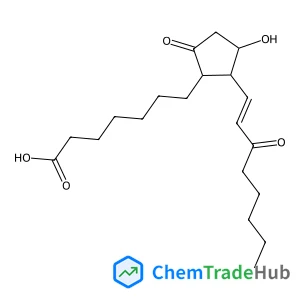
(11alpha,13E)-11-Hydroxy-9,15-dioxoprost-13-en-1-oic acid
CAS Number:
22973-19-9
Molecular Formula:
C20H32O5
Recommended Suppliers






Disclaimer
This page provides academic journal information for reference and research purposes only. We are not affiliated with any journal publishers and do not handle publication submissions. For publication-related inquiries, please contact the respective journal publishers directly.
If you notice any inaccuracies in the information displayed, please contact us at support@chemtradehub.com. We will promptly review and address your concerns.