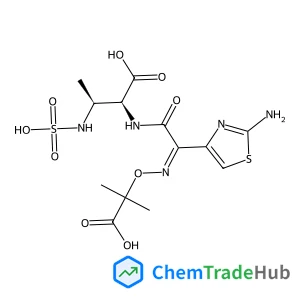
Aztreonam USP Related Compound A (Open-ring Aztreonam)
CAS Number:
87500-74-1
Molecular Formula:
C13H19N5O9S2
I. L. Bradeanu, R. Flesch, N. Kosugi, A. A. Pavlychev
The C 1s → π* transition in molecular benzene and benzene clusters is investigated by photoion yields at high energy resolution. The vibrationally resolved band shows the same shape in clusters as in the bare molecule, but it is redshifted by 50 meV in small clusters, i.e. near the threshold of cluster formation. This redshift increases to 70 meV with increasing cluster size. The results are assigned in comparison with ab initio calculations on model structures of dimers, trimers, and tetramers. These indicate that different carbon sites in the molecular moieties give rise to distinct spectral shifts, where carbon sites that are pointing to the π-system of another molecule show a larger redshift than the other ones. Such structural properties are found in solid benzene, so that the gas-to-solid shift of C 1s → π* excited benzene is derived to be a redshift which is of the order of 100–180 meV.

Molecular Pharmacology

Journal of Organometallic Chemistry

Organic Preparations and Procedures International

Proceedings of the National Academy of Sciences of the United States of America

Science

Fibre Chemistry

Science Progress

Kinetics and Catalysis

Journal of Heterocyclic Chemistry

Russian Chemical Reviews
Yuta Nakazato, Kazuya Taniguchi, Shunichi Ono, Takeshi Eitoku, Kenji Katayama
DOI: 10.1039/B915353E
Francesco Sedona, Stefano Agnoli, Gaetano Granozzi, Giovanni Barcaro, Alessandro Fortunelli
DOI: 10.1039/B915641K
Koichi Fumino, Alexander Wulf
DOI: 10.1039/B905634C
Kamila Réblová, Jiří Šponer
DOI: 10.1039/B911169G
Yasuhiro Sekiguchi, Satoshi Habuchi, Martin Vacha
DOI: 10.1039/B913401H
Marco García-Revilla, Jesús Hernández-Trujillo
DOI: 10.1039/B906961E
E. Fabiano, M. Piacenza, F. Della Sala
DOI: 10.1039/B911302A
Maarten M. M. Jansen, Jose Gracia, Ben E. Nieuwenhuys, (Hans) J. W. Niemantsverdriet
DOI: 10.1039/B910497F
Zhiwei Yang, Gang Yang, Yuangang Zu, Yujie Fu
DOI: 10.1039/B909299D
6-(3-Fluorophenyl)picolinic acid is generally considered safe for laboratory use...
(3R)-3-Pyrrolidinol is used in the pharmaceutical industry as a precursor for dr...
When handling (4R,5R)-4,5-Diethoxycarbonyl-2,2-dimethyldioxolane (CAS: 59779-75-...
1-(6-Chloroimidazo[1,2-b]pyridazin-3-yl)ethanone is often synthesized via a mult...
The market for N-Ethyl-3,4-dimethylbenzylamine (CAS: 39180-83-1) remains steady,...
Tert-butyl 3-(pyrrolidin-1-yl)azetidine-1-carboxylate is a chemical compound wit...
1-Bromo-3-chloro-2,4-dimethoxybenzene (CAS: 1228956-93-1) falls under the classi...
The safety of 8-Bromo-2-methyl-3,4-dihydroisoquinolin-1(2H)-one (CAS: 1368622-07...
Benzyl [(3S)-2,6-dioxo-3-piperidinyl]carbamate is generally safe when handled wi...
1-{[4-(4,4,5,5-Tetramethyl-1,3,2-dioxaborolan-2-yl)phenyl]sulfonyl}pyrrolidine s...

Physical Chemistry Chemical Physics (PCCP) is an international journal co-owned by 19 physical chemistry and physics societies from around the world. This journal publishes original, cutting-edge research in physical chemistry, chemical physics and biophysical chemistry. To be suitable for publication in PCCP, articles must include significant innovation and/or insight into physical chemistry; this is the most important criterion that reviewers and Editors will judge against when evaluating submissions. The journal has a broad scope and welcomes contributions spanning experiment, theory, computation and data science. Topical coverage includes spectroscopy, dynamics, kinetics, statistical mechanics, thermodynamics, electrochemistry, catalysis, surface science, quantum mechanics, quantum computing and machine learning. Interdisciplinary research areas such as polymers and soft matter, materials, nanoscience, energy, surfaces/interfaces, and biophysical chemistry are welcomed if they demonstrate significant innovation and/or insight into physical chemistry. Joined experimental/theoretical studies are particularly appreciated when complementary and based on up-to-date approaches.
![2-Methyl-2-propanyl [(2S)-1-hydroxy-3-(4-hydroxyphenyl)-2-propanyl]carbamate structure](https://static.chemtradehub.com/structs/833/83345-46-4-eec2.webp "2-Methyl-2-propanyl [(2S)-1-hydroxy-3-(4-hydroxyphenyl)-2-propanyl]carbamate structure")