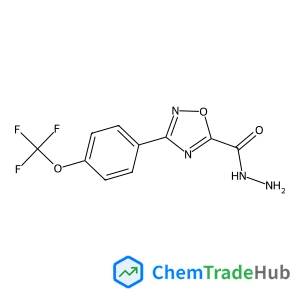
3-(4-(Trifluoromethoxy)phenyl)-1,2,4-oxadiazole-5-carbohydrazide
CAS Number:
883028-82-8
Molecular Formula:
C10H7F3N4O3
K. Krishna Prasad, C. S. Purohit, Alok Jain, R. Sankararamakrishnan, Sandeep Verma
C-terminal dimerization of a tripeptide palindrome afforded fibrillation in solution through an assembly probably driven by hydrogen bonding and hydrophobic contributions; such an approach provides an expeditious entry into fabrication of fibrillating peptides from non-fibrillating peptide sequences.
Daniel Klinger, Eugen M. Aschenbrenner, Clemens K. Weiss, Katharina Landfester
DOI: 10.1039/C1PY00415H
Yung-Chih Lin, Shiao-Wei Kuo
DOI: 10.1039/C1PY00381J
Hirofumi Tsuruta, Yoshihisa Fujii, Keiji Tanaka
DOI: 10.1039/C1PY00488C
Junpeng Zhao, Helmut Schlaad, Steffen Weidner, Markus Antonietti
DOI: 10.1039/C1PY00388G
Jieli Wu, Linzhu Zhou, Chengyu Jin, Chunlai Tu, Bangshang Zhu, Qi Zhu, Deyue Yan
DOI: 10.1039/C1PY00333J
Jiacheng Wang, Yoichi Masui, Makoto Onaka
DOI: 10.1039/C2PY00002D
Anton A. A. Smith, Thomas Hussmann, Joseph Elich, Almar Postma, Marie-Helene Alves, Alexander N. Zelikin
DOI: 10.1039/C1PY00429H
Meina Liu, Johannes van Hensbergen, Robert P. Burford, Andrew B. Lowe
DOI: 10.1039/C2PY20155K
4-(4-tert-Butylphenyl)-1H-pyrazol-3-amine finds applications in various industri...
H3TATAB is used in the pharmaceutical industry for the synthesis of certain orga...
1-Ethyl-3-fluorobenzene (CAS: 696-39-9) is primarily used as a precursor in the ...
1-(tert-Butoxycarbonyl)-4-(4-methoxyphenyl)pyrrolidine-3-carboxylic acid is prim...
1-Cyclobutyl-4-piperidinone (CAS: 359880-05-0) is a colorless or white crystalli...
Pyridine-2,6-dicarboxylic acid mono-tert-butyl ester (CAS: 575433-76-0) is a che...
The market for 2,3-Difluorophenylalanine (CAS: 236754-62-4) is growing with incr...
(2-Hydroxy-1-naphthyl)boronic acid can be synthesized through the reduction of 2...
This compound is a crystalline solid with a molecular weight of approximately 52...
While 5,7-Dihydroxy-4-oxo-2-(3,4,5-trihydroxyphenyl)-4H-chromen-3-yl beta-D-gluc...

ChemComm publishes urgent research which is of outstanding significance and interest to experts in the field, while also appealing to the journal’s broad chemistry readership. Our communication format is ideally suited to short, urgent studies that are of such importance that they require accelerated publication. Our scope covers all topics in chemistry, and research at the interface of chemistry and other disciplines (such as materials science, nanoscience, physics, engineering and biology) where there is a significant novelty in the chemistry aspects. Major topic areas covered include: Analytical Chemistry Catalysis Chemical Biology and medicinal chemistry Computational Chemistry and Machine Learning Energy and sustainable chemistry Environmental Chemistry Green Chemistry Inorganic Chemistry Materials Chemistry Nanoscience Organic Chemistry Physical Chemistry Polymer Chemistry Supramolecular Chemistry