












Improved detection of low vapor pressure compounds in air by serial combination of single-sided membrane introduction with fiber introduction mass spectrometry (SS-MIMS-FIMS)
Literature Information
Publication Date
2005-03-18
DOI
10.1039/B417791F
Impact Factor
4.616
Authors
Ismael Cotte-Rodríguez, Eric Handberg, Robert J. Noll, David P. A. Kilgour, R. Graham Cooks
View Original
Abstract
The use of two methods in tandem, single-sided membrane introduction mass spectrometry (SS-MIMS) and fiber introduction mass spectrometry (FIMS), is presented as a technique for field analysis. The combined SS-MIMS-FIMS technique was employed in both a modified commercial mass spectrometer and a miniature mass spectrometer for the selective preconcentration of the explosive simulant o-nitrotoluene (ONT) and the chemical warfare agent simulant, methyl salicylate (MeS), in air. A home-built FIMS inlet was fabricated to allow introduction of the solid-phase microextraction (SPME) fiber into the mass spectrometer chamber and subsequent desorption of the trapped compounds using resistive heating. The SS-MIMS preconcentration system was also home-built from commercial vacuum parts. Optimization experiments were done separately for each preconcentration system to achieve the best extraction conditions prior to use of the two techniques in combination. Improved limits of detection, in the low ppb range, were observed for the combination compared to FIMS alone, using several SS-MIMS preconcentration cycles. The SS-MIMS-FIMS response for both instruments was found to be linear over the range 50 to 800 ppb. Other parameters studied were absorption time profiles, effects of sample flow rate, desorption temperature, fiber background, memory effects, and membrane fatigue. This simple, sensitive, accurate, robust, selective, and rapid sample preconcentration and introduction technique shows promise for field analysis of low vapor pressure compounds, where analyte concentrations will be extremely low and the compounds are difficult to extract from a matrix like air.
Related Literature
Three-dimensional multiphysics coupling numerical simulation of a proton conductor solid oxide fuel cell based on multi-defect transport
Qiangqiang Li, Xiaoxia Sun, Lili Shen, Guojun Li
2023-02-11
Paper
DOI: 10.1039/D2CP05616J
Fluorescent cellulose nanocrystals/waterborne polyurethane nanocomposites for anti-counterfeiting applications
Sai Wang, Peng Zhou, Dongyang Zhang, Pengli Zhu
2023-03-08
Paper
DOI: 10.1039/D3CP00654A
Adsorption of CO32−/HCO3− on a quartz surface: cluster formation, pH effects, and mechanistic aspects
2023-02-09
Paper
DOI: 10.1039/D2CP05234B
Theoretical mechanism study on the electrochemical benzylation of [60]fullerene derivatives
Nana Ma, Wenyue Guo, Tongxin Liu, Guisheng Zhang
2023-02-01
Paper
DOI: 10.1039/D2CP06027B
Spin Hall effect from bipolaron dynamics in organics
Yuanyuan Miao, Dan Li, Huiqing Zhang, Junfeng Ren, Guichao Hu
2023-02-13
Paper
DOI: 10.1039/D2CP05204K
2D carbon nitride as a support with single Cu, Ag, and Au atoms for carbon dioxide reduction reaction
Sergio Posada-Pérez, Miquel Solà, Albert Poater
2023-02-23
Paper
DOI: 10.1039/D3CP00392B
Surface specific adsorption of glucose to ZnO
Sasthi Charan Mandal, Jaydeb Chakrabarti
2023-02-15
Paper
DOI: 10.1039/D2CP05749B
Does a halogen bond require positive potential on the acid and negative potential on the base?
2023-02-20
Paper
DOI: 10.1039/D3CP00379E
Nanoscale characterization of the heterogeneous interfacial oxidation layer of graphene/Cu based on a SEM electron beam induced reduction effect
Peng Zhang
2023-03-02
Paper
DOI: 10.1039/D2CP05809J
You might also like
Compound Q&A
What are the main uses of 1H-Indazole-6-carbonitrile (CAS: 141290-59-7)?
1H-Indazole-6-carbonitrile finds applications in pharmaceuticals, where it serve...
141290-59-71H-Indazole-6-carbon...
Compound Q&A
How should waste containing Dioctyl (2E)-2-butenedioate (CAS: 2997-85-5) be handled?
Waste containing Dioctyl (2E)-2-butenedioate (CAS: 2997-85-5) should be collecte...
2997-85-5Dioctyl (2E)-2-buten...
Compound Q&A
What industries use Sodium [(1,2-benzoxazol-3-ylmethyl)sulfonyl]azanide (CAS: 68291-98-5)?
Sodium [(1,2-benzoxazol-3-ylmethyl)sulfonyl]azanide is primarily used in pharmac...
68291-98-5Sodium [(1,2-benzoxa...
Compound Q&A
Are there alternatives to Dimethyl 4-(4,4,5,5-tetramethyl-1,3,2-dioxaborolan-2-yl)-2,6-pyridinedicarboxylate (CAS: 741709-66-0) in synthesis?
Dimethyl 4-(4,4,5,5-tetramethyl-1,3,2-dioxaborolan-2-yl)-2,6-pyridinedicarboxyla...
741709-66-0Dimethyl 4-(4,4,5,5-...
Compound Q&A
How should waste containing 2-Fluoro-6-hydrazinopyridine (CAS: 80714-39-2) be handled?
Waste containing 2-Fluoro-6-hydrazinopyridine (CAS: 80714-39-2) should be manage...
80714-39-22-Fluoro-6-hydrazino...
Compound Q&A
What is 6-Formyl-2-pyridinecarboxylic acid (CAS: 499214-11-8)?
6-Formyl-2-pyridinecarboxylic acid is an organic compound with the molecular for...
499214-11-86-Formyl-2-pyridinec...
Compound Q&A
What is the market or research trend for 3-(3,4-dimethoxyphenyl)-2,5-dimethyl-N-(2-morpholin-4-ylethyl)pyrazolo[1,5-a]pyrimidin-7-amine (CAS: 900874-91-1)?
Research trends for this compound indicate a focus on its potential applications...
900874-91-13-(3,4-dimethoxyphen...
Compound Q&A
How is 9H-Tribenzo[b,d,f]azepine (CAS: 29875-73-8) typically synthesized?
9H-Tribenzo[b,d,f]azepine is typically synthesized via a multi-step process invo...
29875-73-89H-Tribenzo[b,d,f]az...
Compound Q&A
How is 1-Cyclopropyl-7-ethoxy-6-fluoro-8-methoxy-4-oxo-1,4-dihydro-3-quinolinecarboxylic acid (CAS: 1797982-51-4) typically synthesized?
1-Cyclopropyl-7-ethoxy-6-fluoro-8-methoxy-4-oxo-1,4-dihydro-3-quinolinecarboxyli...
1797982-51-41-Cyclopropyl-7-etho...
Compound Q&A
How should waste containing Methyl 3-oxo-1,2,3,4-tetrahydro-6-quinoxalinecarboxylate (CAS: 671820-52-3) be handled?
Waste containing Methyl 3-oxo-1,2,3,4-tetrahydro-6-quinoxalinecarboxylate (CAS: ...
671820-52-3Methyl 3-oxo-1,2,3,4...
Source Journal
Analyst

CiteScore:
7.8
Self-citation Rate:
5.6%
Articles per Year:
653
Analyst publishes analytical and bioanalytical research that reports premier fundamental discoveries and inventions, and the applications of those discoveries, unconfined by traditional discipline barriers.
Recommended Compounds
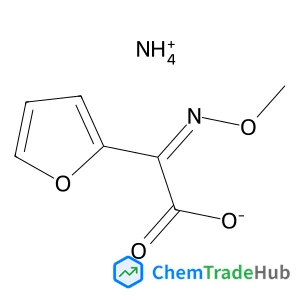
Ammonium (Z)-2-(furan-2-yl)-2-(methoxyimino)acetate
CAS Number:
97148-39-5
Molecular Formula:
C7H10N2O4

Recommended Suppliers






Disclaimer
This page provides academic journal information for reference and research purposes only. We are not affiliated with any journal publishers and do not handle publication submissions. For publication-related inquiries, please contact the respective journal publishers directly.
If you notice any inaccuracies in the information displayed, please contact us at support@chemtradehub.com. We will promptly review and address your concerns.