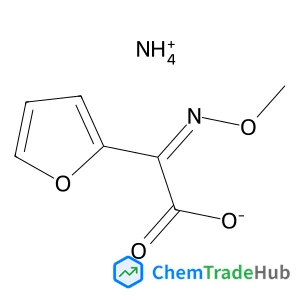
Ammonium (Z)-2-(furan-2-yl)-2-(methoxyimino)acetate
CAS Number:
97148-39-5
Molecular Formula:
C7H10N2O4
Sai Wang, Peng Zhou, Dongyang Zhang, Pengli Zhu
The development of eco-friendly anti-counterfeiting materials with high optical transparency and bright luminescence in the aggregate state is tremendously challenging. Herein, waterborne polyurethane/tetraphenylethylene-cellulose nanocrystal (WPU/TPE-CNC) nanocomposite aqueous solutions and films were prepared via direct blending aggregation-induced emission (AIE) active fluorescent CNCs (TPE-CNCs) with WPU and then applied in the anti-counterfeiting field. TPE-CNCs are compatible with WPU and dispersed homogeneously in the nanocomposite aqueous solutions and films. The thermal stability and mechanical properties of these films significantly improved with the increase in the content of TPE-CNCs. WPU/TPE-CNC nanocomposite films display high transparency (above 80%), excellent fluorescence properties, high mechanical strength, and good flexibility and then successfully applied to anti-counterfeit marking. Moreover, the dispersions of the aqueous WPU/TPE-CNC nanocomposite were nearly colorless and demonstrated promise as fluorescent anti-counterfeiting inks. This novel eco-friendly nanocomposite exhibited the potential for applications in anti-counterfeiting, fluorescent transparent paper and coating, fluorescent 3D printing, and optical/sensing devices.
Sinan Li, Shaobin Yang, Ding Shen, Wen Sun, Xueying Shan, Wei Dong, Yuehui Chen, Xu Zhang, Yongqiang Mao, Shuwei Tang
DOI: 10.1039/C7CP05334G
Z. Y. Li, M. Jibran, A. Pratt, Y. Yamauchi, B. Wang
DOI: 10.1039/C7CP06641D
Tommaso Giovannini, Alberto Baiardi, Benedetta Carlotti, Fausto Elisei, Chiara Cappelli
DOI: 10.1039/C7CP07104C
Marcello A. Budroni, Ilaria Calabrese, Ylenia Miele, Mauro Rustici, Nadia Marchettini, Federico Rossi
DOI: 10.1039/C7CP06601E
Tadeusz Lesniewski, Sebastian Mahlik, Marek Grinberg
DOI: 10.1039/C7CP06548E
Mridula Dixit Bharadwaj, Annigere S. Prakash
DOI: 10.1039/C7CP06458F
Zhi-Feng Wu, Peng-Fei Gao, Lei Guo, Jun Kang, Dang-Qi Fang, Yang Zhang, Ming-Gang Xia, Sheng-Li Zhang, Yu-Hua Wen
DOI: 10.1039/C7CP05404A
Jinxin Zhu, Jun Wang, Jianqiang Wang, Mingxin Dong
DOI: 10.1039/C7CP05659A
Kai Liu, Amir Mokhtare, Xiaozheng Xue
DOI: 10.1039/C7CP05323A
Christine Goyhenex, Laurent Piccolo
DOI: 10.1039/C7CP07155H
1H-Indazole-6-carbonitrile finds applications in pharmaceuticals, where it serve...
Waste containing Dioctyl (2E)-2-butenedioate (CAS: 2997-85-5) should be collecte...
Sodium [(1,2-benzoxazol-3-ylmethyl)sulfonyl]azanide is primarily used in pharmac...
Dimethyl 4-(4,4,5,5-tetramethyl-1,3,2-dioxaborolan-2-yl)-2,6-pyridinedicarboxyla...
Waste containing 2-Fluoro-6-hydrazinopyridine (CAS: 80714-39-2) should be manage...
6-Formyl-2-pyridinecarboxylic acid is an organic compound with the molecular for...
Research trends for this compound indicate a focus on its potential applications...
9H-Tribenzo[b,d,f]azepine is typically synthesized via a multi-step process invo...
1-Cyclopropyl-7-ethoxy-6-fluoro-8-methoxy-4-oxo-1,4-dihydro-3-quinolinecarboxyli...
Waste containing Methyl 3-oxo-1,2,3,4-tetrahydro-6-quinoxalinecarboxylate (CAS: ...

Physical Chemistry Chemical Physics (PCCP) is an international journal co-owned by 19 physical chemistry and physics societies from around the world. This journal publishes original, cutting-edge research in physical chemistry, chemical physics and biophysical chemistry. To be suitable for publication in PCCP, articles must include significant innovation and/or insight into physical chemistry; this is the most important criterion that reviewers and Editors will judge against when evaluating submissions. The journal has a broad scope and welcomes contributions spanning experiment, theory, computation and data science. Topical coverage includes spectroscopy, dynamics, kinetics, statistical mechanics, thermodynamics, electrochemistry, catalysis, surface science, quantum mechanics, quantum computing and machine learning. Interdisciplinary research areas such as polymers and soft matter, materials, nanoscience, energy, surfaces/interfaces, and biophysical chemistry are welcomed if they demonstrate significant innovation and/or insight into physical chemistry. Joined experimental/theoretical studies are particularly appreciated when complementary and based on up-to-date approaches.