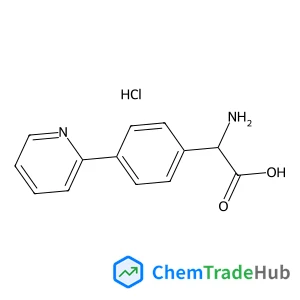
2-Amino-2-(4-(pyridin-2-YL)phenyl)acetic acid hydrochloride
CAS Number:
1135818-89-1
Molecular Formula:
C13H13ClN2O2
Robert B. Grubbs, Jakub K. Wegrzyn, Qing Xia
An alkoxyamine that is an effective initiator for the controlled polymerization of styrene and isoprene has been prepared by the reaction of 2-methyl-2-nitrosopropane with two equivalents of radicals derived from 1-bromoethylbenzene.
DOI: 10.1039/B918608E
T. L. Nguyen, J. Peeters, L. Vereecken
DOI: 10.1039/B822984H
Alessandro Bongini, Mauro Panunzio, Alessandro Venturini
DOI: 10.1039/B925351C
David L. Bones, Leon F. Phillips
DOI: 10.1039/B903329G
Christine L. Bailey, Erhard Kemnitz, Sanghamitra Mukhopadhyay, Adrian Wander, Barry G. Searle
DOI: 10.1039/B821484K
Adrian R. Jaszewski, Rob Stranger, Ronald J. Pace
DOI: 10.1039/B900694J
O. A. Oviedo, M. M. Mariscal, E. P. M. Leiva
DOI: 10.1039/B924348H
Rosa Becerra, J. Pat Cannady, Guy Dormer, Robin Walsh
DOI: 10.1039/B823109E
DOI: 10.1039/B904614C
Rodolfo Gómez-Balderas, Jesús Hernández-Trujillo
DOI: 10.1039/B922203K
(3.beta.)-3-Hydroxy-N,N-dimethyl-chol-5-en-24-amide (CAS: 79066-03-8) is primari...
5-(Aminomethyl)-2-methoxyphenol (CAS: 89702-89-6) is classified under GHS as a s...
Thieno[2,3-c]pyridin-7(6H)-one (CAS: 28981-13-7) is a heterocyclic organic compo...
1-[(6-Methoxy-3-pyridinyl)methyl]-4-piperidinamine dihydrochloride is generally ...
[(2E)-3-Phenyl-2-propen-1-yl]phosphonic acid (CAS: 146404-58-2) is regulated und...
6-Bromo-7-methoxyquinoline (CAS: 1620515-86-7) falls under the scope of the Glob...
This compound is primarily used in the pharmaceutical industry for the developme...
1-Ethyl-7-[2-methyl-6-(4H-1,2,4-triazol-3-yl)-3-pyridinyl]-3,5-dihydropyrazino[2...
Alternative reagents such as 2-[(dimethylamino)methyl]phenylboronic acid or rela...
3-(Piperidin-4-yloxy)pyridine (CAS: 310881-48-2) is an organic compound with the...

ChemComm publishes urgent research which is of outstanding significance and interest to experts in the field, while also appealing to the journal’s broad chemistry readership. Our communication format is ideally suited to short, urgent studies that are of such importance that they require accelerated publication. Our scope covers all topics in chemistry, and research at the interface of chemistry and other disciplines (such as materials science, nanoscience, physics, engineering and biology) where there is a significant novelty in the chemistry aspects. Major topic areas covered include: Analytical Chemistry Catalysis Chemical Biology and medicinal chemistry Computational Chemistry and Machine Learning Energy and sustainable chemistry Environmental Chemistry Green Chemistry Inorganic Chemistry Materials Chemistry Nanoscience Organic Chemistry Physical Chemistry Polymer Chemistry Supramolecular Chemistry
amine structure](https://static.chemtradehub.com/structs/629/62924-61-2-0728.webp "[(2-chlorophenyl)methyl](ethyl)amine structure")