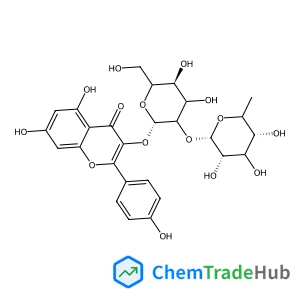
5,7-Dihydroxy-2-(4-hydroxyphenyl)-4-oxo-4H-chromen-3-yl 2-O-(6-deoxy-alpha-L-mannopyranosyl)-beta-D-glucopyranoside
CAS Number:
32602-81-6
Molecular Formula:
C27H30O15
O. A. Oviedo, M. M. Mariscal, E. P. M. Leiva
Following the framework established by Hill and Chamberlin [T. L. Hill and R. V. Chamberlin, Proc. Natl. Acad. Sci. U. S. A., 1998, 95, 12779] to analyze the extension of thermodynamics of small systems to metastable states, we have adopted the same basic ideas to study the thermodynamic stability of core-shell nanoparticles. For the first time we are able to address the question of whether or not core-shell nanoparticles have a limit of stability when they are under oversaturation conditions. By the latter, we mean the excess of chemical potential of the adsorbate (shell) atoms with respect to its bulk material, which is the driving force for nanoparticle growth. In this situation the probability density exhibits multiple local maxima associated with different core-shell metastable states. The decrease of the free energy barriers for the growth of the bulk phase of the shell material is analyzed for increasing oversaturation. At large positive oversaturations, the barrier disappears and the core-shell NP become unstable with respect to the bulk deposit of the shell material. A brief discussion on the model is made illustrating its application to a specific system by means of computer simulations using realistic interatomic potentials. One of the most striking results of these specific studies is the occurrence or not of a core-shell under undersaturation conditions depending on nanoparticle size.
Christopher M. Lee, Kabindra Kafle, Yong Bum Park, Seong H. Kim
DOI: 10.1039/C4CP00515E
Muthuramalingam Prakash, Kévin Mathivon, David M. Benoit, Gilberte Chambaud, Majdi Hochlaf
DOI: 10.1039/C4CP01292E
Robert L. Whetten, Xóchitl López-Lozano
DOI: 10.1039/C4CP01277A
Frederico Alabarse, Claire Levelut, Aude Isambert, Philippe Hébert, Shinji Kohara, David Maurin, Jean-Louis Bantignies, Olivier Cambon, Gaëlle Creff, Pascale Roy, Jean-Blaise Brubach, Tahar Hammouda, Denis Andrault, Julien Haines
DOI: 10.1039/C4CP00186A
Hongxin Zhang, Shurong Wang, Yanshuang Wang, Jiedi Yang, Xueling Gao, Liwei Wang
DOI: 10.1039/C4CP00356J
Dalal Noureldine, Dalaver H. Anjum, Kazuhiro Takanabe
DOI: 10.1039/C4CP00654B
Fengmei Wang, Yuanchang Li, Zhongzhou Cheng, Kai Xu, Xueying Zhan, Zhenxing Wang, Jun He
DOI: 10.1039/C4CP01200C
Subal Dey, Biswajit Mondal, Abhishek Dey
DOI: 10.1039/C4CP01205D
Shunli Yin, Xiaomei Wang, Zhigang Mou, Yijie Wu, Hui Huang, Mingshan Zhu, Yukou Du, Ping Yang
DOI: 10.1039/C4CP00384E
Anna B. Solov'eva, Nickolay S. Melik-Nubarov
DOI: 10.1039/C3CP55510K
When handling 2-Chloro-1,2-bis(4-methylphenyl)ethanone (CAS: 71193-32-3), it is ...
4-Ethoxy-3-(5-methyl-4-oxo-7-propyl-1,4-dihydroimidazo[5,1-f][1,2,4]triazin-2-yl...
Methyl 3-Oxo-4-Androsten-17-Carboxylate (CAS: 2681-55-2) should be stored in a c...
(R)-3-Amino-4-(3-hexylphenylamino)-4-oxobutylphosphonic acid is primarily used i...
2-Methyl-2-propanyl 3-amino-3-carbamoyl-1-azetidinecarboxylate (CAS: 1254120-14-...
There are alternative reagents that can be used in synthesis instead of (E)-4-(t...
[2-(3-Chlorophenyl)-1,3-thiazol-4-yl]methanol (CAS: 121202-20-8) is a crystallin...
The market and research trends for Methyl (2S)-[(4S)-2,2-dimethyl-1,3-dioxolan-4...
The market for 1-Bromo-2-isocyanatoethane (CAS: 42865-19-0) is driven by its use...
4-Nitro-D-phenylalanine hydrochloride (CAS: 147065-06-3) is primarily used in re...

Physical Chemistry Chemical Physics (PCCP) is an international journal co-owned by 19 physical chemistry and physics societies from around the world. This journal publishes original, cutting-edge research in physical chemistry, chemical physics and biophysical chemistry. To be suitable for publication in PCCP, articles must include significant innovation and/or insight into physical chemistry; this is the most important criterion that reviewers and Editors will judge against when evaluating submissions. The journal has a broad scope and welcomes contributions spanning experiment, theory, computation and data science. Topical coverage includes spectroscopy, dynamics, kinetics, statistical mechanics, thermodynamics, electrochemistry, catalysis, surface science, quantum mechanics, quantum computing and machine learning. Interdisciplinary research areas such as polymers and soft matter, materials, nanoscience, energy, surfaces/interfaces, and biophysical chemistry are welcomed if they demonstrate significant innovation and/or insight into physical chemistry. Joined experimental/theoretical studies are particularly appreciated when complementary and based on up-to-date approaches.