












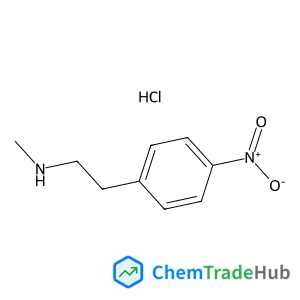
N-Methyl-2-(4-nitrophenyl)ethanamine hydrochloride (1:1)
CAS Number:
166943-39-1
Molecular Formula:
C9H13ClN2O2
Irene Conti, Piero Altoè, Marco Stenta, Marco Garavelli
We have employed hybrid CASPT2//CASSCF/AMBER calculations to map the 1La(1ππ*) deactivation path of a single quantum mechanical adenine in a d(A)10·d(T)10 double strand in water that is treated at the molecular mechanics level. We find that (a) the La relaxation route is flatter in DNA than in vacuo and (b) the La relaxation energy in DNA is much larger than the stabilization energy of the corresponding La excimer. An intra-monomer relaxation process is found to be compatible with the multiexponential decay recorded in DNA, possibly including the longer (>100 ps) lifetime component.
Mark J. Sarsfield, Andrew D. Sutton, Iain May, Gordon H. John, Clint Sharrad, Madeleine Helliwell
DOI: 10.1039/B404424J
Sumod George, Ashwini Nangia, Chi-Keung Lam, Thomas C. W. Mak, Jean-François Nicoud
DOI: 10.1039/B402050B
Marcin Drąg, Adam Jezierski, Pawel Kafarski
DOI: 10.1039/B401633E
Daniel Maspoch, Daniel Ruiz-Molina, Klaus Wurst, Concepció Rovira, Jaume Veciana
DOI: 10.1039/B315147F
Audrey Caravano, Stéphane P. Vincent, Pierre Sinaÿ
DOI: 10.1039/B402469A
Yasuo Iida, Kyuichi Yasui, Toru Tuziuti, Manickam Sivakumar, Yoshishige Endo
DOI: 10.1039/B410015H
David Curiel, Paul D. Beer, Rowena L. Paul, Andrew Cowley, Mark R. Sambrook, Fridrich Szemes
DOI: 10.1039/B401900H
Corinne Wartelle, Fethi Bedioui
DOI: 10.1039/B402735C
Nicolas Christinat, Rosario Scopelliti, Kay Severin
DOI: 10.1039/B402510E
Kyuwon Kim, Haesik Yang, Se Ho Park, Dae-Sik Lee, Sung-Jin Kim, Yong Taik Lim, Youn Tae Kim
DOI: 10.1039/B402914C
When handling 2-Chloro-1,2-bis(4-methylphenyl)ethanone (CAS: 71193-32-3), it is ...
4-Ethoxy-3-(5-methyl-4-oxo-7-propyl-1,4-dihydroimidazo[5,1-f][1,2,4]triazin-2-yl...
Methyl 3-Oxo-4-Androsten-17-Carboxylate (CAS: 2681-55-2) should be stored in a c...
(R)-3-Amino-4-(3-hexylphenylamino)-4-oxobutylphosphonic acid is primarily used i...
2-Methyl-2-propanyl 3-amino-3-carbamoyl-1-azetidinecarboxylate (CAS: 1254120-14-...
There are alternative reagents that can be used in synthesis instead of (E)-4-(t...
[2-(3-Chlorophenyl)-1,3-thiazol-4-yl]methanol (CAS: 121202-20-8) is a crystallin...
The market and research trends for Methyl (2S)-[(4S)-2,2-dimethyl-1,3-dioxolan-4...
The market for 1-Bromo-2-isocyanatoethane (CAS: 42865-19-0) is driven by its use...
4-Nitro-D-phenylalanine hydrochloride (CAS: 147065-06-3) is primarily used in re...

Physical Chemistry Chemical Physics (PCCP) is an international journal co-owned by 19 physical chemistry and physics societies from around the world. This journal publishes original, cutting-edge research in physical chemistry, chemical physics and biophysical chemistry. To be suitable for publication in PCCP, articles must include significant innovation and/or insight into physical chemistry; this is the most important criterion that reviewers and Editors will judge against when evaluating submissions. The journal has a broad scope and welcomes contributions spanning experiment, theory, computation and data science. Topical coverage includes spectroscopy, dynamics, kinetics, statistical mechanics, thermodynamics, electrochemistry, catalysis, surface science, quantum mechanics, quantum computing and machine learning. Interdisciplinary research areas such as polymers and soft matter, materials, nanoscience, energy, surfaces/interfaces, and biophysical chemistry are welcomed if they demonstrate significant innovation and/or insight into physical chemistry. Joined experimental/theoretical studies are particularly appreciated when complementary and based on up-to-date approaches.
![2-Hydroxy-4-[({[(4-methylphenyl)sulfonyl]oxy}acetyl)amino]benzoic acid structure](https://static.chemtradehub.com/structs/501/501919-59-1-579f.webp "2-Hydroxy-4-[({[(4-methylphenyl)sulfonyl]oxy}acetyl)amino]benzoic acid structure")





