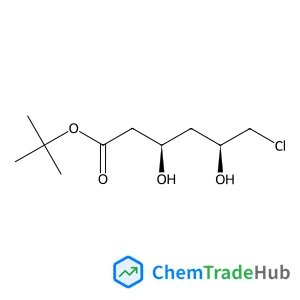
2-Methyl-2-propanyl (3R,5S)-6-chloro-3,5-dihydroxyhexanoate
CAS Number:
154026-93-4
Molecular Formula:
C10H19ClO4
Interaction of CO molecules with Cu-MFI zeolites reduced in vacuum or CO atmosphere was investigated. The character of the absorption bands ascribed to intrazeolitic carbonyl species was explored in the dependence on the Cu loading, Si/Al ratio, degree of reduction and on the coverage of the Cu+ ions by CO molecules. The different character of individual Cu sites was revealed in the IR spectra of carbonyl species upon CO pressure. Some Cu ions are not able to form dicarbonyl species even at 7.5 kPa of CO. The band of residual monocarbonyl species strongly overlaps with the band of asymmetric vibration of dicarbonyl species, making the quantitative analysis of this band rather difficult. It was found that the position and the half-width of the monocarbonyl band, as well as the third and fourth statistical moment of the band are independent of the variable factors mentioned above. The main vibrational band of monocarbonyl species cannot be deconvoluted to individual bands corresponding to different Cu exchangeable sites. It means that IR spectroscopy of carbonyl species in the range of C–O stretching frequencies is not a suitable method for monitoring of the individual Cu+ sites in MFI zeolite framework. In addition, no correlation of –ΔHads and wavenumber of the fundamental vibration of C–O adsorbed on Cu+ ions in MFI zeolite matrix was found.
Byungkyun Kang, Koushik Biswas
DOI: 10.1039/C7CP04417H
Gehong Su, Tao Zhou, Xifei Liu, Yulin Zhang
DOI: 10.1039/C7CP04571A
S. Mocanu, I. Matei, S. Ionescu, V. Tecuceanu, G. Marinescu, D. Culita, A. Leonties, Gabriela Ionita
DOI: 10.1039/C7CP05276F
Yu-Hsuan Weng, Cyuan-Jhang Wu, Yu-Jane Sheng
DOI: 10.1039/C7CP04979J
Jean-François Paul, Laurent Cantrel, Michael Badawi
DOI: 10.1039/C7CP05562E
Kris Rosseel, Jun Lim, Alessandro Marino, Geraldine Heynderickx, Alexander Aerts
DOI: 10.1039/C7CP05068B
Xianlong Wang
DOI: 10.1039/C7CP05385A
Yu Chang, Nannan Zhang, Yuxin Yang, Jun Du, Xing Fan, Changyuan Tao
DOI: 10.1039/C7CP05414A
(1R,3S)-1,3-Cyclopentanediol finds applications in various industries. In the ph...
When handling N'-[4-(Dimethylamino)phenyl]-N,N-dimethyl-1,4-benzenediamine, it i...
There are several alternatives to 5-(2,4-Difluorophenyl)-2-methoxypyrimidine in ...
1-(3-Methoxyphenoxy)propan-2-ol (CAS: 382141-68-6) must comply with the Globally...
Tetrodotoxin Citrate is extremely dangerous and should be handled with extreme c...
2-Methyl-2-propanyl [(1R,3S)-3-hydroxycyclopentyl]carbamate (CAS: 225641-84-9) i...
Waste containing 4-(2-Hydroxyhexafluoroisopropyl)Benzoic Acid (CAS: 16261-80-6) ...
2-Methyl-2-proanyl {(2S)-1-[(benzyloxy)amino]-3-hydroxy-3-methyl-1-oxo-2-butanyl...
Benzeneethanamine, α-ethyl-, hydrochloride (1:1) is an organic compound with the...
In the synthesis of compounds similar to 3-{(E)-[4-(Dimethylamino)phenyl]diazeny...

Physical Chemistry Chemical Physics (PCCP) is an international journal co-owned by 19 physical chemistry and physics societies from around the world. This journal publishes original, cutting-edge research in physical chemistry, chemical physics and biophysical chemistry. To be suitable for publication in PCCP, articles must include significant innovation and/or insight into physical chemistry; this is the most important criterion that reviewers and Editors will judge against when evaluating submissions. The journal has a broad scope and welcomes contributions spanning experiment, theory, computation and data science. Topical coverage includes spectroscopy, dynamics, kinetics, statistical mechanics, thermodynamics, electrochemistry, catalysis, surface science, quantum mechanics, quantum computing and machine learning. Interdisciplinary research areas such as polymers and soft matter, materials, nanoscience, energy, surfaces/interfaces, and biophysical chemistry are welcomed if they demonstrate significant innovation and/or insight into physical chemistry. Joined experimental/theoretical studies are particularly appreciated when complementary and based on up-to-date approaches.