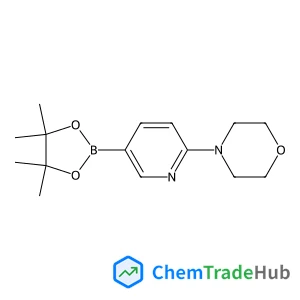
4-(5-(4,4,5,5-tetramethyl-1,3,2-dioxaborolan-2-yl)pyridin-2-yl)morpholine
CAS Number:
485799-04-0
Molecular Formula:
C15H23BN2O3
Gehong Su, Tao Zhou, Xifei Liu, Yulin Zhang
In this study, temperature-dependent FTIR spectroscopy in combination with the perturbation–correlation moving-window (PCMW2D) technique and generalized two-dimensional (2D) correlation analysis was applied to investigate the phase transition mechanism of poly(N-vinylcaprolactam) (PVCL) hydrogel upon heating. In the conventional 1D FTIR spectra, the gradual dehydration of C–H groups, as well as the gradual dissociation of hydrogen bonds between CO groups and water molecules, was observed during phase transition. Moreover, we found that the rate at which water molecules were expelled out of the gel network during phase transition was changed to a sigmoid mode, rather than increasing linearly with increasing temperature. PCMW2D FTIR spectra revealed that the phase transition of PVCL hydrogel can be divided into two steps (named as I and II) upon heating, and we further determined the temperature regions of steps I and II to be 29.0–35.7 °C and 35.7–47.5 °C, respectively. Step I is the formation of hydrophobic domains in the gel, and step II is the chain collapse of the gel. Finally, with the help of generalized 2D correlation analysis, it was confirmed that the transformation of hydrogen bonds was the driving force of the hydrophobic domain formation process, while the hydrophobic interaction of C–H groups was the driving force for the chain collapse process. Combined with the obtained sequential orders of step I and step II, an integrated two-step phase transition mechanism of PVCL hydrogel upon heating was proposed.
Ganeswar Dalei, Swagat Kumar Das, Susri Sangita Mohapatra
DOI: 10.1039/D3FB00096F
Diana Bura, Lorenzo Pedrini, Stephen J. Connon
DOI: 10.1039/D3SU00336A
Julia Diener, Christian Bartsch, Florian Dietrich, Claudia Falcke, Iva Anic, Steffen Roth, Andreas Taden, Michael Richter
DOI: 10.1039/D3SU00269A
Victor V. Yashin, Fariha Mahmood, Kalaichelvi Saravanamuttu, Anna C. Balazs
DOI: 10.1039/D3LF00156C
David Cannella, Diego Montesdeoca, Iwona Cybulska, Damien P. Debecker
DOI: 10.1039/D3SU00140G
Andrea Paulillo, Martina Pucciarelli, Phil Prior, Paola Lettieri
DOI: 10.1039/D3SU00279A
Bareera Siddiqui, Alisha Ahmad, Owais Yousuf, Kaiser Younis
DOI: 10.1039/D3FB00111C
Mir Sayed Shah Danish
DOI: 10.1039/D3SU00179B
Jieming Yuan, Yunkyoung Han, Krishnamoorthy Sathiyan, Virender K. Sharma, Abdol Hadi Mokarizadeh, Mesfin Tsige, Jiechao Jiang, Xingmao Ma
DOI: 10.1039/D3SU00265A
(1R,3S)-1,3-Cyclopentanediol finds applications in various industries. In the ph...
When handling N'-[4-(Dimethylamino)phenyl]-N,N-dimethyl-1,4-benzenediamine, it i...
There are several alternatives to 5-(2,4-Difluorophenyl)-2-methoxypyrimidine in ...
1-(3-Methoxyphenoxy)propan-2-ol (CAS: 382141-68-6) must comply with the Globally...
Tetrodotoxin Citrate is extremely dangerous and should be handled with extreme c...
2-Methyl-2-propanyl [(1R,3S)-3-hydroxycyclopentyl]carbamate (CAS: 225641-84-9) i...
Waste containing 4-(2-Hydroxyhexafluoroisopropyl)Benzoic Acid (CAS: 16261-80-6) ...
2-Methyl-2-proanyl {(2S)-1-[(benzyloxy)amino]-3-hydroxy-3-methyl-1-oxo-2-butanyl...
Benzeneethanamine, α-ethyl-, hydrochloride (1:1) is an organic compound with the...
In the synthesis of compounds similar to 3-{(E)-[4-(Dimethylamino)phenyl]diazeny...

Physical Chemistry Chemical Physics (PCCP) is an international journal co-owned by 19 physical chemistry and physics societies from around the world. This journal publishes original, cutting-edge research in physical chemistry, chemical physics and biophysical chemistry. To be suitable for publication in PCCP, articles must include significant innovation and/or insight into physical chemistry; this is the most important criterion that reviewers and Editors will judge against when evaluating submissions. The journal has a broad scope and welcomes contributions spanning experiment, theory, computation and data science. Topical coverage includes spectroscopy, dynamics, kinetics, statistical mechanics, thermodynamics, electrochemistry, catalysis, surface science, quantum mechanics, quantum computing and machine learning. Interdisciplinary research areas such as polymers and soft matter, materials, nanoscience, energy, surfaces/interfaces, and biophysical chemistry are welcomed if they demonstrate significant innovation and/or insight into physical chemistry. Joined experimental/theoretical studies are particularly appreciated when complementary and based on up-to-date approaches.