












Shallow trapping vs. deep polarons in a hybrid lead halide perovskite, CH3NH3PbI3
Literature Information
Publication Date
2017-08-16
DOI
10.1039/C7CP04417H
Impact Factor
3.676
Authors
Byungkyun Kang, Koushik Biswas
View Original
Abstract
There has been considerable speculation over the nature of charge carriers in organic–inorganic hybrid perovskites, i.e., whether they are free and band-like, or they are prone to self-trapping via short range deformation potentials. Unusually long minority-carrier diffusion lengths and moderate-to-low mobilities, together with relatively few deep defects add to their intrigue. Here we implement density functional methods to investigate the room-temperature, tetragonal phase of CH3NH3PbI3. We compare charge localization behavior at shallow levels and associated lattice relaxation versus those at deep polaronic states. The shallow level originates from screened Coulomb interaction between the perturbed host and an excited electron or hole. The host lattice has a tendency towards forming these shallow traps where the electron or hole is localized not too far from the band edge. In contrast, there is a considerable potential barrier that must be overcome in order to initiate polaronic hole trapping. The formation of a hole polaron (I2− center) involves strong lattice relaxation, including large off-center displacement of the organic cation, CH3NH3+. This type of deep polaron is energetically unfavorable, and active shallow traps are expected to shape the carrier dynamics in this material.
Related Literature
Use of machine learning for monitoring the growth stages of an agricultural crop
Shara Ahmed, Nabanita Basu, Catherine E. Nicholson, Simon R. Rutter, John R. Marshall, Justin J. Perry, John R. Dean
2023-10-26
Paper
DOI: 10.1039/D3FB00101F
Alkali and alkaline earth metals in liquid salts for supercapatteries
Peiying Fan, Yuhan Zhang, Li Guan, Han Wang, George Zheng Chen
2023-11-29
Tutorial Review
DOI: 10.1039/D3SU00197K
Understanding the electrocatalytic oxidation of propionic acid for the sustainable production of ethylene
Andrea Angulo, Carolina Elizarraras, Ju Hee Shin, Alexandra van Riel, Toshihiro Akashige, Miguel Modestino
2023-10-20
Paper
DOI: 10.1039/D3SU00347G
A comprehensive review of food waste valorization for the sustainable management of global food waste
Aniruddha Sarker, Raju Ahmmed, S. M. Ahsan, Juwel Rana, Mithun Kumar Ghosh, Rakhi Nandi
2023-12-04
Review Article
DOI: 10.1039/D3FB00156C
Recovery of anthocyanins from Eugenia spp. fruit peels: a comparison between heat- and ultrasound-assisted extraction
M. Beatriz P. P. Oliveira
2023-10-30
Paper
DOI: 10.1039/D3FB00115F
Co-Al-CO3 layered double hydroxide: an efficient and regenerable catalyst for glycolysis of polyethylene terephthalate
Rakesh Ranjan, Benny Kattikanal George
2023-10-16
Paper
DOI: 10.1039/D3SU00304C
Exploring metal oxides for the hydrogen evolution reaction (HER) in the field of nanotechnology
Mir Sayed Shah Danish
2023-11-10
Perspective
DOI: 10.1039/D3SU00179B
You might also like
Compound Q&A
What industries use (1R,3S)-1,3-Cyclopentanediol (CAS: 16326-97-9)?
(1R,3S)-1,3-Cyclopentanediol finds applications in various industries. In the ph...
16326-97-9(1R,3S)-1,3-Cyclopen...
Compound Q&A
What precautions should be taken when handling N'-[4-(Dimethylamino)phenyl]-N,N-dimethyl-1,4-benzenediamine (CAS: 637-31-0)?
When handling N'-[4-(Dimethylamino)phenyl]-N,N-dimethyl-1,4-benzenediamine, it i...
637-31-0N'-[4-(Dimethylamino...
Compound Q&A
Are there alternatives to 5-(2,4-Difluorophenyl)-2-methoxypyrimidine (CAS: 1352318-16-1) in synthesis?
There are several alternatives to 5-(2,4-Difluorophenyl)-2-methoxypyrimidine in ...
1352318-16-15-(2,4-Difluoropheny...
Compound Q&A
What regulatory guidelines apply to 1-(3-Methoxyphenoxy)propan-2-ol (CAS: 382141-68-6)?
1-(3-Methoxyphenoxy)propan-2-ol (CAS: 382141-68-6) must comply with the Globally...
382141-68-61-(3-Methoxyphenoxy)...
Compound Q&A
Is Tetrodotoxin Citrate (CAS: 18660-81-6) safe?
Tetrodotoxin Citrate is extremely dangerous and should be handled with extreme c...
18660-81-6Tetrodotoxin Citrate
Compound Q&A
What are the main uses of 2-Methyl-2-propanyl [(1R,3S)-3-hydroxycyclopentyl]carbamate (CAS: 225641-84-9)?
2-Methyl-2-propanyl [(1R,3S)-3-hydroxycyclopentyl]carbamate (CAS: 225641-84-9) i...
225641-84-92-Methyl-2-propanyl ...
Compound Q&A
How should waste containing 4-(2-Hydroxyhexafluoroisopropyl)Benzoic Acid (CAS: 16261-80-6) be handled?
Waste containing 4-(2-Hydroxyhexafluoroisopropyl)Benzoic Acid (CAS: 16261-80-6) ...
16261-80-64-(2-Hydroxyhexafluo...
Compound Q&A
How is 2-Methyl-2-proanyl {(2S)-1-[(benzyloxy)amino]-3-hydroxy-3-methyl-1-oxo-2-butanyl}carbamate (CAS: 102507-19-7) typically synthesized?
2-Methyl-2-proanyl {(2S)-1-[(benzyloxy)amino]-3-hydroxy-3-methyl-1-oxo-2-butanyl...
102507-19-72-Methyl-2-propanyl ...
Compound Q&A
What is Benzeneethanamine, α-ethyl-, hydrochloride (1:1) (CAS: 20735-15-3)?
Benzeneethanamine, α-ethyl-, hydrochloride (1:1) is an organic compound with the...
20735-15-3Benzeneethanamine, α...
Compound Q&A
Are there alternatives to 3-{(E)-[4-(Dimethylamino)phenyl]diazenyl}benzoic acid (CAS: 20691-84-3) in synthesis?
In the synthesis of compounds similar to 3-{(E)-[4-(Dimethylamino)phenyl]diazeny...
20691-84-33-{(E)-[4-(Dimethyla...
Source Journal
Physical Chemistry Chemical Physics

CiteScore:
5.5
Self-citation Rate:
10.3%
Articles per Year:
3036
Physical Chemistry Chemical Physics (PCCP) is an international journal co-owned by 19 physical chemistry and physics societies from around the world. This journal publishes original, cutting-edge research in physical chemistry, chemical physics and biophysical chemistry. To be suitable for publication in PCCP, articles must include significant innovation and/or insight into physical chemistry; this is the most important criterion that reviewers and Editors will judge against when evaluating submissions. The journal has a broad scope and welcomes contributions spanning experiment, theory, computation and data science. Topical coverage includes spectroscopy, dynamics, kinetics, statistical mechanics, thermodynamics, electrochemistry, catalysis, surface science, quantum mechanics, quantum computing and machine learning. Interdisciplinary research areas such as polymers and soft matter, materials, nanoscience, energy, surfaces/interfaces, and biophysical chemistry are welcomed if they demonstrate significant innovation and/or insight into physical chemistry. Joined experimental/theoretical studies are particularly appreciated when complementary and based on up-to-date approaches.
Recommended Compounds
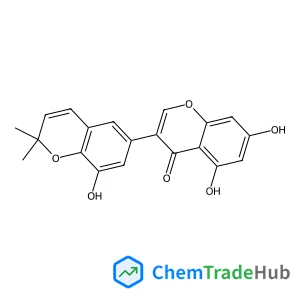
5,7,8'-Trihydroxy-2',2'-dimethyl-2'H,4H-3,6'-bichromen-4-one
CAS Number:
129280-33-7
Molecular Formula:
C20H16O6
Recommended Suppliers







Disclaimer
This page provides academic journal information for reference and research purposes only. We are not affiliated with any journal publishers and do not handle publication submissions. For publication-related inquiries, please contact the respective journal publishers directly.
If you notice any inaccuracies in the information displayed, please contact us at support@chemtradehub.com. We will promptly review and address your concerns.