












![1-oxaspiro[4.4]nonan-6-one structure](https://static.chemtradehub.com/structs/134/134179-01-4-e051.webp "1-oxaspiro[4.4]nonan-6-one structure")
Synthesis of a quinone-functionalized macrocyclic ligand and the intense fluorescence of its zinc complex
Literature Information
Publication Date
2004-03-23
DOI
10.1039/B401334D
Impact Factor
6.222
Authors
Michael Ruf, William S. Durfee, Cortlandt G. Pierpont
View Original
Abstract
The redox-active quinone-functionalized macrocyclic ligand 1,4,14,17-tetrahydroxyhemiporphyrazine, H2hp(OH)4, has been synthesized and its zinc complex, [Zn{hp(OH)4}(py)], found to exhibit intense fluorescence.
Related Literature
Quasi-perpetual discharge behaviour in p-type Ge–air batteries
Joey D. Ocon, Jin Won Kim, Graniel Harne A. Abrenica, Jae Kwang Lee
2014-06-20
Paper
DOI: 10.1039/C4CP02134G
Tavorite-FeSO4F as a potential cathode material for Mg ion batteries: a first principles calculation
Jiandong Wu, Guohua Gao, Guangming Wu, Bo Liu, Huiyu Yang, Xiaowei Zhou, Jichao Wang
2014-09-03
Communication
DOI: 10.1039/C4CP03176H
Characterization of C60 fullerene complexation with antibiotic doxorubicin
Yu. I. Prylutskyy, I. S. Pashkova, D. Wyrzykowski, A. Woziwodzka, G. Gołuński, J. Piosik, V. V. Cherepanov, U. Ritter
2014-09-03
Paper
DOI: 10.1039/C4CP03367A
Diffusive and non-diffusive photo-induced proton coupled electron transfer from hydrogen bonded phenols to meso-tetrakis-5,10,15,20-pentafluorophenyl porphyrin
P. Hemant Kumar, Y. Venkatesh, S. Prashanthi, D. Siva, B. Ramakrishna, Prakriti Ranjan Bangal
2014-09-09
Paper
DOI: 10.1039/C4CP02505A
On the dual character of charged metal–molecule hybrids and the opposite behaviour of the forward and reverse CT processes
J. Roman-Perez, S. P. Centeno, M. R. López-Ramírez, J. F. Arenas, J. Soto, I. López-Tocón, J. C. Otero
2014-09-17
Communication
DOI: 10.1039/C4CP03984J
Photoisomerization and structural dynamics of two nitrosylruthenium complexes: a joint study by NMR and nonlinear IR spectroscopies
Jianru Wang, Yan Zhao, Xiaoyan Qiao
2014-09-09
Paper
DOI: 10.1039/C4CP02298J
Temperature-dependent excitonic photoluminescence of hybrid organometal halide perovskite films
Kewei Wu, Ashok Bera, Chun Ma, Yuanmin Du, Yang Yang, Liang Li, Tom Wu
2014-09-17
Communication
DOI: 10.1039/C4CP03573A
Understanding the adsorption mechanism of noble gases Kr and Xe in CPO-27-Ni, CPO-27-Mg, and ZIF-8
O. V. Magdysyuk, F. Adams, H.-P. Liermann, I. Spanopoulos, P. N. Trikalitis, M. Hirscher, R. E. Morris, M. J. Duncan, L. J. McCormick, R. E. Dinnebier
2014-09-17
Paper
DOI: 10.1039/C4CP03298E
Entropy reduction in unfolded peptides (and proteins) due to conformational preferences of amino acid residues
Reinhard Schweitzer-Stenner, Siobhan E. Toal
2014-09-09
Paper
DOI: 10.1039/C4CP02108H
You might also like
Compound Q&A
What is the market or research trend for N-(4-Methoxybenzyl)-2-pyridinamine (CAS: 52818-63-0)?
N-(4-Methoxybenzyl)-2-pyridinamine (CAS: 52818-63-0) is increasingly being used ...
52818-63-0N-(4-Methoxybenzyl)-...
Compound Q&A
What precautions should be taken when handling Ethyl 4-(2-chlorophenyl)-1,3-thiazole-2-carboxylate (CAS: 1050507-06-6)?
When handling Ethyl 4-(2-chlorophenyl)-1,3-thiazole-2-carboxylate, appropriate p...
1050507-06-6Ethyl 4-(2-chlorophe...
Compound Q&A
What regulatory guidelines apply to diethyldiselane (CAS: 628-39-7)?
Diethyldiselane (CAS: 628-39-7) is classified under the Globally Harmonized Syst...
628-39-7Diethyldiselane
Compound Q&A
What is the market or research trend for oxocopper (CAS: 12053-18-8)?
The market for oxocopper (CAS: 12053-18-8) is primarily driven by its use in cat...
12053-18-8oxocopper; oxo-(oxoc...
Compound Q&A
What is the market or research trend for 5-{[(2-Methyl-2-propanyl)oxy]carbonyl}-5-azaspiro[2.4]heptane-7-carboxylic acid?
The market for 5-{[(2-Methyl-2-propanyl)oxy]carbonyl}-5-azaspiro[2.4]heptane-7-c...
1268519-54-55-{[(2-Methyl-2-prop...
Compound Q&A
What is 2-(1-Pyrrolidinyl)-4-pyridinamine (CAS: 35981-63-6)?
2-(1-Pyrrolidinyl)-4-pyridinamine is a chemical compound with the CAS number 359...
35981-63-62-(1-Pyrrolidinyl)-4...
Compound Q&A
What are the physical and chemical properties of 2-(3-Pyridinyl)-1-azabicyclo[2.2.2]octane (CAS: 91556-75-1)?
2-(3-Pyridinyl)-1-azabicyclo[2.2.2]octane (CAS: 91556-75-1) is a crystalline sol...
91556-75-12-(3-Pyridinyl)-1-az...
Compound Q&A
How is (S)-Alpha-allyl-proline hydrochloride (CAS: 129704-91-2) typically synthesized?
(S)-Alpha-allyl-proline hydrochloride is usually synthesized via a Wittig reacti...
129704-91-2(S)-Alpha-allyl-prol...
Compound Q&A
What is 3-Methyl-1,2-oxazole-5-carboxylic acid (CAS: 4857-42-5)?
3-Methyl-1,2-oxazole-5-carboxylic acid (CAS: 4857-42-5) is an organic compound w...
4857-42-53-Methyl-1,2-oxazole...
Compound Q&A
How is Lys-SMCC-DM1 (CAS: 1281816-04-3) typically synthesized?
Lys-SMCC-DM1 is synthesized via a multi-step process involving the coupling of S...
1281816-04-3Lys-SMCC-DM1
Source Journal
Chemical Communications

CiteScore:
8.6
Self-citation Rate:
4.7%
Articles per Year:
2458
ChemComm publishes urgent research which is of outstanding significance and interest to experts in the field, while also appealing to the journal’s broad chemistry readership. Our communication format is ideally suited to short, urgent studies that are of such importance that they require accelerated publication. Our scope covers all topics in chemistry, and research at the interface of chemistry and other disciplines (such as materials science, nanoscience, physics, engineering and biology) where there is a significant novelty in the chemistry aspects. Major topic areas covered include: Analytical Chemistry Catalysis Chemical Biology and medicinal chemistry Computational Chemistry and Machine Learning Energy and sustainable chemistry Environmental Chemistry Green Chemistry Inorganic Chemistry Materials Chemistry Nanoscience Organic Chemistry Physical Chemistry Polymer Chemistry Supramolecular Chemistry
Recommended Compounds
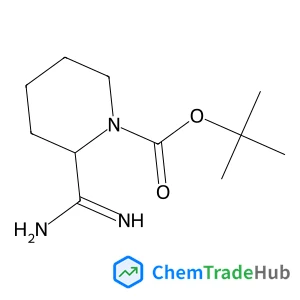
2-Methyl-2-propanyl 2-carbamimidoyl-1-piperidinecarboxylate
CAS Number:
1258640-98-0
Molecular Formula:
C11H21N3O2
Recommended Suppliers





Disclaimer
This page provides academic journal information for reference and research purposes only. We are not affiliated with any journal publishers and do not handle publication submissions. For publication-related inquiries, please contact the respective journal publishers directly.
If you notice any inaccuracies in the information displayed, please contact us at support@chemtradehub.com. We will promptly review and address your concerns.