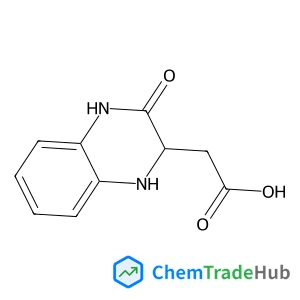
(3-Oxo-1,2,3,4-tetrahydro-2-quinoxalinyl)acetic acid
CAS Number:
136584-14-0
Molecular Formula:
C10H10N2O3
Scott M. Woodley
A genetic algorithm has been used to generate crystal framework structures, including that of sodalite and chabazite, from the knowledge of only the unit cell dimensions, constituent elements and by defining exclusion zones–regions within the unit cell where the constituent elements are forbidden, as opposed to being discouraged. We present details of a direct approach to restricting the possible location of the constituent ions and compare its success rate, of generating the target framework, with an indirect approach reported in Part 1.
Jeff Armstrong, Fernando Bresme
DOI: 10.1039/C4CP00818A
Kang Guo, Huaihe Song, Xiaohong Chen, Xian Du, Liang Zhong
DOI: 10.1039/C4CP00592A
DOI: 10.1039/C4CP00502C
Sandra Flessau, Christopher Wolter, Elmar Pöselt, Elvira Kröger, Alf Mews, Tobias Kipp
DOI: 10.1039/C4CP00443D
Dipankar Mandal, Karsten Henkel, Dieter Schmeißer
DOI: 10.1039/C3CP55238A
S. V. Koroleva, A. I. Victorov
DOI: 10.1039/C4CP02178A
Stefania Ferrari, Doretta Capsoni, Simone Casino, Matteo Destro, Claudio Gerbaldi, Marcella Bini
DOI: 10.1039/C4CP00511B
Marccus V. A. Martins, Andressa R. Pereira, Roberto A. S. Luz, Rodrigo M. Iost, Frank N. Crespilho
DOI: 10.1039/C4CP00452C
This compound is mainly used as an intermediate in the synthesis of antipsychoti...
Waste containing 1-(D-Ribofuranosyl)-1,4-dihydro-3-pyridinecarboxamide (CAS: 191...
2-Methyl-2-propanyl 3-bromo-3-(hydroxymethyl)-1-azetidinecarboxylate (CAS: 20079...
N-(4-Chloro-2-pyridinyl)acetamide (CAS: 245056-66-0) is a chemical compound with...
5-Chloro-2-hydroxybenzoic acid, also known as 5-chlorosalicylic acid, is an arom...
When handling 1,1-Dichloro-1-fluoroethane (CAS: 1717-00-6), it is important to u...
Fmoc-(2S,3R)-3-phenylpyrrolidine-2-carboxylic acid is a white crystalline solid ...
4-Amino-5-bromo-2-pyridinecarboxylic acid is primarily used as a precursor in th...
Handling this compound should be done with personal protective equipment (PPE) i...
When handling 8-bromo-2,2-dimethyl-3,4-dihydro-2H-1,4-benzoxazin-3-one, use prop...

Physical Chemistry Chemical Physics (PCCP) is an international journal co-owned by 19 physical chemistry and physics societies from around the world. This journal publishes original, cutting-edge research in physical chemistry, chemical physics and biophysical chemistry. To be suitable for publication in PCCP, articles must include significant innovation and/or insight into physical chemistry; this is the most important criterion that reviewers and Editors will judge against when evaluating submissions. The journal has a broad scope and welcomes contributions spanning experiment, theory, computation and data science. Topical coverage includes spectroscopy, dynamics, kinetics, statistical mechanics, thermodynamics, electrochemistry, catalysis, surface science, quantum mechanics, quantum computing and machine learning. Interdisciplinary research areas such as polymers and soft matter, materials, nanoscience, energy, surfaces/interfaces, and biophysical chemistry are welcomed if they demonstrate significant innovation and/or insight into physical chemistry. Joined experimental/theoretical studies are particularly appreciated when complementary and based on up-to-date approaches.