












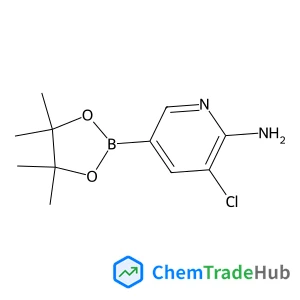
3-Chloro-5-(4,4,5,5-tetramethyl-1,3,2-dioxaborolan-2-yl)-2-pyridinamine
CAS Number:
1032758-99-8
Molecular Formula:
C11H16BClN2O2
S. V. Koroleva, A. I. Victorov
Viscoelastic solutions of ionic surfactants with an added salt exhibit a surprisingly strong dependence of their behavior on the nature of the added coion. We apply a recently proposed molecular-thermodynamic model to elucidate the effect of a coion's specificity on the aggregation of cationic and anionic surfactants. We show that micellar growth and branching are opposed by penetration of coions inside a micelle's corona leading to an increase of the aggregate's preferential curvature. These effects result from hydration/dehydration and dispersion attraction of coions and are only important at high salinity where electrostatic repulsion of coions from the micelle is screened and where branching of micelles and viscosity maxima are observed. At low and medium salinity, the coion plays a minor role; its effect on critical micelle concentration and sphere-to-rod transitions is insignificant. Our molecular-thermodynamic approach describes the specific effects of both counterions and coions and their different roles at different salinity levels based on a unified physical picture.
Benjamin A. Link, Ammon J. Sindt, Linda S. Shimizu, Thanh D. Do
DOI: 10.1039/C9CP06938K
Andreas Mauracher, Patrik Španěl
DOI: 10.1039/D0CP00297F
J. Samuel Arey
DOI: 10.1039/D0CP00582G
Linghui Lin, Liye Gao, Ke Xie, Rong Jiang, Sen Lin
DOI: 10.1039/D0CP00698J
Yuanyuan Ji, Hongxi Luo, Geoffrey M. Geise
DOI: 10.1039/D0CP00018C
Elisabeth Levrau, Matthias M. Minjauw, Michiel Van Daele, Rita Vos, Jolien Dendooven, Christophe Detavernier
DOI: 10.1039/D0CP00395F
Marina Rumyantseva, Abulkosim Nasriddinov, Alexander Gaskov, Anna Moiseeva, Yuri Fedorov, Gediminas Jonusauskas
DOI: 10.1039/C9CP07016H
Jeremias Sibold, Vera E. Tewaag, Thomas Vagedes, Ingo Mey
DOI: 10.1039/D0CP00335B
Michael J. Servis, Ernesto Martinez-Baez
DOI: 10.1039/D0CP00164C
Edvinas Radiunas, Manvydas Dapkevičius, Steponas Raišys, Saulius Juršėnas, Augustina Jozeliūnaitė, Tomas Javorskis, Ugnė Šinkevičiūtė, Edvinas Orentas, Karolis Kazlauskas
DOI: 10.1039/D0CP00144A
This compound is mainly used as an intermediate in the synthesis of antipsychoti...
Waste containing 1-(D-Ribofuranosyl)-1,4-dihydro-3-pyridinecarboxamide (CAS: 191...
2-Methyl-2-propanyl 3-bromo-3-(hydroxymethyl)-1-azetidinecarboxylate (CAS: 20079...
N-(4-Chloro-2-pyridinyl)acetamide (CAS: 245056-66-0) is a chemical compound with...
5-Chloro-2-hydroxybenzoic acid, also known as 5-chlorosalicylic acid, is an arom...
When handling 1,1-Dichloro-1-fluoroethane (CAS: 1717-00-6), it is important to u...
Fmoc-(2S,3R)-3-phenylpyrrolidine-2-carboxylic acid is a white crystalline solid ...
4-Amino-5-bromo-2-pyridinecarboxylic acid is primarily used as a precursor in th...
Handling this compound should be done with personal protective equipment (PPE) i...
When handling 8-bromo-2,2-dimethyl-3,4-dihydro-2H-1,4-benzoxazin-3-one, use prop...

Physical Chemistry Chemical Physics (PCCP) is an international journal co-owned by 19 physical chemistry and physics societies from around the world. This journal publishes original, cutting-edge research in physical chemistry, chemical physics and biophysical chemistry. To be suitable for publication in PCCP, articles must include significant innovation and/or insight into physical chemistry; this is the most important criterion that reviewers and Editors will judge against when evaluating submissions. The journal has a broad scope and welcomes contributions spanning experiment, theory, computation and data science. Topical coverage includes spectroscopy, dynamics, kinetics, statistical mechanics, thermodynamics, electrochemistry, catalysis, surface science, quantum mechanics, quantum computing and machine learning. Interdisciplinary research areas such as polymers and soft matter, materials, nanoscience, energy, surfaces/interfaces, and biophysical chemistry are welcomed if they demonstrate significant innovation and/or insight into physical chemistry. Joined experimental/theoretical studies are particularly appreciated when complementary and based on up-to-date approaches.
![2,6-Di(thiophen-2-yl)dithieno[3,2-b:2',3'-d]thiophene structure](https://static.chemtradehub.com/structs/910/910788-24-8-5b70.webp "2,6-Di(thiophen-2-yl)dithieno[3,2-b:2',3'-d]thiophene structure")
![Pyrazolo[1,5-a]pyridine-3-carbothioamide structure](https://static.chemtradehub.com/structs/885/885275-44-5-aae0.webp "Pyrazolo[1,5-a]pyridine-3-carbothioamide structure")




