












Graphene oxide as an anti-shrinkage additive for resorcinol–formaldehyde composite aerogels
Literature Information
Publication Date
2014-03-26
DOI
10.1039/C4CP00592A
Impact Factor
3.676
Authors
Kang Guo, Huaihe Song, Xiaohong Chen, Xian Du, Liang Zhong
View Original
Abstract
In order to strengthen the nanostructure and suppress the collapse of nanopores of resorcinol–formaldehyde (RF) aerogels during the drying process, graphene oxide (GO) was incorporated into the RF matrix to prepare GO–RF composite aerogels by sol–gel polymerization. The influences of GO content on the sol–gel process, structure, and physical properties of RF aerogels were investigated. The morphologies of composite aerogels were characterized by scanning electron microscopy and transmission electron microscopy, and it was found that GO was well dispersed in the RF matrix. In addition, GO can obviously accelerate the gelation of the RF solution and reduce both the drying shrinkage and aerogel density. As the content of GO increased from 0 to 2 wt%, both the linear shrinkage and density of composite aerogels decreased progressively from 28.3% to 2.0% and 506 to 195 kg m−3, respectively, implying that GO is an effective additive for inhibiting the volume shrinkage of aerogels during the drying process.
Recommended Journals
Related Literature
Impact of t-butyl substitution in a rubrene emitter for solid state NIR-to-visible photon upconversion
Edvinas Radiunas, Manvydas Dapkevičius, Steponas Raišys, Saulius Juršėnas, Augustina Jozeliūnaitė, Tomas Javorskis, Ugnė Šinkevičiūtė, Edvinas Orentas, Karolis Kazlauskas
2020-03-05
Paper
DOI: 10.1039/D0CP00144A
Semiconducting few-layer PdSe2 and Pd2Se3: native point defects and contacts with native metallic Pd17Se15
Xintong Xu, John Robertson, Huanglong Li
2020-03-18
Paper
DOI: 10.1039/C9CP06654C
Enhanced extraction of phenol from model oils using ionic liquids elucidated with neutron diffraction
Emily L. Byrne, Thaise Pereira, John D. Holbrey
2020-04-08
Paper
DOI: 10.1039/D0CP01013H
Aqueous solvation of the chloride ion revisited with density functional theory: impact of correlation and exchange approximations
Mark DelloStritto, Jianhang Xu, Xifan Wu, Michael L. Klein
2020-02-04
Paper
DOI: 10.1039/C9CP06821J
Fe3C cluster-promoted single-atom Fe, N doped carbon for oxygen-reduction reaction
Jun Wang
2020-02-28
Paper
DOI: 10.1039/D0CP00109K
High-performance III–VI monolayer transistors for flexible devices
Jianhui Chen, Shuchang Cai, Rui Xiong, Baisheng Sa, Cuilian Wen, Bo Wu, Zhimei Sun
2020-03-03
Paper
DOI: 10.1039/D0CP00578A
Including dispersion in density functional theory for adsorption on flat oxide surfaces, in metal–organic frameworks and in acidic zeolites
Florian R. Rehak, GiovanniMaria Piccini, Maristella Alessio, Joachim Sauer
2020-03-30
Paper
DOI: 10.1039/D0CP00394H
The statistical molecular fragmentation model compared to experimental plasma induced hydrocarbon decays
Stéphane Pasquiers, Nicole Blin-Simiand, Lionel Magne, Nguyen-Thi Van-Oanh, Sébastien Thomas
2020-03-20
Paper
DOI: 10.1039/C9CP06958E
Selective host–guest chemistry, self-assembly and conformational preferences of m-xylene macrocycles probed by ion-mobility spectrometry mass spectrometry
Benjamin A. Link, Ammon J. Sindt, Linda S. Shimizu, Thanh D. Do
2020-04-14
Paper
DOI: 10.1039/C9CP06938K
Thermodynamics of the formation of surface PtO2 stripes on Pt(111) in the absence of subsurface oxygen
Selwyn Hanselman, Ian T. McCrum, Marcel J. Rost, Marc T. M. Koper
2019-10-30
Paper
DOI: 10.1039/C9CP05107D
You might also like
Compound Q&A
What are the main uses of 1-(3-Aminophenyl)-3-[(3R)-1-(3,3-dimethyl-2-oxobutyl)-2-oxo-5-(2-pyridinyl)-2,3-dihydro-1H-1,4-benzodiazepin-3-yl]urea (CAS: 155412-88-7)?
This compound is mainly used as an intermediate in the synthesis of antipsychoti...
155412-88-71-(3-Aminophenyl)-3-...
Compound Q&A
How should waste containing 1-(D-Ribofuranosyl)-1,4-dihydro-3-pyridinecarboxamide (CAS: 19132-12-8) be handled?
Waste containing 1-(D-Ribofuranosyl)-1,4-dihydro-3-pyridinecarboxamide (CAS: 191...
19132-12-81-(D-Ribofuranosyl)-...
Compound Q&A
What regulatory guidelines apply to 2-Methyl-2-propanyl 3-bromo-3-(hydroxymethyl)-1-azetidinecarboxylate (CAS: 2007919-81-3)?
2-Methyl-2-propanyl 3-bromo-3-(hydroxymethyl)-1-azetidinecarboxylate (CAS: 20079...
2007919-81-32-Methyl-2-propanyl ...
Compound Q&A
What is N-(4-Chloro-2-pyridinyl)acetamide (CAS: 245056-66-0)?
N-(4-Chloro-2-pyridinyl)acetamide (CAS: 245056-66-0) is a chemical compound with...
245056-66-0N-(4-Chloro-2-pyridi...
Compound Q&A
What is 5-Chloro-2-hydroxybenzoic acid (CAS: 321-14-2)?
5-Chloro-2-hydroxybenzoic acid, also known as 5-chlorosalicylic acid, is an arom...
321-14-25-Chloro-2-hydroxybe...
Compound Q&A
What precautions should be taken when handling 1,1-Dichloro-1-fluoroethane (CAS: 1717-00-6)?
When handling 1,1-Dichloro-1-fluoroethane (CAS: 1717-00-6), it is important to u...
1717-00-61,1-Dichloro-1-fluor...
Compound Q&A
What are the physical and chemical properties of Fmoc-(2S,3R)-3-phenylpyrrolidine-2-carboxylic acid (CAS: 281655-32-1)?
Fmoc-(2S,3R)-3-phenylpyrrolidine-2-carboxylic acid is a white crystalline solid ...
281655-32-1Fmoc-(2S,3R)-3-pheny...
Compound Q&A
What are the main uses of 4-Amino-5-bromo-2-pyridinecarboxylic acid (CAS: 1363381-01-4)?
4-Amino-5-bromo-2-pyridinecarboxylic acid is primarily used as a precursor in th...
1363381-01-44-Amino-5-bromo-2-py...
Compound Q&A
What precautions should be taken when handling (S)-tert-butyl 2-((2-(4-bromophenyl)-2-oxoethyl)carbamoyl)pyrrolidine-1-carboxylate (CAS: 1007881-98-2)?
Handling this compound should be done with personal protective equipment (PPE) i...
1007881-98-2(S)-tert-butyl 2-((2...
Compound Q&A
What precautions should be taken when handling 8-bromo-2,2-dimethyl-3,4-dihydro-2H-1,4-benzoxazin-3-one (CAS: 688363-73-7)?
When handling 8-bromo-2,2-dimethyl-3,4-dihydro-2H-1,4-benzoxazin-3-one, use prop...
688363-73-78-bromo-2,2-dimethyl...
Source Journal
Physical Chemistry Chemical Physics

CiteScore:
5.5
Self-citation Rate:
10.3%
Articles per Year:
3036
Physical Chemistry Chemical Physics (PCCP) is an international journal co-owned by 19 physical chemistry and physics societies from around the world. This journal publishes original, cutting-edge research in physical chemistry, chemical physics and biophysical chemistry. To be suitable for publication in PCCP, articles must include significant innovation and/or insight into physical chemistry; this is the most important criterion that reviewers and Editors will judge against when evaluating submissions. The journal has a broad scope and welcomes contributions spanning experiment, theory, computation and data science. Topical coverage includes spectroscopy, dynamics, kinetics, statistical mechanics, thermodynamics, electrochemistry, catalysis, surface science, quantum mechanics, quantum computing and machine learning. Interdisciplinary research areas such as polymers and soft matter, materials, nanoscience, energy, surfaces/interfaces, and biophysical chemistry are welcomed if they demonstrate significant innovation and/or insight into physical chemistry. Joined experimental/theoretical studies are particularly appreciated when complementary and based on up-to-date approaches.
Recommended Compounds
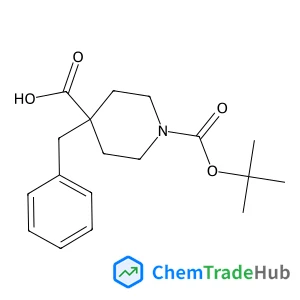
4-Benzyl-1-(tert-butoxycarbonyl)piperidine-4-carboxylic acid
CAS Number:
170838-87-6
Molecular Formula:
C18H25NO4
Recommended Suppliers






Disclaimer
This page provides academic journal information for reference and research purposes only. We are not affiliated with any journal publishers and do not handle publication submissions. For publication-related inquiries, please contact the respective journal publishers directly.
If you notice any inaccuracies in the information displayed, please contact us at support@chemtradehub.com. We will promptly review and address your concerns.