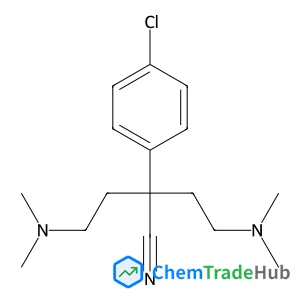
2-(4-Chlorophenyl)-4-(dimethylamino)-2-(2-(dimethylamino)ethyl)butanenitrile
CAS Number:
1246816-57-8
Molecular Formula:
C16H24ClN3
Marccus V. A. Martins, Andressa R. Pereira, Roberto A. S. Luz, Rodrigo M. Iost, Frank N. Crespilho
Direct electron transfer (DET) between redox enzymes and electrode surfaces is of growing interest and an important strategy in the development of biofuel cells and biosensors. Among the nanomaterials utilized at electrode/enzyme interfaces to enhance the electronic communication, graphene oxide (GO) has been identified as a highly promising candidate. It is postulated that GO layers decrease the distance between the flavin cofactor (FAD/FADH2) of the glucose oxidase enzyme (GOx) and the electrode surface, though experimental evidence concerning the distance dependence of the rate constant for heterogeneous electron-transfer (khet) has not yet been observed. In this work, we report the experimentally observed DET of the GOx enzyme adsorbed on flexible carbon fiber (FCF) electrodes modified with GO (FCF-GO), where the khet between GO and electroactive GOx has been measured at a structurally well-defined interface. The curves obtained from the Marcus theory were used to obtain khet, by using the model proposed by Chidsey. In agreement with experimental data, this model proved to be useful to systematically probe the dependence of electron transfer rates on distance, in order to provide an empirical basis to understand the origin of interfacial DET between GO and GOx. We also demonstrate that the presence of GO at the enzyme/electrode interface diminishes the activation energy by decreasing the distance between the electrode surface and FAD/FADH2.

Journal of the Chinese Chemical Society

Corrosion Science

Accounts of Chemical Research

Australian Journal of Chemistry

Advances in Colloid and Interface Science

Anti-Corrosion Methods and Materials

Ferroelectrics

Journal of the American Chemical Society

Cement and Concrete Research

Bulletin of the Chemical Society of Japan
Omar Baig, Oliver Kühn, Leticia González
DOI: 10.1039/D0CP04781C
Peng Cen, Mikhail S. Tyumentsev, Mark R. St. J. Foreman
DOI: 10.1039/C9CP05982B
Pascal Didier, Jagannath Kuchlyan, Lara Martinez-Fernandez, Pauline Gosset, Jérémie Léonard, Yitzhak Tor, Roberto Improta, Yves Mély
DOI: 10.1039/C9CP06931C
Pengfei Qiu, Kunpeng Zhao, Dudi Ren, Xun Shi
DOI: 10.1039/D0CP00733A
Michael Gradzielski
DOI: 10.1039/D0CP01076F
Sarah Komaty, Ayoub Daouli, Michael Badawi, Clément Anfray, Moussa Zaarour, Samuel Valable, Svetlana Mintova
DOI: 10.1039/D0CP00111B
Elisabeth Levrau, Matthias M. Minjauw, Michiel Van Daele, Rita Vos, Jolien Dendooven, Christophe Detavernier
DOI: 10.1039/D0CP00395F
Xintong Xu, John Robertson, Huanglong Li
DOI: 10.1039/C9CP06654C
Florian R. Rehak, GiovanniMaria Piccini, Maristella Alessio, Joachim Sauer
DOI: 10.1039/D0CP00394H
Abida Sultana, Jintana Meesungnoen, Jean-Paul Jay-Gerin
DOI: 10.1039/D0CP00601G
This compound is mainly used as an intermediate in the synthesis of antipsychoti...
Waste containing 1-(D-Ribofuranosyl)-1,4-dihydro-3-pyridinecarboxamide (CAS: 191...
2-Methyl-2-propanyl 3-bromo-3-(hydroxymethyl)-1-azetidinecarboxylate (CAS: 20079...
N-(4-Chloro-2-pyridinyl)acetamide (CAS: 245056-66-0) is a chemical compound with...
5-Chloro-2-hydroxybenzoic acid, also known as 5-chlorosalicylic acid, is an arom...
When handling 1,1-Dichloro-1-fluoroethane (CAS: 1717-00-6), it is important to u...
Fmoc-(2S,3R)-3-phenylpyrrolidine-2-carboxylic acid is a white crystalline solid ...
4-Amino-5-bromo-2-pyridinecarboxylic acid is primarily used as a precursor in th...
Handling this compound should be done with personal protective equipment (PPE) i...
When handling 8-bromo-2,2-dimethyl-3,4-dihydro-2H-1,4-benzoxazin-3-one, use prop...

Physical Chemistry Chemical Physics (PCCP) is an international journal co-owned by 19 physical chemistry and physics societies from around the world. This journal publishes original, cutting-edge research in physical chemistry, chemical physics and biophysical chemistry. To be suitable for publication in PCCP, articles must include significant innovation and/or insight into physical chemistry; this is the most important criterion that reviewers and Editors will judge against when evaluating submissions. The journal has a broad scope and welcomes contributions spanning experiment, theory, computation and data science. Topical coverage includes spectroscopy, dynamics, kinetics, statistical mechanics, thermodynamics, electrochemistry, catalysis, surface science, quantum mechanics, quantum computing and machine learning. Interdisciplinary research areas such as polymers and soft matter, materials, nanoscience, energy, surfaces/interfaces, and biophysical chemistry are welcomed if they demonstrate significant innovation and/or insight into physical chemistry. Joined experimental/theoretical studies are particularly appreciated when complementary and based on up-to-date approaches.
![2,6-Bis({(2R)-2-[hydroxy(diphenyl)methyl]-1-pyrrolidinyl}methyl)-4-methylphenol structure](https://static.chemtradehub.com/structs/877/877395-58-9-70bf.webp "2,6-Bis({(2R)-2-[hydroxy(diphenyl)methyl]-1-pyrrolidinyl}methyl)-4-methylphenol structure")