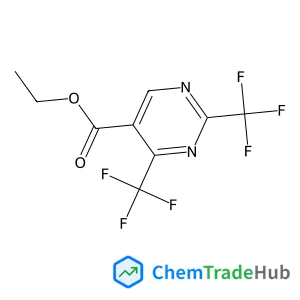
Ethyl 2,4-bis(trifluoromethyl)-5-pyrimidinecarboxylate
CAS Number:
188781-15-9
Molecular Formula:
C9H6F6N2O2
Hung A. Duong, Thomas N. Tekavec, Atta M. Arif, Janis Louie
Spectroscopic analysis, thermogravimetric analysis, and crossover experiments performed on a series of imidazolium carboxylates revealed carboxylation was reversible with N-aryl substituted adducts.
Sajal Kanti Dutta
DOI: 10.1039/D1RE00201E
Jayendran Iyer, Fatima Jalid, Tuhin S. Khan, M. Ali Haider
DOI: 10.1039/D1RE00396H
Bin Feng, Heather O'Connor, Denis Dowling, Geoff Gibson, Kevin P. Girard
DOI: 10.1039/D1RE00119A
Basit Yameen, Mubarak Ali, Marta Álvarez, Reinhard Neumann, Wolfgang Ensinger, Wolfgang Knoll, Omar Azzaroni
DOI: 10.1039/B9PY00201D
Vimal Katiyar, Hemant Nanavati
DOI: 10.1039/C0PY00125B
Bhanwar Kumar Malviya, Genji Sukumar
DOI: 10.1039/D1RE00260K
Anirudh M. K. Nambiar, Christopher P. Breen, Timothy F. Jamison, Klavs F. Jensen
DOI: 10.1039/D1RE00350J
Raquel Viveiros, Teresa Casimiro
DOI: 10.1039/D1RE00194A
DOI: 10.1039/D1RE00200G
When handling lithium chloride hydrate (1:1:1) (CAS: 16712-20-2), it is importan...
4-(4H-1,2,4-Triazol-4-yl)piperidine is generally considered safe for use in phar...
Waste containing 1,3-Thiazole-2-carboxamide (CAS: 16733-85-0) should be collecte...
5-(Difluoromethyl)-2-fluorobenzonitrile (CAS: 934175-58-3) is subject to regulat...
Methyl 3-acetamido-2-thiophenecarboxylate can be synthesized by the reaction of ...
4-Isoquinolinecarbonitrile is a chemical compound with the CAS number 34846-65-6...
Store Methyl 1H-1,2,3-triazole-4-carboxylate (CAS: 877309-59-6) in a cool, dry p...
6-Bromo[1,3]thiazolo[5,4-b]pyridin-2-amine (CAS: 1160791-13-8) is subject to the...
(2S,3S)-2-Ammonio-3-(3,4-dihydroxyphenyl)-3-hydroxypropanoate (CAS: 23651-95-8) ...
7-Bromo-3-methyl-3,4-dihydroquinazolin-4-one is a solid with a crystalline form....

ChemComm publishes urgent research which is of outstanding significance and interest to experts in the field, while also appealing to the journal’s broad chemistry readership. Our communication format is ideally suited to short, urgent studies that are of such importance that they require accelerated publication. Our scope covers all topics in chemistry, and research at the interface of chemistry and other disciplines (such as materials science, nanoscience, physics, engineering and biology) where there is a significant novelty in the chemistry aspects. Major topic areas covered include: Analytical Chemistry Catalysis Chemical Biology and medicinal chemistry Computational Chemistry and Machine Learning Energy and sustainable chemistry Environmental Chemistry Green Chemistry Inorganic Chemistry Materials Chemistry Nanoscience Organic Chemistry Physical Chemistry Polymer Chemistry Supramolecular Chemistry
![[(2R)-6,6-Dimethyl-2-morpholinyl]methanol hydrochloride (1:1) structure](https://static.chemtradehub.com/structs/141/1416444-88-6-e06a.webp "[(2R)-6,6-Dimethyl-2-morpholinyl]methanol hydrochloride (1:1) structure")