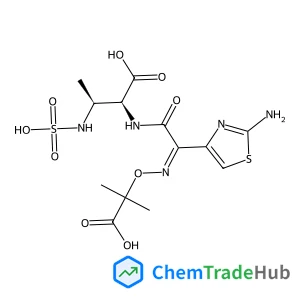
Aztreonam USP Related Compound A (Open-ring Aztreonam)
CAS Number:
87500-74-1
Molecular Formula:
C13H19N5O9S2
Ann Louise Sumner, Erik J. Menke, Yael Dubowski, John T. Newberg, Reginald M. Penner, John C. Hemminger, Lisa M. Wingen, Theo Brauers, Barbara J. Finlayson-Pitts
A number of heterogeneous reactions of atmospheric importance occur in thin water films on surfaces in the earth's boundary layer. It is therefore important to understand the interaction of water with various materials, both those used to study heterogeneous chemistry in laboratory systems, as well as those found in the atmosphere. We report here studies at 22 °C to characterize the interaction of water with such materials as a function of relative humidity from 0–100%. The surfaces studied include borosilicate glass, both untreated and after cleaning by three different methods (water, hydrogen peroxide and an argon plasma discharge), quartz, FEP Teflon film, a self assembled monolayer of n-octyltrichlorosilane (C8 SAM) on glass, halocarbon wax coatings prepared by two different methods, and several different types of Teflon coatings on solid substrates. Four types of measurements covering the range from the macroscopic level to the molecular scale were made: (1) contact angle measurements of water droplets on these surfaces to obtain macroscopic scale data on the water-surface interaction, (2) atomic force microscopy measurements to provide micron to sub-micron level data on the surface topography, (3) transmission FTIR of the surfaces in the presence of increasing water vapor concentrations to probe the interaction with the surface at a molecular level, and (4) X-ray photoelectron spectroscopy measurements of the elemental surface composition of the glass and quartz samples. Both borosilicate glass and the halocarbon wax coatings adsorbed significantly more water than the FEP Teflon film, which can be explained by a combination of the chemical nature of the surfaces and their physical topography. The C8 SAM, which is both hydrophobic and has a low surface roughness, takes up little water. The implications for the formation of thin water films on various surfaces in contact with the atmosphere, including building materials, soil, and vegetation, are discussed.
Paola Baiocco, Anna Maria Barreca, Maura Fabbrini, Carlo Galli, Patrizia Gentili
DOI: 10.1039/B208951C
Feng Li, Ziyan Wu, Jingjing Wang, Siyuan Zhang, Jiaxin Yu, Zhen Yuan, Jingya Liu, Renzeng Shen, Yao Zhou
DOI: 10.1039/D1QO01665B
Martin G. Banwell, Alison J. Edwards, Jason A. Smith, Ernest Hamel, Pascal Verdier-Pinard
DOI: 10.1039/B209992F
Franco Cozzi, Rita Annunziata, Maurizio Benaglia, Mauro Cinquini, Laura Raimondi, Kim K. Baldridge, Jay S. Siegel
DOI: 10.1039/B208871A
Leilei Cao, Liliang Huang, Xianjun Xu
DOI: 10.1039/D1QO01358K
Mingsheng Wu, Xianghu Zhao, Yisen Liu, Song Cao
DOI: 10.1039/C8OB02117A
Gennaro Pescitelli, Nina Berova, Tom L. Xiao, Roman V. Rozhkov, Richard C. Larock, Daniel W. Armstrong
DOI: 10.1039/B207652G
Jason P. Holland, Harald Scherer, Stephan Maus, Tobias Stemler, Hendrik Bohnenberger, Samer Ezziddin, Philipp Kurz
DOI: 10.1039/C8OB01981A
Jing Xu, Da-Jun Zheng, Mi-Mi Su, Yan-Chi Chen, Qing-Cai Jiao
DOI: 10.1039/C8OB01908H
6-(3-Fluorophenyl)picolinic acid is generally considered safe for laboratory use...
(3R)-3-Pyrrolidinol is used in the pharmaceutical industry as a precursor for dr...
When handling (4R,5R)-4,5-Diethoxycarbonyl-2,2-dimethyldioxolane (CAS: 59779-75-...
1-(6-Chloroimidazo[1,2-b]pyridazin-3-yl)ethanone is often synthesized via a mult...
The market for N-Ethyl-3,4-dimethylbenzylamine (CAS: 39180-83-1) remains steady,...
Tert-butyl 3-(pyrrolidin-1-yl)azetidine-1-carboxylate is a chemical compound wit...
1-Bromo-3-chloro-2,4-dimethoxybenzene (CAS: 1228956-93-1) falls under the classi...
The safety of 8-Bromo-2-methyl-3,4-dihydroisoquinolin-1(2H)-one (CAS: 1368622-07...
Benzyl [(3S)-2,6-dioxo-3-piperidinyl]carbamate is generally safe when handled wi...
1-{[4-(4,4,5,5-Tetramethyl-1,3,2-dioxaborolan-2-yl)phenyl]sulfonyl}pyrrolidine s...

Physical Chemistry Chemical Physics (PCCP) is an international journal co-owned by 19 physical chemistry and physics societies from around the world. This journal publishes original, cutting-edge research in physical chemistry, chemical physics and biophysical chemistry. To be suitable for publication in PCCP, articles must include significant innovation and/or insight into physical chemistry; this is the most important criterion that reviewers and Editors will judge against when evaluating submissions. The journal has a broad scope and welcomes contributions spanning experiment, theory, computation and data science. Topical coverage includes spectroscopy, dynamics, kinetics, statistical mechanics, thermodynamics, electrochemistry, catalysis, surface science, quantum mechanics, quantum computing and machine learning. Interdisciplinary research areas such as polymers and soft matter, materials, nanoscience, energy, surfaces/interfaces, and biophysical chemistry are welcomed if they demonstrate significant innovation and/or insight into physical chemistry. Joined experimental/theoretical studies are particularly appreciated when complementary and based on up-to-date approaches.