












From manganese(ii)-azido layers to a novel three-dimensional molecular magnet: spin canting and metamagnetism
Literature Information
Publication Date
2003-06-16
DOI
10.1039/B304536F
Impact Factor
6.222
Authors
Zhe-Ming Wang, Chun-Hua Yan
View Original
Abstract
Interlinking 2D azido-bridged and spin-canted antiferro-magnetic layers with semi-rigid organic pillars yields a 3D molecular metamagnet.
Related Literature
Adenine deactivation in DNA resolved at the CASPT2//CASSCF/AMBER level
Irene Conti, Piero Altoè, Marco Stenta, Marco Garavelli
2010-04-21
Paper
DOI: 10.1039/B926608A
Core shell structure for solid gas synthesis of LiBD4
D. Wallacher, A. Hoser, Y. W. Cho, K. H. Oh
2010-03-17
Paper
DOI: 10.1039/B927068J
Tailoring the synthesis of supported Pdcatalysts towards desired structure and size of metal particles
Gatla Suresh, Jörg Radnik, Venkata Narayana Kalevaru, Marga-Martina Pohl, Matthias Schneider, Bernhard Lücke, Andreas Martin, Neetika Madaan, Angelika Brückner
2010-03-23
Paper
DOI: 10.1039/B920464D
Nanocomposite microstructures with tunable mechanical and chemical properties
Sameh Tawfick, Xiaopei Deng, A. John Hart, Joerg Lahann
2010-02-24
Paper
DOI: 10.1039/C000304M
Evidences in favour of a single electron transfer (SET) mechanism in the TiO2 sensitized photo-oxidation of α-hydroxy- and α,β-dihydroxybenzyl derivatives in water
Marta Bettoni, Cesare Rol, Giovanni V. Sebastiani
2010-04-06
Paper
DOI: 10.1039/B920785F
Study of the CH3⋯H2O radical complex stabilized in helium nanodroplets
Svemir Rudić, Jeremy M. Merritt, Roger E. Miller
2009-04-20
Paper
DOI: 10.1039/B817484A
Dissociative double photoionization of CO2 molecules in the 36–49 eV energy range: angular and energy distribution of ion products
P. Candori, S. Falcinelli, M. Lavollée, F. Pirani, R. Richter, F. Vecchiocattivi
2010-04-01
Paper
DOI: 10.1039/B926960F
Silyloxyazadienes: one intermediate and two competitive pericyclic reactions
Alessandro Bongini, Mauro Panunzio, Alessandro Venturini
2010-03-29
Paper
DOI: 10.1039/B925351C
Dimerisation of nitrile oxides: a quantum-chemical study
Tibor Pasinszki, Balázs Havasi, Nicholas P. C. Westwood
2009-04-17
Paper
DOI: 10.1039/B823406J
You might also like
Compound Q&A
What are the main uses of (3.beta.)-3-Hydroxy-N,N-dimethyl-chol-5-en-24-amide (CAS: 79066-03-8)?
(3.beta.)-3-Hydroxy-N,N-dimethyl-chol-5-en-24-amide (CAS: 79066-03-8) is primari...
79066-03-8(3.beta.)-3-Hydroxy-...
Compound Q&A
What regulatory guidelines apply to 5-(aminomethyl)-2-methoxyphenol (CAS: 89702-89-6)?
5-(Aminomethyl)-2-methoxyphenol (CAS: 89702-89-6) is classified under GHS as a s...
89702-89-65-(aminomethyl)-2-me...
Compound Q&A
What is Thieno[2,3-c]pyridin-7(6H)-one (CAS: 28981-13-7)?
Thieno[2,3-c]pyridin-7(6H)-one (CAS: 28981-13-7) is a heterocyclic organic compo...
28981-13-7Thieno[2,3-c]pyridin...
Compound Q&A
Is 1-[(6-Methoxy-3-pyridinyl)methyl]-4-piperidinamine dihydrochloride (CAS: 1185311-28-7) safe?
1-[(6-Methoxy-3-pyridinyl)methyl]-4-piperidinamine dihydrochloride is generally ...
1185311-28-71-[(6-Methoxy-3-pyri...
Compound Q&A
What regulatory guidelines apply to [(2E)-3-Phenyl-2-propen-1-yl]phosphonic acid (CAS: 146404-58-2)?
[(2E)-3-Phenyl-2-propen-1-yl]phosphonic acid (CAS: 146404-58-2) is regulated und...
146404-58-2[(2E)-3-Phenyl-2-pro...
Compound Q&A
What regulatory guidelines apply to 6-Bromo-7-methoxyquinoline (CAS: 1620515-86-7)?
6-Bromo-7-methoxyquinoline (CAS: 1620515-86-7) falls under the scope of the Glob...
1620515-86-76-Bromo-7-methoxyqui...
Compound Q&A
What industries use (2R)-1-(1-Benzofuran-2-yl)-N-propyl-2-pentanamine (CAS: 260550-89-8)?
This compound is primarily used in the pharmaceutical industry for the developme...
260550-89-8(2R)-1-(1-Benzofuran...
Compound Q&A
What are the main uses of 1-Ethyl-7-[2-methyl-6-(4H-1,2,4-triazol-3-yl)-3-pyridinyl]-3,5-dihydropyrazino[2,3-b]pyrazin-2(1H)-one (CAS: 1228013-15-7)?
1-Ethyl-7-[2-methyl-6-(4H-1,2,4-triazol-3-yl)-3-pyridinyl]-3,5-dihydropyrazino[2...
1228013-15-71-Ethyl-7-[2-methyl-...
Compound Q&A
Are there alternatives to {5-(Acryloylamino)-2-[(dimethylamino)methyl]phenyl}boronic acid (CAS: 1217500-78-1) in synthesis?
Alternative reagents such as 2-[(dimethylamino)methyl]phenylboronic acid or rela...
1217500-78-1{5-(Acryloylamino)-2...
Compound Q&A
What is 3-(Piperidin-4-yloxy)pyridine (CAS: 310881-48-2)?
3-(Piperidin-4-yloxy)pyridine (CAS: 310881-48-2) is an organic compound with the...
310881-48-23-(Piperidin-4-yloxy...
Source Journal
Chemical Communications

CiteScore:
8.6
Self-citation Rate:
4.7%
Articles per Year:
2458
ChemComm publishes urgent research which is of outstanding significance and interest to experts in the field, while also appealing to the journal’s broad chemistry readership. Our communication format is ideally suited to short, urgent studies that are of such importance that they require accelerated publication. Our scope covers all topics in chemistry, and research at the interface of chemistry and other disciplines (such as materials science, nanoscience, physics, engineering and biology) where there is a significant novelty in the chemistry aspects. Major topic areas covered include: Analytical Chemistry Catalysis Chemical Biology and medicinal chemistry Computational Chemistry and Machine Learning Energy and sustainable chemistry Environmental Chemistry Green Chemistry Inorganic Chemistry Materials Chemistry Nanoscience Organic Chemistry Physical Chemistry Polymer Chemistry Supramolecular Chemistry
Recommended Compounds
![4,4-Difluoro-2-methyl-1-{[(2-methyl-2-propanyl)oxy]carbonyl}-L-proline structure](https://static.chemtradehub.com/structs/119/1194032-23-9-f426.webp "4,4-Difluoro-2-methyl-1-{[(2-methyl-2-propanyl)oxy]carbonyl}-L-proline structure")
4,4-Difluoro-2-methyl-1-{[(2-methyl-2-propanyl)oxy]carbonyl}-L-proline
CAS Number:
1194032-23-9
Molecular Formula:
C11H17F2NO4
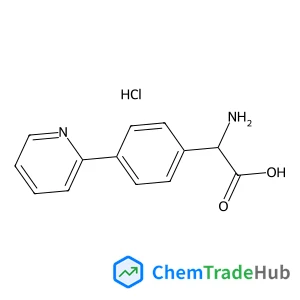
2-Amino-2-(4-(pyridin-2-YL)phenyl)acetic acid hydrochloride
CAS Number:
1135818-89-1
Molecular Formula:
C13H13ClN2O2
Recommended Suppliers




Disclaimer
This page provides academic journal information for reference and research purposes only. We are not affiliated with any journal publishers and do not handle publication submissions. For publication-related inquiries, please contact the respective journal publishers directly.
If you notice any inaccuracies in the information displayed, please contact us at support@chemtradehub.com. We will promptly review and address your concerns.