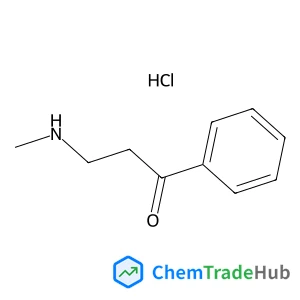
3-(Methylamino)-1-phenyl-1-propanone hydrochloride (1:1)
CAS Number:
2538-50-3
Molecular Formula:
C10H14ClNO
Christophe Bucher, Charles H. Devillers, Jean-Claude Moutet, Guy Royal, Eric Saint-Aman
The supramolecular assembly of a ferrocene–porphyrin conjugate allowed ferrocene-based electrochemical sensing of the metalloporphyrin axial coordination via a “tail on–tail off” binding process.
Alex G. F. de Beer
DOI: 10.1039/C2CP40324B
Fivos Perakis, Peter Hamm
DOI: 10.1039/C2CP23710E
Simantini Nayak, P. Ulrich Biedermann, Martin Stratmann, Andreas Erbe
DOI: 10.1039/C2CP43909C
Charith E. Nanayakkara
DOI: 10.1039/C2CP23684B
Md. Anower Hossain, James Robert Jennings, Nripan Mathews, Qing Wang
DOI: 10.1039/C2CP40277G
Daniel G. Kuroda, Robin M. Hochstrasser
DOI: 10.1039/C2CP23892F
Navendu Bhatnagar, Ganesh Kamath, Jeffrey J. Potoff
DOI: 10.1039/C3CP44284E
Maryam Tahmasebpoor, Lilian de Martín, Mojgan Talebi, Navid Mostoufi, J. Ruud van Ommen
DOI: 10.1039/C3CP43687J
Valeska P. Ting, Paul F. Henry, Marc Schmidtmann, Chick C. Wilson, Mark T. Weller
DOI: 10.1039/C2CP40366H
Jia-Yuan Tao, De-Cai Fang, Gregory A. Chass
DOI: 10.1039/C2CP40067G
When handling 4-(2-Furylmethyl)thiomorpholine 1,1-dioxide (CAS: 79206-94-3), it ...
When handling 4-Chloro-N-[2-(4-morpholinyl)ethyl]benzamide (CAS: 71320-77-9), it...
Waste containing this compound (CAS: 62921-74-8) should be handled according to ...
Waste containing (S)-Methyl 2-amino-3-cyclohexylpropanoate should be collected i...
This compound can be synthesized using a multi-step process involving the conjug...
There are several alternatives to (2E)-3-(3,4-Dichlorophenyl)acrylic acid in syn...
Ethyl 6-(2-nitrophenyl)imidazo[2,1-b][1,3]thiazole-3-carboxylate (CAS: 925437-84...
Waste containing 2-(1,3-Thiazol-2-yl)ethanamine (CAS: 18453-07-1) should be coll...
Methyl 5-iodo-2-methylbenzoate can be synthesized through the iodination of meth...
5-Chloro[1,2,4]triazolo[1,5-a]pyridine is commonly synthesized via the condensat...

ChemComm publishes urgent research which is of outstanding significance and interest to experts in the field, while also appealing to the journal’s broad chemistry readership. Our communication format is ideally suited to short, urgent studies that are of such importance that they require accelerated publication. Our scope covers all topics in chemistry, and research at the interface of chemistry and other disciplines (such as materials science, nanoscience, physics, engineering and biology) where there is a significant novelty in the chemistry aspects. Major topic areas covered include: Analytical Chemistry Catalysis Chemical Biology and medicinal chemistry Computational Chemistry and Machine Learning Energy and sustainable chemistry Environmental Chemistry Green Chemistry Inorganic Chemistry Materials Chemistry Nanoscience Organic Chemistry Physical Chemistry Polymer Chemistry Supramolecular Chemistry