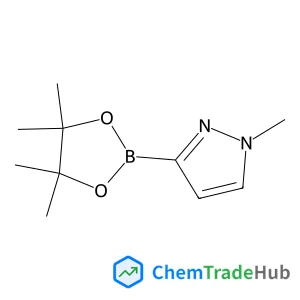
1-Methyl-3-(4,4,5,5-tetramethyl-1,3,2-dioxaborolan-2-yl)-1H-pyrazole
CAS Number:
1020174-04-2
Molecular Formula:
C10H17BN2O2
Alex G. F. de Beer
We present a comparison between sum frequency scattering (SFS) and reflection mode sum frequency generation (R-SFG). We have used scattering theory to describe both scattering experiments as well as reflection mode experiments. The interfacial vibrational spectrum of nanoscopic oil droplets dispersed in water was probed with SFS as well as with R-SFG. Spectra recorded in phase-matched R-SFG mode and spectra recorded with SFS from the same sample are different, which shows that different interfaces are measured. Scattering spectra at different scattering angles agree with nonlinear light scattering theory. We further present experiments with polymer films aimed at quantifying the comparative strength of R-SFG and SFS experiments.
Madhvi Garg, Dhiraj Sud
DOI: 10.1039/D2AN01873J
Dain Kim, Jiyoung Lee, Jueun Han, Jaewoo Lim
DOI: 10.1039/D2AN01672A
Visakan Kadirkamanathan, Martin R. Turner, Andrea Malaspina, John C. C. Day
DOI: 10.1039/D2AN00936F
Francis Buan Hong Lim, Tingjun Lei, Gabriella Fernandez, Nicole Lopez, Andre-Lorenz Chu, Allan Valiente, Abhignyan Nagesetti, Andy Nelson, Kerstin Schmidt, Ta Chen Chang, Obdulio Piloto
DOI: 10.1039/D2AN01615J
Guohua Qi, Xing Du, Xuan Yi, Minmin Wang, Hongyan Zhu, Dan Sun
DOI: 10.1039/D2AN01459A
Tim J. Causon, Robert A. Shellie, Emily F. Hilder
DOI: 10.1039/B815886J
Xu Zhao, Meihong Peng, Jialu Wang, Shutong Chen, Yuqing Lin
DOI: 10.1039/D2AN01095J
Xinchen Deng, Kirsty Milligan, Alexandre Brolo, Jeffrey L. Andrews, Andrew Jirasek
DOI: 10.1039/D2AN01222G
Luiz Fernando Moreira, Marcos Roberto de Vasconcelos Lanza, Auro Atsushi Tanaka, Maria Del Pilar Taboada Sotomayor
DOI: 10.1039/B902273B
Ryan Buckmaster, Fareid Asphahani, Myo Thein, Jian Xu, Miqin Zhang
DOI: 10.1039/B900420C
When handling 4-(2-Furylmethyl)thiomorpholine 1,1-dioxide (CAS: 79206-94-3), it ...
When handling 4-Chloro-N-[2-(4-morpholinyl)ethyl]benzamide (CAS: 71320-77-9), it...
Waste containing this compound (CAS: 62921-74-8) should be handled according to ...
Waste containing (S)-Methyl 2-amino-3-cyclohexylpropanoate should be collected i...
This compound can be synthesized using a multi-step process involving the conjug...
There are several alternatives to (2E)-3-(3,4-Dichlorophenyl)acrylic acid in syn...
Ethyl 6-(2-nitrophenyl)imidazo[2,1-b][1,3]thiazole-3-carboxylate (CAS: 925437-84...
Waste containing 2-(1,3-Thiazol-2-yl)ethanamine (CAS: 18453-07-1) should be coll...
Methyl 5-iodo-2-methylbenzoate can be synthesized through the iodination of meth...
5-Chloro[1,2,4]triazolo[1,5-a]pyridine is commonly synthesized via the condensat...

Physical Chemistry Chemical Physics (PCCP) is an international journal co-owned by 19 physical chemistry and physics societies from around the world. This journal publishes original, cutting-edge research in physical chemistry, chemical physics and biophysical chemistry. To be suitable for publication in PCCP, articles must include significant innovation and/or insight into physical chemistry; this is the most important criterion that reviewers and Editors will judge against when evaluating submissions. The journal has a broad scope and welcomes contributions spanning experiment, theory, computation and data science. Topical coverage includes spectroscopy, dynamics, kinetics, statistical mechanics, thermodynamics, electrochemistry, catalysis, surface science, quantum mechanics, quantum computing and machine learning. Interdisciplinary research areas such as polymers and soft matter, materials, nanoscience, energy, surfaces/interfaces, and biophysical chemistry are welcomed if they demonstrate significant innovation and/or insight into physical chemistry. Joined experimental/theoretical studies are particularly appreciated when complementary and based on up-to-date approaches.