












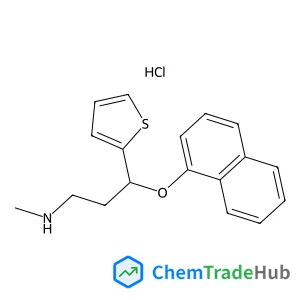
N-Methyl-3-(1-naphthyloxy)-3-(2-thienyl)-1-propanamine hydrochloride (1:1)
CAS Number:
1188266-11-6
Molecular Formula:
C18H20ClNOS
Jörgen Ohlsson, Anders Sundin, Ulf J. Nilsson
Phenyl S-galabiosides display altered conformational properties, as compared to phenyl O-galabiosides, characterised by a remote effect on the galabiose intersaccharidic glycoside bond by the phenyl aglycon, resulting in significantly lowered affinity for the PapG class II adhesin of uropathogenic E. coli.
Chang Yeol Lee, Hyo Yong Kim, Soeun Kim, Ki Soo Park, Hyun Gyu Park
DOI: 10.1039/C8AN00099A
Yansheng Li, Xiangyu Jiao, Xin Du, Fang Wang, Qianhui Wei, Yongqiang Wen, Xueji Zhang
DOI: 10.1039/C8AN00735G
Huang Chen, Yu Yang, Zhenzhen Qiao, Piliang Xiang, Jiangtao Ren, Yunzhu Meng, Kaiqi Zhang, Joann Juan Lu, Shaorong Liu
DOI: 10.1039/C7AN02065A
Ravikumar A, Panneerselvam P
DOI: 10.1039/C8AN00377G
Guanwen Yan, Yuan Zhang, Weihua Di
DOI: 10.1039/C8AN00657A
Rong Zhu, Xingyu Luo, Lu Deng, Chunyang Lei, Yan Huang, Zhou Nie, Shouzhuo Yao
DOI: 10.1039/C8AN00535D
Sadagopan Krishnan, Michael Frazis, Gayan Premaratne, Jinesh Niroula, Elena Echeverria, David N. McIlroy
DOI: 10.1039/C8AN00703A
N-(4-Methoxybenzyl)-2-pyridinamine (CAS: 52818-63-0) is increasingly being used ...
When handling Ethyl 4-(2-chlorophenyl)-1,3-thiazole-2-carboxylate, appropriate p...
Diethyldiselane (CAS: 628-39-7) is classified under the Globally Harmonized Syst...
The market for oxocopper (CAS: 12053-18-8) is primarily driven by its use in cat...
The market for 5-{[(2-Methyl-2-propanyl)oxy]carbonyl}-5-azaspiro[2.4]heptane-7-c...
2-(1-Pyrrolidinyl)-4-pyridinamine is a chemical compound with the CAS number 359...
2-(3-Pyridinyl)-1-azabicyclo[2.2.2]octane (CAS: 91556-75-1) is a crystalline sol...
(S)-Alpha-allyl-proline hydrochloride is usually synthesized via a Wittig reacti...
3-Methyl-1,2-oxazole-5-carboxylic acid (CAS: 4857-42-5) is an organic compound w...
Lys-SMCC-DM1 is synthesized via a multi-step process involving the coupling of S...

ChemComm publishes urgent research which is of outstanding significance and interest to experts in the field, while also appealing to the journal’s broad chemistry readership. Our communication format is ideally suited to short, urgent studies that are of such importance that they require accelerated publication. Our scope covers all topics in chemistry, and research at the interface of chemistry and other disciplines (such as materials science, nanoscience, physics, engineering and biology) where there is a significant novelty in the chemistry aspects. Major topic areas covered include: Analytical Chemistry Catalysis Chemical Biology and medicinal chemistry Computational Chemistry and Machine Learning Energy and sustainable chemistry Environmental Chemistry Green Chemistry Inorganic Chemistry Materials Chemistry Nanoscience Organic Chemistry Physical Chemistry Polymer Chemistry Supramolecular Chemistry
![5'-Fluoro-[2,3'-biindolinylidene]-2',3-dione structure](https://static.chemtradehub.com/structs/251/251903-00-1-9cb1.webp "5'-Fluoro-[2,3'-biindolinylidene]-2',3-dione structure")


