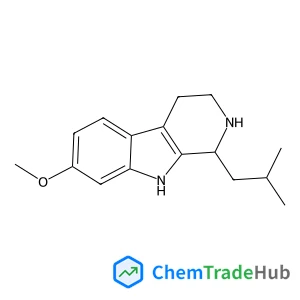
1-Isobutyl-7-methoxy-2,3,4,9-tetrahydro-1H-beta-carboline
CAS Number:
175975-76-5
Molecular Formula:
C16H22N2O
Ken-ichi Fujita, Maki Owaki, Ryohei Yamaguchi
An effective Cp*Rh catalyzed transfer hydrodechlorination of aryl chlorides was achieved with high tolerance towards a variety of functional groups using 2-butanol as a hydrogen source.
Senthil Kumar Karuppannan, Ayelet Vilan
DOI: 10.1039/D1CP01690C
M. Hussein N. Assadi, José Julio Gutiérrez Moreno, Dorian A. H. Hanaor, Hiroshi Katayama-Yoshida
DOI: 10.1039/D1CP02164H
Peter A. Banks, Luke Burgess, Michael T. Ruggiero
DOI: 10.1039/D1CP02496E
Jian-Hua Huang, Dan-Dan Sun, Rong-Xing Lu
DOI: 10.1039/D1CP00089F
Diandong Tang, Lin Shen, Wei-Hai Fang
DOI: 10.1039/D1CP01374B
Dongdong Zhang, Yi Cao, Pan Zhang, Jiankang Liang, Ke Xue, Yong Xia, Zhengjian Qi
DOI: 10.1039/D1CP01526E
Jozef Rakovský, Ondrej Votava
DOI: 10.1039/D1CP02639A
Jose L. C. Fajín, Ana S. Moura, M. Natália D. S. Cordeiro
DOI: 10.1039/D1CP00729G
Leire del Campo, Domingos De Sousa Meneses
DOI: 10.1039/D1CP01259B
Ivan Angelov, Liudmil Antonov
DOI: 10.1039/D1CP01378E
N-(4-Methoxybenzyl)-2-pyridinamine (CAS: 52818-63-0) is increasingly being used ...
When handling Ethyl 4-(2-chlorophenyl)-1,3-thiazole-2-carboxylate, appropriate p...
Diethyldiselane (CAS: 628-39-7) is classified under the Globally Harmonized Syst...
The market for oxocopper (CAS: 12053-18-8) is primarily driven by its use in cat...
The market for 5-{[(2-Methyl-2-propanyl)oxy]carbonyl}-5-azaspiro[2.4]heptane-7-c...
2-(1-Pyrrolidinyl)-4-pyridinamine is a chemical compound with the CAS number 359...
2-(3-Pyridinyl)-1-azabicyclo[2.2.2]octane (CAS: 91556-75-1) is a crystalline sol...
(S)-Alpha-allyl-proline hydrochloride is usually synthesized via a Wittig reacti...
3-Methyl-1,2-oxazole-5-carboxylic acid (CAS: 4857-42-5) is an organic compound w...
Lys-SMCC-DM1 is synthesized via a multi-step process involving the coupling of S...

ChemComm publishes urgent research which is of outstanding significance and interest to experts in the field, while also appealing to the journal’s broad chemistry readership. Our communication format is ideally suited to short, urgent studies that are of such importance that they require accelerated publication. Our scope covers all topics in chemistry, and research at the interface of chemistry and other disciplines (such as materials science, nanoscience, physics, engineering and biology) where there is a significant novelty in the chemistry aspects. Major topic areas covered include: Analytical Chemistry Catalysis Chemical Biology and medicinal chemistry Computational Chemistry and Machine Learning Energy and sustainable chemistry Environmental Chemistry Green Chemistry Inorganic Chemistry Materials Chemistry Nanoscience Organic Chemistry Physical Chemistry Polymer Chemistry Supramolecular Chemistry
![1-oxaspiro[4.4]nonan-6-one structure](https://static.chemtradehub.com/structs/134/134179-01-4-e051.webp "1-oxaspiro[4.4]nonan-6-one structure")