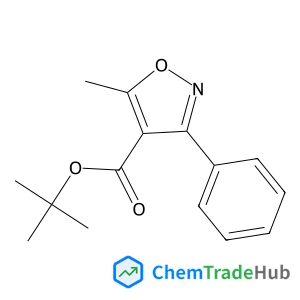
2-Methyl-2-propanyl 5-methyl-3-phenyl-1,2-oxazole-4-carboxylate
CAS Number:
211429-79-7
Molecular Formula:
C15H17NO3
The first page of this article is displayed as the abstract.
Timo Witt, Stefan Mecking
DOI: 10.1039/C3GC40905H
Fei Gao, Ronghua Jin, Dacheng Zhang, Quanxi Liang, Qunqun Ye, Guohua Liu
DOI: 10.1039/C3GC40547H
Jinzhu Chen, Xing Huang, Limin Chen, Longlong Ma, Xinjun Li
DOI: 10.1039/C3GC41139G
Cecilia Paris, Manuel Moliner, Avelino Corma
DOI: 10.1039/C3GC40267C
Joseph P. Adams, Catherine M. Alder, Ian Andrews, Ann M. Bullion, Matthew Campbell-Crawford, Michael G. Darcy, John D. Hayler, Richard K. Henderson, Catriona A. Oare, Israil Pendrak, Anikó M. Redman, Leanna E. Shuster, Helen F. Sneddon, Matthew D. Walker
DOI: 10.1039/C3GC40225H
Hamid Salehzadeh, Davood Nematollahi, Hooman Hesari
DOI: 10.1039/C3GC40954F
Ali Pourjavadi, Seyed Hassan Hosseini, Firouz Matloubi Moghaddam, Behzad Koushki Foroushani, Craig Bennett
DOI: 10.1039/C3GC41307A
Matyas Kosa, Arthur J. Ragauskas
DOI: 10.1039/C3GC40434J
Carlos Vila, Magnus Rueping
DOI: 10.1039/C3GC40587G
When handling 4-Methyl-6-(trifluoromethyl)quinoline (CAS: 40716-16-3), safety go...
4-(3,5-Difluorophenyl)aniline is an aromatic organic compound with the CAS numbe...
5-{[4-(Trifluoromethyl)phenyl]sulfanyl}-1,2,3-thiadiazole-4-carboxylic acid can ...
The market for 4-Benzylaniline hydrochloride (CAS: 6317-57-3) is steadily growin...
[3-(Diethylsulfamoyl)phenyl]boronic acid is generally considered safe when handl...
3-Bromo-2,5-dimethoxyaniline is mainly used in the pharmaceutical and chemical i...
N-Methyl-1-(5-methyl-1H-indol-3-yl)methanamine (CAS: 915922-67-7) is subject to ...
This compound is primarily used in the pharmaceutical industry for the synthesis...
2-Methyl-2-propanyl [(1S,3R)-3-aminocyclohexyl]carbamate (CAS: 1298101-47-9) sho...
Ethyl 2-bromo-4,4,4-trifluorobutanoate (CAS: 367-33-9) is utilized in the pharma...

ChemComm publishes urgent research which is of outstanding significance and interest to experts in the field, while also appealing to the journal’s broad chemistry readership. Our communication format is ideally suited to short, urgent studies that are of such importance that they require accelerated publication. Our scope covers all topics in chemistry, and research at the interface of chemistry and other disciplines (such as materials science, nanoscience, physics, engineering and biology) where there is a significant novelty in the chemistry aspects. Major topic areas covered include: Analytical Chemistry Catalysis Chemical Biology and medicinal chemistry Computational Chemistry and Machine Learning Energy and sustainable chemistry Environmental Chemistry Green Chemistry Inorganic Chemistry Materials Chemistry Nanoscience Organic Chemistry Physical Chemistry Polymer Chemistry Supramolecular Chemistry