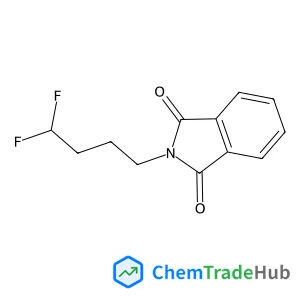
2-(4,4-Difluorobutyl)-1H-isoindole-1,3(2H)-dione
CAS Number:
1265341-14-7
Molecular Formula:
C12H11F2NO2
Andrei N. Vedernikov, Kenneth G. Caulton
T-shaped 14 valence electron (η2-L)PtMe+ (based on DFT geometry optimization, L = [2.1.1]-2,6-pyridinophane) reacts with benzene to give (η3-L) PtIV(Ph)2H+ and methane; the latter cation is in thermal equilibrium with the N-protonated PtII tautomer (η2-L-H)Pt(Ph)2+, and these complexes react with ethane or cyclopentane to produce benzene and (L)PtH(olefin)+.
Lian Yang, Xudong Liu, Yan Zhang, Yongsheng Yang, Ying Xue
DOI: 10.1039/D1CP01973B
Anastasiia I. Fadeeva, Vitaly A. Gorbunov, Alexander V. Myshlyavtsev
DOI: 10.1039/D1CP03111B
Alejandro Cruz
DOI: 10.1039/D1CP01338F
Jordan M. Rabus, Robert P. Pellegrinelli, Ali Hassan Abi Khodr, Benjamin J. Bythell, Thomas R. Rizzo, Eduardo Carrascosa
DOI: 10.1039/D1CP01058A
Hayato Aida, Rikuri Morita
DOI: 10.1039/D1CP02876F
Tzu-Yu Lee, Yi-Ching Li, Min-Guan Lin, Chwan-Deng Hsiao, Hung-Wen Li
DOI: 10.1039/D1CP00638J
Artem I. Ivanov, Victor Ya. Prinz, Irina V. Antonova, Anton K. Gutakovskii
DOI: 10.1039/D1CP02930D
Zhongxu Wang, Yu Liu, FengYu Li, Jingxiang Zhao
DOI: 10.1039/D1CP02648H
Deanna Myers, Sabrina Chee, James N. Smith
DOI: 10.1039/D1CP01704G
N-(4-Methoxybenzyl)-2-pyridinamine (CAS: 52818-63-0) is increasingly being used ...
When handling Ethyl 4-(2-chlorophenyl)-1,3-thiazole-2-carboxylate, appropriate p...
Diethyldiselane (CAS: 628-39-7) is classified under the Globally Harmonized Syst...
The market for oxocopper (CAS: 12053-18-8) is primarily driven by its use in cat...
The market for 5-{[(2-Methyl-2-propanyl)oxy]carbonyl}-5-azaspiro[2.4]heptane-7-c...
2-(1-Pyrrolidinyl)-4-pyridinamine is a chemical compound with the CAS number 359...
2-(3-Pyridinyl)-1-azabicyclo[2.2.2]octane (CAS: 91556-75-1) is a crystalline sol...
(S)-Alpha-allyl-proline hydrochloride is usually synthesized via a Wittig reacti...
3-Methyl-1,2-oxazole-5-carboxylic acid (CAS: 4857-42-5) is an organic compound w...
Lys-SMCC-DM1 is synthesized via a multi-step process involving the coupling of S...

ChemComm publishes urgent research which is of outstanding significance and interest to experts in the field, while also appealing to the journal’s broad chemistry readership. Our communication format is ideally suited to short, urgent studies that are of such importance that they require accelerated publication. Our scope covers all topics in chemistry, and research at the interface of chemistry and other disciplines (such as materials science, nanoscience, physics, engineering and biology) where there is a significant novelty in the chemistry aspects. Major topic areas covered include: Analytical Chemistry Catalysis Chemical Biology and medicinal chemistry Computational Chemistry and Machine Learning Energy and sustainable chemistry Environmental Chemistry Green Chemistry Inorganic Chemistry Materials Chemistry Nanoscience Organic Chemistry Physical Chemistry Polymer Chemistry Supramolecular Chemistry
![1-[6-(1H-Imidazol-1-yl)-3-pyridinyl]methanamine structure](https://static.chemtradehub.com/structs/914/914637-08-4-8825.webp "1-[6-(1H-Imidazol-1-yl)-3-pyridinyl]methanamine structure")