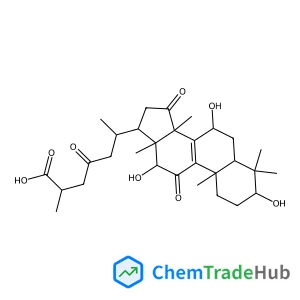
(3beta,7beta,12beta)-3,7,12-Trihydroxy-11,15,23-trioxolanost-8-en-26-oic acid
CAS Number:
98665-22-6
Molecular Formula:
C30H44O8
Tanja van Mourik, Laura E. V. Emson
The conformational landscape of neutral serotonin has been investigated by several theoretical methods. The potential energy surface was scanned by systematically varying the three dihedral angles that determine the conformation of the alkyl side chain. In addition, the two possible conformations of the phenol hydroxyl group (anti and syn with respect to the indole NH) were considered. The OH-anti stationary points located with SCF/6-31G* have been re-optimised with B3LYP/6-31+G*, which resulted in twelve true minima. Eleven of these have a corresponding OH-syn conformer that is 1–4 kJ mol−1 higher in energy. IR vibrational spectra of all twenty-three serotonin conformers, computed at the B3LYP/6-31+G* level of theory, are presented. The initial scan of the serotonin potential energy surface has been repeated with several computationally cheaper methods, to assess their reliability for locating the correct serotonin conformers. It is found that the semi-empirical methods AM1 and PM3 do not yield sufficiently accurate results, due to their inability to account for subtle intramolecular interactions within the serotonin molecule. On the other hand, SCF in combination with the 3-21G* basis set is ascertained to be a good alternative to SCF/6-31G* for performing the initial scan of the potential energy surface of flexible molecules.
Alexei Bagrets
DOI: 10.1039/C3CP44286A
Haoguang Li, Mickael Rivallan, Frederic Thibault-Starzyk, Arnaud Travert
DOI: 10.1039/C3CP50442E
Zhuang Liu, Hao Zhang, Jinghong Li, Junhong Chen
DOI: 10.1039/C3CP50647A
Qian Gou, Gang Feng, Luca Evangelisti, Alberto Lesarri, Emilio J. Cocinero, Walther Caminati
DOI: 10.1039/C3CP50306B
Alex Domingo, Martin Vérot, Fernando Mota, Juan J. Novoa, Vincent Robert
DOI: 10.1039/C3CP44647F
Stephan Menzel, Stefan Tappertzhofen, Ilia Valov
DOI: 10.1039/C3CP50738F
Dong Jun Kim, Sang Jin Kim, Dong Kyu Roh, Jong Hak Kim
DOI: 10.1039/C3CP44308F
DOI: 10.1039/C3CP44303E
Yimin Cui, Wei Liu, Rongming Wang
DOI: 10.1039/C3CP00132F
When handling 4-(2-Furylmethyl)thiomorpholine 1,1-dioxide (CAS: 79206-94-3), it ...
When handling 4-Chloro-N-[2-(4-morpholinyl)ethyl]benzamide (CAS: 71320-77-9), it...
Waste containing this compound (CAS: 62921-74-8) should be handled according to ...
Waste containing (S)-Methyl 2-amino-3-cyclohexylpropanoate should be collected i...
This compound can be synthesized using a multi-step process involving the conjug...
There are several alternatives to (2E)-3-(3,4-Dichlorophenyl)acrylic acid in syn...
Ethyl 6-(2-nitrophenyl)imidazo[2,1-b][1,3]thiazole-3-carboxylate (CAS: 925437-84...
Waste containing 2-(1,3-Thiazol-2-yl)ethanamine (CAS: 18453-07-1) should be coll...
Methyl 5-iodo-2-methylbenzoate can be synthesized through the iodination of meth...
5-Chloro[1,2,4]triazolo[1,5-a]pyridine is commonly synthesized via the condensat...

Physical Chemistry Chemical Physics (PCCP) is an international journal co-owned by 19 physical chemistry and physics societies from around the world. This journal publishes original, cutting-edge research in physical chemistry, chemical physics and biophysical chemistry. To be suitable for publication in PCCP, articles must include significant innovation and/or insight into physical chemistry; this is the most important criterion that reviewers and Editors will judge against when evaluating submissions. The journal has a broad scope and welcomes contributions spanning experiment, theory, computation and data science. Topical coverage includes spectroscopy, dynamics, kinetics, statistical mechanics, thermodynamics, electrochemistry, catalysis, surface science, quantum mechanics, quantum computing and machine learning. Interdisciplinary research areas such as polymers and soft matter, materials, nanoscience, energy, surfaces/interfaces, and biophysical chemistry are welcomed if they demonstrate significant innovation and/or insight into physical chemistry. Joined experimental/theoretical studies are particularly appreciated when complementary and based on up-to-date approaches.
![1,2-Diphenyl-4-[2-(phenylsulfinyl)ethyl]-3,5-pyrazolidinedione structure](https://static.chemtradehub.com/structs/57-/57-96-5-efcc.webp "1,2-Diphenyl-4-[2-(phenylsulfinyl)ethyl]-3,5-pyrazolidinedione structure")