












Separation of sterols using zeolites
Literature Information
Publication Date
2001-05-10
DOI
10.1039/B100239M
Impact Factor
3.676
Authors
Mikhail Yu. Berezin, John M. Dzenitis, B. Mason Hughes, Sa V. Ho
View Original
Abstract
Campesterol and β-sitosterol, two similar plant sterols which differ by only one methyl group in a side chain, were successfully separated using NaY zeolite. The zeolite preferentially adsorbed campesterol over β-sitosterol from a hexane solution. Mathematical analysis of the adsorption kinetics showed that the data could be fitted by a simple irreversible adsorption expression. Molecular modeling showed that the sterol and zeolite pore dimensions are such that size selectivity is the likely mechanism for separation. This hypothesis is consistent with the trend in adsorption rates: as the sterol diameter decreases, the adsorption rate increases in the order cholesterol>campesterol>β-sitosterol>stigmasterol.
Recommended Journals
Related Literature
Synthesis and characterization of 2,7-bis(pentafluorophenylethynyl)hexafluoroheterofluorenes: new materials with high electron affinities
Katharine Geramita, Jennifer McBee, Yuefei Tao, Rachel A. Segalman, T. Don Tilley
2008-09-30
Communication
DOI: 10.1039/B813440E
Pre-programmed bicomponent porous networks at the solid–liquid interface: the low concentration regime
Carlos-Andres Palma, Massimo Bonini, Anna Llanes-Pallas, Thomas Breiner, Maurizio Prato
2008-09-18
Communication
DOI: 10.1039/B811534F
Rotational spectrum and equilibrium structure of silanethione, H2SiS
Sven Thorwirth, Jürgen Gauss, Michael C. McCarthy, François Shindo, Patrick Thaddeus
2008-10-01
Communication
DOI: 10.1039/B814558J
A genetic selection system for evolving enantioselectivity of enzymes
Manfred T. Reetz, Horst Höbenreich, Pankaj Soni, Layla Fernández
2008-09-22
Communication
DOI: 10.1039/B814538E
Enhanced carbohydrate structural selectivity in ion mobility-mass spectrometry analyses by boronic acid derivatization
Larissa S. Fenn, John A. McLean
2008-09-22
Communication
DOI: 10.1039/B810421B
Non-hydrolytic synthesis of mesoporous silica–titania catalysts for the mild oxidation of sulfur compounds with hydrogen peroxide
P. Hubert Mutin, Emil Dumitriu, François Fajula, André Vioux, Vasile Hulea
2008-09-18
Communication
DOI: 10.1039/B811668G
Bisucaberin biosynthesis: an adenylating domain of the BibC multi-enzyme catalyzes cyclodimerization of N-hydroxy-N-succinylcadaverine
2008-09-22
Communication
DOI: 10.1039/B813029A
Identification of oligo(p-phenylene vinylene)–naphthalene diimide heterocomplexes by scanning tunneling microscopy and spectroscopy at the liquid–solid interface
Inge De Cat, Cornelia Röger, Cameron C. Lee, Freek J. M. Hoeben, Maarten J. Pouderoijen, Albertus P. H. J. Schenning, Frank Würthner, Steven De Feyter
2008-10-07
Communication
DOI: 10.1039/B811961A
Synthesis of poly(vinyl acetate) block copolymers by successive RAFT and ATRP with a bromoxanthate iniferter
Renaud Nicolaÿ, Yungwan Kwak, Krzysztof Matyjaszewski
2008-09-18
Communication
DOI: 10.1039/B810778E
You might also like
Compound Q&A
What are the main uses of 1H-Indazole-6-carbonitrile (CAS: 141290-59-7)?
1H-Indazole-6-carbonitrile finds applications in pharmaceuticals, where it serve...
141290-59-71H-Indazole-6-carbon...
Compound Q&A
How should waste containing Dioctyl (2E)-2-butenedioate (CAS: 2997-85-5) be handled?
Waste containing Dioctyl (2E)-2-butenedioate (CAS: 2997-85-5) should be collecte...
2997-85-5Dioctyl (2E)-2-buten...
Compound Q&A
What industries use Sodium [(1,2-benzoxazol-3-ylmethyl)sulfonyl]azanide (CAS: 68291-98-5)?
Sodium [(1,2-benzoxazol-3-ylmethyl)sulfonyl]azanide is primarily used in pharmac...
68291-98-5Sodium [(1,2-benzoxa...
Compound Q&A
Are there alternatives to Dimethyl 4-(4,4,5,5-tetramethyl-1,3,2-dioxaborolan-2-yl)-2,6-pyridinedicarboxylate (CAS: 741709-66-0) in synthesis?
Dimethyl 4-(4,4,5,5-tetramethyl-1,3,2-dioxaborolan-2-yl)-2,6-pyridinedicarboxyla...
741709-66-0Dimethyl 4-(4,4,5,5-...
Compound Q&A
How should waste containing 2-Fluoro-6-hydrazinopyridine (CAS: 80714-39-2) be handled?
Waste containing 2-Fluoro-6-hydrazinopyridine (CAS: 80714-39-2) should be manage...
80714-39-22-Fluoro-6-hydrazino...
Compound Q&A
What is 6-Formyl-2-pyridinecarboxylic acid (CAS: 499214-11-8)?
6-Formyl-2-pyridinecarboxylic acid is an organic compound with the molecular for...
499214-11-86-Formyl-2-pyridinec...
Compound Q&A
What is the market or research trend for 3-(3,4-dimethoxyphenyl)-2,5-dimethyl-N-(2-morpholin-4-ylethyl)pyrazolo[1,5-a]pyrimidin-7-amine (CAS: 900874-91-1)?
Research trends for this compound indicate a focus on its potential applications...
900874-91-13-(3,4-dimethoxyphen...
Compound Q&A
How is 9H-Tribenzo[b,d,f]azepine (CAS: 29875-73-8) typically synthesized?
9H-Tribenzo[b,d,f]azepine is typically synthesized via a multi-step process invo...
29875-73-89H-Tribenzo[b,d,f]az...
Compound Q&A
How is 1-Cyclopropyl-7-ethoxy-6-fluoro-8-methoxy-4-oxo-1,4-dihydro-3-quinolinecarboxylic acid (CAS: 1797982-51-4) typically synthesized?
1-Cyclopropyl-7-ethoxy-6-fluoro-8-methoxy-4-oxo-1,4-dihydro-3-quinolinecarboxyli...
1797982-51-41-Cyclopropyl-7-etho...
Compound Q&A
How should waste containing Methyl 3-oxo-1,2,3,4-tetrahydro-6-quinoxalinecarboxylate (CAS: 671820-52-3) be handled?
Waste containing Methyl 3-oxo-1,2,3,4-tetrahydro-6-quinoxalinecarboxylate (CAS: ...
671820-52-3Methyl 3-oxo-1,2,3,4...
Source Journal
Physical Chemistry Chemical Physics

CiteScore:
5.5
Self-citation Rate:
10.3%
Articles per Year:
3036
Physical Chemistry Chemical Physics (PCCP) is an international journal co-owned by 19 physical chemistry and physics societies from around the world. This journal publishes original, cutting-edge research in physical chemistry, chemical physics and biophysical chemistry. To be suitable for publication in PCCP, articles must include significant innovation and/or insight into physical chemistry; this is the most important criterion that reviewers and Editors will judge against when evaluating submissions. The journal has a broad scope and welcomes contributions spanning experiment, theory, computation and data science. Topical coverage includes spectroscopy, dynamics, kinetics, statistical mechanics, thermodynamics, electrochemistry, catalysis, surface science, quantum mechanics, quantum computing and machine learning. Interdisciplinary research areas such as polymers and soft matter, materials, nanoscience, energy, surfaces/interfaces, and biophysical chemistry are welcomed if they demonstrate significant innovation and/or insight into physical chemistry. Joined experimental/theoretical studies are particularly appreciated when complementary and based on up-to-date approaches.
Recommended Compounds
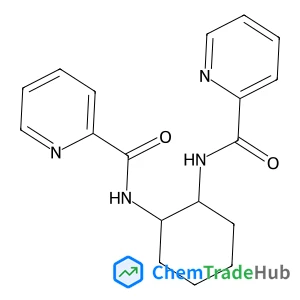
N,N'-(1R,2R)-1,2-Cyclohexanediyldi(2-pyridinecarboxamide)
CAS Number:
218290-24-5
Molecular Formula:
C18H20N4O2
Recommended Suppliers




Disclaimer
This page provides academic journal information for reference and research purposes only. We are not affiliated with any journal publishers and do not handle publication submissions. For publication-related inquiries, please contact the respective journal publishers directly.
If you notice any inaccuracies in the information displayed, please contact us at support@chemtradehub.com. We will promptly review and address your concerns.