












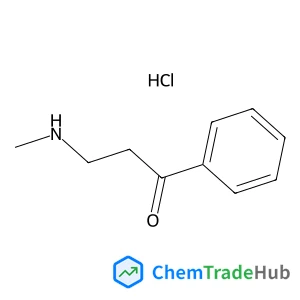
3-(Methylamino)-1-phenyl-1-propanone hydrochloride (1:1)
CAS Number:
2538-50-3
Molecular Formula:
C10H14ClNO
Reactions within complexes consisting of metal cluster cations and water molecules have been studied using a pulsed arc cluster source (PACS) and a reflectron time-of-flight mass spectrometer. The mass spectra obtained from metal–water cluster ions reveals extensive dehydrogenation of the associated water molecules resulting in the formation of metal-oxide clusters of the general form MMOP(OH)+ (where M=copper, barium and holmium). For clusters with barium, and holmium, the dehydrogenation occurs from P1 and for copper for P3. These metal oxide and hydroxide products are more abundant than both that of the bare metal clusters MM+ and the associated hydrated metal clusters MM+(H2O)N. The stability of the metal oxide clusters as determined by the relative abundances of these species as a function of N and P is seen to correspond to oxidation numbers accessible to the metal ions. The correspondence between the formal oxidation number of a metal and its propensity for oxide formation is investigated. Possible mechanisms for the formation of the observed complex ions are proposed. For complexes containing HoM+ the variation of the abundances with cluster size is discussed.
Akinori Kuzuya, Ryo Mizoguchi, Fumi Morisawa, Makoto Komiyama
DOI: 10.1039/B300368J
Sergio Bambirra, Daan van Leusen, Auke Meetsma, Bart Hessen, Jan H. Teuben
DOI: 10.1039/B208502J
Sang Wook Kang, Jong Hak Kim, Jongok Won, Kookheon Char, Yong Soo Kang
DOI: 10.1039/B211933A
Pierre Braunstein, Xavier Morise, Marc Bénard, Marie-Madeleine Rohmer, Richard Welter
DOI: 10.1039/B211289M
Debasis Samanta, Nicolas Faure, Francis Rondelez, Amitabha Sarkar
DOI: 10.1039/B300833A
Richard S. Grainger, Aslam Patel
DOI: 10.1039/B300815K
Kun-Chan Wu, Moawia O. Ahmed, Chun-Yan Chen, Guo-Wei Huang, Yung-Son Hon, Pi-Tai Chou
DOI: 10.1039/B300941F
Amitava Choudhury
DOI: 10.1039/B210037C
Bartolo Gabriele, Raffaella Mancuso, Giuseppe Salerno, Mirco Costa
DOI: 10.1039/B211740A
Bettina Hölzer, Reinhard W. Hoffmann
DOI: 10.1039/B300033H
When handling 4-(2-Furylmethyl)thiomorpholine 1,1-dioxide (CAS: 79206-94-3), it ...
When handling 4-Chloro-N-[2-(4-morpholinyl)ethyl]benzamide (CAS: 71320-77-9), it...
Waste containing this compound (CAS: 62921-74-8) should be handled according to ...
Waste containing (S)-Methyl 2-amino-3-cyclohexylpropanoate should be collected i...
This compound can be synthesized using a multi-step process involving the conjug...
There are several alternatives to (2E)-3-(3,4-Dichlorophenyl)acrylic acid in syn...
Ethyl 6-(2-nitrophenyl)imidazo[2,1-b][1,3]thiazole-3-carboxylate (CAS: 925437-84...
Waste containing 2-(1,3-Thiazol-2-yl)ethanamine (CAS: 18453-07-1) should be coll...
Methyl 5-iodo-2-methylbenzoate can be synthesized through the iodination of meth...
5-Chloro[1,2,4]triazolo[1,5-a]pyridine is commonly synthesized via the condensat...

Physical Chemistry Chemical Physics (PCCP) is an international journal co-owned by 19 physical chemistry and physics societies from around the world. This journal publishes original, cutting-edge research in physical chemistry, chemical physics and biophysical chemistry. To be suitable for publication in PCCP, articles must include significant innovation and/or insight into physical chemistry; this is the most important criterion that reviewers and Editors will judge against when evaluating submissions. The journal has a broad scope and welcomes contributions spanning experiment, theory, computation and data science. Topical coverage includes spectroscopy, dynamics, kinetics, statistical mechanics, thermodynamics, electrochemistry, catalysis, surface science, quantum mechanics, quantum computing and machine learning. Interdisciplinary research areas such as polymers and soft matter, materials, nanoscience, energy, surfaces/interfaces, and biophysical chemistry are welcomed if they demonstrate significant innovation and/or insight into physical chemistry. Joined experimental/theoretical studies are particularly appreciated when complementary and based on up-to-date approaches.
![5-Acetyl-2,3-dihydrobenzo[b]furan structure](https://static.chemtradehub.com/structs/908/90843-31-5-eea4.webp "5-Acetyl-2,3-dihydrobenzo[b]furan structure")
![[4-(Heptyloxy)phenyl]boronic acid structure](https://static.chemtradehub.com/structs/136/136370-19-9-ad33.webp "[4-(Heptyloxy)phenyl]boronic acid structure")





