













Dewetting of confined polymer films: an X-ray and neutron scattering study
Literature Information
Publication Date
DOI
10.1039/A903012C
Impact Factor
3.676
Authors
View Original
Abstract
The dewetting behavior of thin, deuterated polystyrene (dPS) layers on silicon surfaces is investigated. The surface topographics thus produced are investigated with scanning force microscopy and with grazing incidence small angle scattering. Neutrons and X-rays interact differently with this system, producing a reverse of the scattering contrast in the investigated system dPS–Si. For samples annealed above their glass transition temperature a difference in the evolved surface structures is detected as compared with samples stored under toluene vapor. Confined thin films, with a thickness below one-third of the radius of gyration of the unperturbed molecule l
Recommended Journals
Related Literature
Experimental and theoretical studies on fluvastatin primary photoproduct formation
Dorota Jarmużek, Marcin Hoffmann, Tomasz Siodła, Kinga Salus, Donata Pluskota-Karwatka
2017-06-16
Paper
DOI: 10.1039/C7CP01094J
Comment on “Brownian diffusion of a particle at an air/liquid interface: elastic (not viscous) response of the surface”
G. Boniello, A. Stocco, C. Blanc, M. Nobili
2017-07-28
Comment
DOI: 10.1039/C7CP02970E
Modelling of the charge carrier mobility in disordered linear polymer materials
Petr Toman, Miroslav Menšík, Wojciech Bartkowiak, Jiří Pfleger
2017-02-20
Paper
DOI: 10.1039/C6CP07789G
SAXS on a chip: from dynamics of phase transitions to alignment phenomena at interfaces studied with microfluidic devices
2017-08-07
Perspective
DOI: 10.1039/C7CP02736B
Synergistically enhanced photocatalytic reduction of CO2 on N–Fe codoped BiVO4 under visible light irradiation
L. Zhang, X. Chen, Y. L. Liu, S. G. Xu, S. K. Cao
2017-07-27
Paper
DOI: 10.1039/C7CP03995F
Silica nanoparticle monolayers on a macroion modified surface: formation mechanism and stability
M. Morga, Z. Adamczyk, D. Kosior
2017-07-27
Paper
DOI: 10.1039/C7CP03876C
Unusual cis-diprotonated forms and fluorescent aggregates of non-peripherally alkoxy-substituted metallophthalocyanines
P. Kasprzycki, L. Sobotta, S. Lijewski, M. Wierzchowski, T. Goslinski, J. Mielcarek, C. Radzewicz, P. Fita
2017-07-24
Paper
DOI: 10.1039/C7CP04321J
Mechanistic investigations of confinement effects on the self-assembly of symmetric amphiphilic copolymers in thin films
Dan Mu, Jian-Quan Li, Sheng-Yu Feng
2017-06-05
Paper
DOI: 10.1039/C7CP02019H
In- and Ga-based inorganic double perovskites with direct bandgaps for photovoltaic applications
Jun Dai, Liang Ma, Minggang Ju, Jinsong Huang
2017-07-18
Paper
DOI: 10.1039/C7CP03448B
Concerted transfer of multiple protons in acid–water clusters: [(HCl)(H2O)]2 and [(HF)(H2O)]4
I. Zakai, M. E. Varner, R. B. Gerber
2017-07-12
Paper
DOI: 10.1039/C7CP04006G
You might also like
Compound Q&A
What are the main uses of 4-Nitrophenyl phosphate disodium salt hexahydrate (CAS: 333338-18-4)?
4-Nitrophenyl phosphate disodium salt hexahydrate is primarily used as a substra...
333338-18-44-Nitrophenyl phosph...
Compound Q&A
What are the main uses of 2-(Trifluoromethyl)-1,3-oxazole-4-carboxylic Acid (CAS: 1060816-01-4)?
2-(Trifluoromethyl)-1,3-oxazole-4-carboxylic Acid (CAS: 1060816-01-4) is widely ...
1060816-01-42-(Trifluoromethyl)-...
Compound Q&A
How should 2-Fluoro-4-biphenylcarboxylic acid (CAS: 137045-30-8) be stored?
2-Fluoro-4-biphenylcarboxylic acid should be stored in a cool, dry place at room...
137045-30-82-Fluoro-4-biphenylc...
Compound Q&A
What industries use Prednisolone-21-Carboxylic Acid (CAS: 61549-70-0)?
Prednisolone-21-Carboxylic Acid is primarily used in the pharmaceutical industry...
61549-70-0Prednisolone-21-Carb...
Compound Q&A
How should 4-(Hydrazinomethyl)-1,2,3-benzenetriol (CAS: 3614-72-0) be stored?
4-(Hydrazinomethyl)-1,2,3-benzenetriol (CAS: 3614-72-0) should be stored in a co...
3614-72-04-(Hydrazinomethyl)-...
Compound Q&A
What industries use 4-Amino-1-methyl-1H-pyrazole-5-carboxylic acid hydrochloride (CAS: 92534-70-8)?
4-Amino-1-methyl-1H-pyrazole-5-carboxylic acid hydrochloride (CAS: 92534-70-8) i...
92534-70-84-Amino-1-methyl-1H-...
Compound Q&A
What regulatory guidelines apply to dehydropachymic acid (CAS: 77012-31-8)?
Dehydropachymic acid (CAS: 77012-31-8) is regulated by various agencies. It fall...
77012-31-8Dehydropachymic acid
Compound Q&A
What is the market or research trend for 6-[(2,2-Dimethylpropanoyl)amino]nicotinic acid (CAS: 898561-66-5)?
The market and research trends for 6-[(2,2-Dimethylpropanoyl)amino]nicotinic aci...
898561-66-56-[(2,2-Dimethylprop...
Compound Q&A
How should 1,10-Phenanthroline-2,9-dicarbaldehyde (CAS: 57709-62-3) be stored?
1,10-Phenanthroline-2,9-dicarbaldehyde should be stored in a cool, dry place awa...
57709-62-31,10-Phenanthroline-...
Compound Q&A
How is 5-Carbamoyl-11-oxo-10,11-dihydro-5H-dibenzo[b,f]azepin-10-yl acetate (CAS: 113952-21-9) typically synthesized?
5-Carbamoyl-11-oxo-10,11-dihydro-5H-dibenzo[b,f]azepin-10-yl acetate can be synt...
113952-21-95-Carbamoyl-11-oxo-1...
Source Journal
Physical Chemistry Chemical Physics

CiteScore:
5.5
Self-citation Rate:
10.3%
Articles per Year:
3036
Physical Chemistry Chemical Physics (PCCP) is an international journal co-owned by 19 physical chemistry and physics societies from around the world. This journal publishes original, cutting-edge research in physical chemistry, chemical physics and biophysical chemistry. To be suitable for publication in PCCP, articles must include significant innovation and/or insight into physical chemistry; this is the most important criterion that reviewers and Editors will judge against when evaluating submissions. The journal has a broad scope and welcomes contributions spanning experiment, theory, computation and data science. Topical coverage includes spectroscopy, dynamics, kinetics, statistical mechanics, thermodynamics, electrochemistry, catalysis, surface science, quantum mechanics, quantum computing and machine learning. Interdisciplinary research areas such as polymers and soft matter, materials, nanoscience, energy, surfaces/interfaces, and biophysical chemistry are welcomed if they demonstrate significant innovation and/or insight into physical chemistry. Joined experimental/theoretical studies are particularly appreciated when complementary and based on up-to-date approaches.
Recommended Compounds

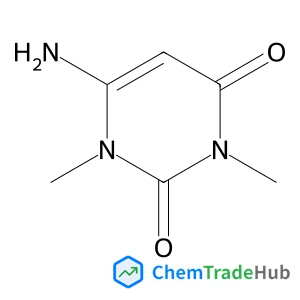
6-amino-1,3-dimethyl-1,2,3,4-tetrahydropyrimidine-2,4-dione
CAS Number:
6642-31-5
Molecular Formula:
C6H9N3O2
Recommended Suppliers




Disclaimer
This page provides academic journal information for reference and research purposes only. We are not affiliated with any journal publishers and do not handle publication submissions. For publication-related inquiries, please contact the respective journal publishers directly.
If you notice any inaccuracies in the information displayed, please contact us at support@chemtradehub.com. We will promptly review and address your concerns.