


Controlled synthesis of homopolymers and block copolymers based on 2-(acetoacetoxy)ethyl methacrylatevia RAFT radical polymerisation
Literature Information
Publication Date
2003-01-27
DOI
10.1039/B212634F
Impact Factor
6.222
Authors
Theodora Krasia, Rémi Soula, Hans G. Börner, Helmut Schlaad
View Original
Abstract
Reversible addition–fragmentation chain transfer (RAFT) radical polymerisation enables to synthesise well-defined homopolymers and block copolymers based on 2-(acetoacetoxy)ethyl methacrylate, which are capable to strongly coordinate to metals and metal ions.
Recommended Journals

Colloid Journal

Topics in Catalysis

Chinese Journal of Chemistry

Acta Metallurgica Sinica-English Letters

Medicinal Chemistry Research

Electroanalysis

Atomization and Sprays

Journal of the Indian Institute of Science

Journal of Asian Natural Products Research

Critical Reviews in Solid State and Materials Sciences
Related Literature
A novel three-dimensional macrocellular carbonaceous biofuel cell
2013-03-01
Paper
DOI: 10.1039/C3CP50807B
Photoion-pair dissociation dynamics of polyatomic molecules with synchrotron radiation
Shan Xi Tian
2012-03-15
Perspective
DOI: 10.1039/C2CP23763F
A theoretical study on photomagnetic fluorescent proteinchromophore coupled diradicals and their possible applications
Debojit Bhattacharya, Anirban Panda, Suranjan Shil, Tamal Goswami, Anirban Misra
2012-03-09
Paper
DOI: 10.1039/C2CP00053A
Using graphenenanosheets as a conductive additive to enhance the rate performance of spinel LiMn2O4 cathode material
Rongyan Jiang, Congying Cui, Houyi Ma
2013-03-04
Paper
DOI: 10.1039/C3CP44516J
Intercalation and de-intercalation pathway of proflavine through the minor and major grooves of DNA: roles of water and entropy
Wilbee D. Sasikala, Arnab Mukherjee
2013-03-25
Paper
DOI: 10.1039/C3CP50501D
Comparison of scattering and reflection SFG: a question of phase-matching
Alex G. F. de Beer
2012-03-20
Paper
DOI: 10.1039/C2CP40324B
You might also like
Compound Q&A
What precautions should be taken when handling 4-(2-Furylmethyl)thiomorpholine 1,1-dioxide (CAS: 79206-94-3)?
When handling 4-(2-Furylmethyl)thiomorpholine 1,1-dioxide (CAS: 79206-94-3), it ...
79206-94-34-(2-Furylmethyl)thi...
Compound Q&A
What precautions should be taken when handling 4-Chloro-N-[2-(4-morpholinyl)ethyl]benzamide (CAS: 71320-77-9)?
When handling 4-Chloro-N-[2-(4-morpholinyl)ethyl]benzamide (CAS: 71320-77-9), it...
71320-77-94-Chloro-N-[2-(4-mor...
Compound Q&A
How should waste containing 2-[2-(2-Methoxyethoxy)ethoxy]ethyl 4-methylbenzenesulfonate (CAS: 62921-74-8) be handled?
Waste containing this compound (CAS: 62921-74-8) should be handled according to ...
62921-74-82-[2-(2-Methoxyethox...
Compound Q&A
How should waste containing (S)-Methyl 2-amino-3-cyclohexylpropanoate be handled?
Waste containing (S)-Methyl 2-amino-3-cyclohexylpropanoate should be collected i...
40056-18-6(S)-Methyl 2-amino-3...
Compound Q&A
How is 5-({4-[(2S,4R)-4-Hydroxy-2-methyltetrahydro-2H-pyran-4-yl]-2-thienyl}sulfanyl)-1-methyl-1,3-dihydro-2H-indol-2-one (CAS: 166882-70-8) typically synthesized?
This compound can be synthesized using a multi-step process involving the conjug...
166882-70-85-({4-[(2S,4R)-4-Hyd...
Compound Q&A
Are there alternatives to (2E)-3-(3,4-Dichlorophenyl)acrylic acid (CAS: 7312-27-8) in synthesis?
There are several alternatives to (2E)-3-(3,4-Dichlorophenyl)acrylic acid in syn...
7312-27-8(2E)-3-(3,4-Dichloro...
Compound Q&A
How should Ethyl 6-(2-nitrophenyl)imidazo[2,1-b][1,3]thiazole-3-carboxylate (CAS: 925437-84-9) be stored?
Ethyl 6-(2-nitrophenyl)imidazo[2,1-b][1,3]thiazole-3-carboxylate (CAS: 925437-84...
925437-84-9Ethyl 6-(2-nitrophen...
Compound Q&A
How should waste containing 2-(1,3-Thiazol-2-yl)ethanamine (CAS: 18453-07-1) be handled?
Waste containing 2-(1,3-Thiazol-2-yl)ethanamine (CAS: 18453-07-1) should be coll...
18453-07-12-(1,3-Thiazol-2-yl)...
Compound Q&A
How is Methyl 5-iodo-2-methylbenzoate (CAS: 103440-54-6) typically synthesized?
Methyl 5-iodo-2-methylbenzoate can be synthesized through the iodination of meth...
103440-54-6Methyl 5-iodo-2-meth...
Compound Q&A
How is 5-Chloro[1,2,4]triazolo[1,5-a]pyridine (CAS: 1427399-34-5) typically synthesized?
5-Chloro[1,2,4]triazolo[1,5-a]pyridine is commonly synthesized via the condensat...
1427399-34-55-Chloro[1,2,4]triaz...
Source Journal
Chemical Communications

CiteScore:
8.6
Self-citation Rate:
4.7%
Articles per Year:
2458
ChemComm publishes urgent research which is of outstanding significance and interest to experts in the field, while also appealing to the journal’s broad chemistry readership. Our communication format is ideally suited to short, urgent studies that are of such importance that they require accelerated publication. Our scope covers all topics in chemistry, and research at the interface of chemistry and other disciplines (such as materials science, nanoscience, physics, engineering and biology) where there is a significant novelty in the chemistry aspects. Major topic areas covered include: Analytical Chemistry Catalysis Chemical Biology and medicinal chemistry Computational Chemistry and Machine Learning Energy and sustainable chemistry Environmental Chemistry Green Chemistry Inorganic Chemistry Materials Chemistry Nanoscience Organic Chemistry Physical Chemistry Polymer Chemistry Supramolecular Chemistry
Recommended Compounds
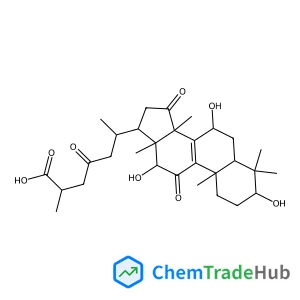
(3beta,7beta,12beta)-3,7,12-Trihydroxy-11,15,23-trioxolanost-8-en-26-oic acid
CAS Number:
98665-22-6
Molecular Formula:
C30H44O8
Recommended Suppliers





Disclaimer
This page provides academic journal information for reference and research purposes only. We are not affiliated with any journal publishers and do not handle publication submissions. For publication-related inquiries, please contact the respective journal publishers directly.
If you notice any inaccuracies in the information displayed, please contact us at support@chemtradehub.com. We will promptly review and address your concerns.