



AD
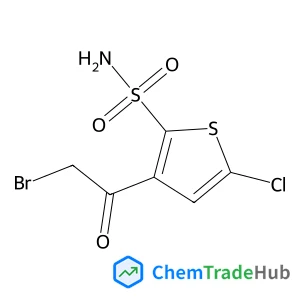
3-(Bromoacetyl)-5-chloro-2-thiophenesulfonamide(CAS: 160982-11-6)
CAS Number
Related Products
![2-[(2S)-2-Oxiranylmethyl]-1H-isoindole-1,3(2H)-dione](https://static.chemtradehub.com/structs/161/161596-47-0-5431.webp)
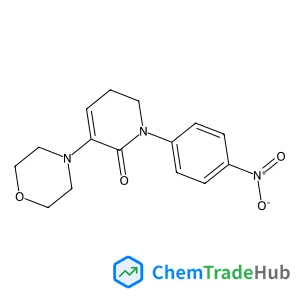
Apixaban Impurity 113
CAS Number: 503615-03-0
![ethyl 2-chloro-2-[(4-methoxyphenyl)hydrazono]acetate](https://static.chemtradehub.com/structs/271/27143-07-3-e25b.webp)
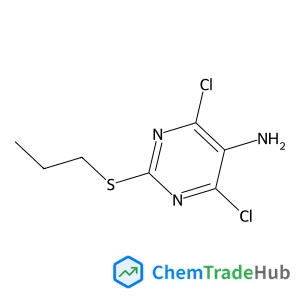
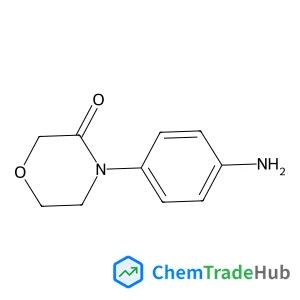
4-(4-Aminophenyl)-3-morpholinone
CAS Number: 438056-69-0
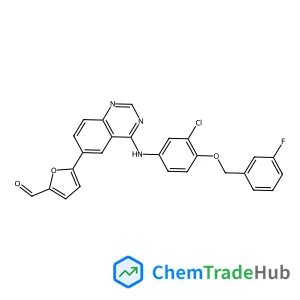
Lapatinib Impurity 9
CAS Number: 231278-84-5
Other Suppliers for 3-(Bromoacetyl)-5-chloro-2-thiophenesulfonamide




Basic Information
Molecular Formula
C6H5BrClNO3S2
Molecular Weight
318.6 g/mol
Physical Properties
Boiling Point
492.247°C at 760 mmHg
Flash Point
492.247 °C at 760 mmHg
Chemical Identifiers
SMILES
C1=C(SC(=C1C(=O)CBr)S(=O)(=O)N)Cl
InChIKey
OZESFFKYLOCAOV-UHFFFAOYSA-N
Database References
MDL Number
MFCD09033310
FAQ
3-(Bromoacetyl)-5-chloro-2-thiophenesulfonamide is a white to off-white crystalline solid with a molecular weight of approximately 350.04 g/mol. It is sparingly soluble in water and readily soluble in organic solvents like ethanol and acetone. The compound is reactive, showing electrophilic aromatic substitution chemistry and nucleophilic substitution at the bromoacetyl and thiophene rings. It is stable under normal conditions but should be stored in a dry environment away from moisture and light.
3-(Bromoacetyl)-5-chloro-2-thiophenesulfonamide can be synthesized through a multi-step reaction involving thiophene sulfonamide formation followed by bromoacetylation. Commonly, thiophene sulfonamide is prepared by reacting thiophene with sodium hydrosulfite in an aqueous medium, followed by acetylation with acetyl chloride in the presence of a base like pyridine. The resulting acetylated intermediate is then brominated using bromine in the presence of a Lewis acid like aluminum bromide to introduce the bromoacetyl group.
3-(Bromoacetyl)-5-chloro-2-thiophenesulfonamide is primarily used in the pharmaceutical industry for the synthesis of certain drugs, particularly those targeting metabolic pathways. It also finds applications in the development of novel sensors and semiconductors due to its unique chemical properties. Additionally, it may be used in the polymer industry for specific functionalization and modification of polymers.
When handling 3-(Bromoacetyl)-5-chloro-2-thiophenesulfonamide, it is crucial to wear appropriate personal protective equipment (PPE) such as gloves, goggles, and a lab coat. Work should be conducted in a fume hood to minimize exposure to vapors. Spills should be cleaned up carefully using absorbent materials. The material safety data sheet (MSDS) should be consulted for detailed safety information and emergency procedures. The compound should be stored in a cool, dry place away from direct sunlight and sources of ignition.
Safety Notice
Please verify product specifications and safety data before use. Contact the supplier for detailed safety information.
Always follow proper handling procedures
Contact Information
2880127809@qq.com